Budget 2026: Experts suggest policy push for Viksit Bharat
/ 10 min read
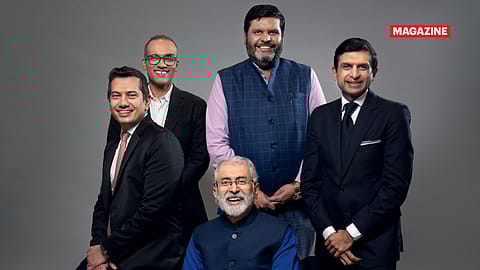
(Clockwise from top left): Rishi Shah, partner and economist, Grant Thornton Bharat; Prof. Gourav Vallabh, member, Economic Advisory Council to the Prime Minister; Vineet Agarwal, MD, Transport Corporation of India; Shardul Shroff, founder and executive chairman, Shardul Amarchand Mangaldas and Co, and Pranav Haldea, MD, PRIME Database Group. | Credits: Sanjay Rawat
Budget 2026: Experts suggest policy push for Viksit Bharat
India's economic resilience is evident with GDP surpassing 8% in Q2FY26. Experts at Fortune India's Boardroom emphasise the need for Budget 2026 to focus on reforms in AI, ESG, and infrastructure to sustain growth. Key areas include capex, fiscal deficit management, and income tax reforms to drive consumption-led growth and formalisation of the economy.
This summary is AI-generated, and Fortune India is not responsible for its content or any associated copyright issues.
At Fortune India’s pre-Budget Boardroom, experts discuss strategic policy priorities to accelerate India’s long-term development goals.
(Clockwise from top left): Rishi Shah, partner and economist, Grant Thornton Bharat; Prof. Gourav Vallabh, member, Economic Advisory Council to the Prime Minister; Vineet Agarwal, MD, Transport Corporation of India; Shardul Shroff, founder and executive chairman, Shardul Amarchand Mangaldas and Co, and Pranav Haldea, MD, PRIME Database Group. | Credits: Sanjay Rawat
This story belongs to the Fortune India Magazine best-investments-2026-january-2026 issue.
INDIA HAS SHOWN economic resilience with the GDP breaching the 8% level in Q2FY26. The question now is how to make India’s economic growth more sustainable and whether Budget 2026 can play an instrumental role towards that end.
Vineet Agarwal, MD, Transport Corporation of India; Shardul Shroff, founder and executive chairman, Shardul Amarchand Mangaldas and Co; Prof. Gourav Vallabh, member, Economic Advisory Council to the Prime Minister; Pranav Haldea, MD, PRIME Database Group; and Rishi Shah, partner and economist, Grant Thornton Bharat, participated in Fortune India’s Boardroom titled “Policy Priorities to Power Budget 2026”. The panel discussed key initiatives required to make India’s journey to Viksit Bharat a success. Edited excerpts:
The Indian economy picked up momentum in the last quarter of the previous fiscal, and the sprint continues, largely led by reforms. What are the growth levers that the Budget should explore?
Shardul Shroff: There are five areas, which have already been demonstrated as subject to reforms. First, labour reforms have been notified, and the Insurance Act amendment has been passed. The IBC Bill has been referred to the Select Committee of Parliament. You have got issues in relation to the AI policy, which is continuously changing, and the environmental law in terms of COP30 is also under preparation.
We are at the cusp of a new Budget. The Budget will have to make announcements with reference to AI and ESG, so as to give a perspective of what should be done from now onwards. That’s what will kick-start the reforms process in India again.
Gourav Vallabh: See, the focus is on CDID (capex, deficit, income tax reform, and deregulation)... Capex includes both from the government and the private sector. Research studies say capex has a multiplier impact on GDP and employment creation. Public capital expenditure is somewhere around 3.1% of GDP. But we have to push private capex, especially with schemes such as PLI and other Make in India initiatives.
The second is deficit. The fiscal deficit estimate for FY26 is 4.4% of GDP. So if we are at that deficit level with a capex of 3.1% of GDP, we are at a high-growth trajectory. Thirdly, with income tax reforms, consumption-led growth is having a major impact on the economy. In spite of geopolitical tensions, our GDP growth is 7%-plus. That is the power of consumption-led growth. Income tax on annual income up to ₹12.75 lakh was made tax-free in the previous Budget. One can think of something in that direction as there is already a consumption-led growth.
More Stories from this Issue
And the last D is for deregulation. Ease of doing business 2.0 and deregulation 2.0, especially in the MSME sector, since that will create a stimulus in the economy.
So before we resume the larger point on growth levers, while consumers may be happy, up to what extent will government finances be affected by the lower-than-estimated nominal GDP growth?
Rishi Shah: What you pointed out is fundamentally correct. So, you’re likely to see this disinflationary environment continue for the next six months, possibly. But then inflation should move up. The immediate challenge is that some of your numbers may not look as good. Nominal growth, which was budgeted around 10-11%, will come down to say 9%. And that plays havoc with the Budget projections.
But this is a cyclical phenomenon. We’re likely to see inflation return to 3-4%, which will iron out a lot of these issues. It’s the long-term trend that one needs to look at.
{{#most-powerful-women-snapshot-individual.slug}} {{/most-powerful-women-snapshot-individual.slug}} {{^most-powerful-women-snapshot-individual.slug}} {{/most-powerful-women-snapshot-individual.slug}} {{#showRanking}} {{current-rank}} {{/showRanking}} {{#photo.0.url}}
{{name}}
Coming back to the overall question on growth levers…
Vineet Agarwal: Clearly, there are some things that are already underway, but some things need to be accelerated and augmented. The most important thing we are seeing is the formalisation of the economy. But it is a very top-heavy situation. So, if we can move people towards formalisation, we will get a bit more uniform growth. Let’s say, if MSMEs start looking at formalisation, which means more digitisation, tax compliance, getting more competitive, and deeper participation in the economy. And that is going to have a multiplier effect.
The second multiplier effect would be infrastructure growth. Today, we’ve seen that it has, maybe, a 3x or 4x kind of an impact on various industries, from cement and steel to construction and earth-moving equipment.
Capacity being created is getting utilised very fast. We need to do long-range planning when it comes to infrastructure, with 25, 30, 50 years in mind.
So, there’s capex and other key points. But, on one hand a lot of relief is being given on the tax front, while tax on capital gains is going up. How do you see the future growth paradigm?
Pranav Haldea: Clearly, the market has taken taxation in its stride in the last four to five years. Tax consistency is an important aspect because the market doesn’t like shocks. If a taxation roadmap can be provided for the next five years, it would give a lot of comfort to market participants, especially foreign investors, who have moved out of Indian markets… We need to understand what really is going on there and make India an attractive destination.
Policy levers have been put on the backburner, but it is time to look at disinvestment and privatisation of PSUs. With the support the markets are providing right now, the sort of valuations that PSUs command versus five years ago, it’s time to take a relook.
Beyond the headline growth numbers and reforms bandwagon, deeper issues persist in the economy. Per capita income is a major concern and needs government attention. How do we approach the issue and how can the Budget actually be instrumental?
Gourav Vallabh: On per capita income, there is no doubt that we have a lot of miles to travel before we become Viksit Bharat by 2047. But this is part of the development process. Every developed country has gone through this process. First, GDP growth comes followed by improvement in the quality of the people at the bottom. In between, schemes empower people at the bottom of the pyramid and improve per capita income. An example is GST 2.0. This improved the per capita income because disposable income increased for everyone.
Disposable income has increased across economic classes. Secondly, inclusive government schemes like Startup [India], Stand-Up [India], Make in India, PLI, Mudra for SMEs, or Jan Dhan under which 550 million-plus bank accounts were opened in the last 11 years, are the instruments for empowering people. In the last 11 years, there have been improvements in our per capita income. It is not that it has been constant.
Tax tinkering may be helping with more cash in people’s hands, but what more needs to be done on the per capita income front?
Rishi Shah: I have a slightly different input on this. At the end of the day, the government is promoting innovation. That has to be the first question. Is it spending on fundamental areas, which will improve the quality of labour or the quality of people in general? So, social expenditure, education, health and basic infrastructure… When you have got many more roads and bridges, people can travel, and think of 10 other things to do [economic opportunities].
So, if the government is doing that and if you are coming up with new ways of pushing innovation, the question of per capita income will take care of itself over a period of time. I don’t think it is a metric that needs to be targeted standalone.
Shardul Shroff: The first issue is going to be tariffs in the short term because if tariffs are high, export markets will keep changing. You had the U.S., now you have Mexico. If the process keeps on happening, a domino effect sets in and your export markets are cornered. Then, you have to focus on the domestic market.
The other issue is that artificial intelligence is a new game because you still don’t have the user benefits, or safety standards. A lot of work has to be done on that score. In relation to the aspects of ESG, we are poised at the right position. If you get all these policies right, there will be a growth pattern, which is continuous.
What can the private sector do about per capita income?
Vineet Agarwal: When we talk about per capita income, the larger question will always come up — what is the quality of life? Even though the per capita income as a country might be lower, in some cases, the quality of life could be better.
So, as long as we can also keep a focus on that, and not just on per capita income, it will make it a little bit more holistic in terms of where we are as a country. Wage growth can also happen with productivity increase. [We need] to figure out where we are losing our productivity and how we can incentivise productivity.
The second is value addition in every sector. How can we move from lower value-added products to high-tech products [in manufacturing], from just basic food products to processed products [in agriculture], and from just general, let’s say, hypothetically, a call centre mentality to AI-driven value-added service [in services]?
All those would mean that, once we start increasing the value addition across the system, automatically, we will see wage growth improve, as well as its impact on GDP.
Pranav Haldea: On per capita income, one important metric which also needs to be looked at is income inequality. I was reading somewhere that if you remove the top 1% of the rich in India, the per capita income drops significantly.
So, we need to ensure that while overall per capita income goes up, the benefits also are spread.
Gourav Vallabh: Globally, there are a number of measures people talk about beyond GDP. [For instance], happiness. Just recently we had done a study on per capita TV consumption, and air conditioner or refrigerator consumption. It is going up phenomenally. So, we have miles to go, there is no argument on that. But we are on that path.
But is that a factor of accessible credit, or income?
Gourav Vallabh: Not credit. It is because disposable income in the hands of people have increased. Television and car sales last Navratri were phenomenal. There were reports that a high-end car was sold every six minutes.
The quality of life, happiness in life, the consumption of white goods per capita had an exponential growth in the last 11 years because disposable income went up. So, we are on track and we will achieve the per capita income on global standards.
Vineet Agarwal: Just to add, in the past, we used to talk about roti, kapda and makaan. Electricity and education got added to it. Now the latest addition is broadband. That is an indicator of per capita income in many ways also.
Where do we really stand on growth with equity?
Rishi Shah: Equity for the global economy as a whole has become problematic. The systems are such that the access to wealth, or capital in general, is becoming easier for the people at the top. And with AI coming in, people who have a certain level of wealth, and capability to exploit the productivity gains from this will actually end up gaining more amount of wealth. But, what about the bottom [of the pyramid]? That is the question theoretical economists are also grappling with, because you don’t really have a system which works very well to uplift the society as a whole. So, how do you bring in sustainability and growth? This may look like a very simplistic sort of answer. But it is a fact that we need MSMEs to grow by making their lives easier in terms of a framework, wherein they do not have to run after getting licences...
How does one empower small businesses?
Gourav Vallabh: No. 1 is systematic deregulation. No. 2 is ease of doing business. Ease of doing business is not just reducing paperwork. It is reduction in the cost of doing business, and time taken to complete the process. This will improve employment and competitiveness in the global market, because MSMEs can take exports to the next level.
Point No. 2 is that we need a cluster approach for MSMEs. Thirdly, we need to ease access to capital for MSMEs. Micro requires good hand-holding and they have a capacity to compete in the global market.
What are the immediate needs for MSMEs? How can they be addressed in the Budget?
Pranav Haldea: One of the biggest challenges for SMEs is capital. It was with this idea that SME platforms of both the NSE and the BSE were launched in 2012. This calendar year (2025), we have had over ₹10,000 crore being raised on the platforms. Still the space remains extremely speculative. Shareholding is narrow, trading is less. So, investors need to be extremely careful. While there are good SMEs which have made use of this platform, there are some bad apples as well.
Since we are talking in the context of the Budget and the larger context is of the developed economy goal by 2047, what are the immediate and extremely important policy agendas?
Vineet Agarwal: The latest discussion around developed economies is that it’s not good to be called a developed economy. Look at the status of infrastructure in the U.S. Being a developed economy, it is completely crumbling.
Goals for us are still very high. On factors of production — land, labour, capital, and enterprise — land is one area that really requires a lot of work. We talked about increasing per capita income or even formalisation of the economy. All of these factors, with land reforms, can be a game changer. If I have to give you one of the largest moves to really get to a developed economy, it would be investment in education and health.
We have to ensure that people rise up from the lowest strata to a much higher level and become real contributors to the economy and the society as a whole.
Shardul Shroff: I think addressing arrears of court cases. They have just ballooned and nobody’s really paying serious attention to how these cases can be brought down. That issue has to be addressed.
It is not about classifying clusters or getting the same issue of law gathered together and disposed in one particular case. We have a massive problem because from the district courts to the Supreme Court, every court has an arrear. So, this has to be an aspect on which attention has to be paid, because if you get the dispute settlement system working, the speed of turnaround is much better.
Gourav Vallabh: Yes, land, labour, and legal are already on the agenda. A lot of work is done. Labour reform has already been initiated. States are going to frame rules for labour codes. Secondly, the capacity India had shown in the last 11 years on rolling out major reforms has to be showcased to the world on the private capital expenditure front.
And point No. 3, on the blue economy and the green economy, we still have to do a lot of things. Those are the way forward for a country like India.
Rishi Shah: I would like to focus on three things. One, the existing focus on innovation should continue. Secondly, can we actually incentivise MSMEs to become bigger? We need to find out ways of helping the small guy become bigger. And lastly, the focus on quality. Can the government actually help SMEs develop those quality norms across some major sectors, starting with a few? If we are able to do these things, it will be a game changer in the long term.
Pranav Haldea: Enforcement of contracts and speedy justice is one. Secondly, the government should really make a push towards getting out of business, privatise and divest, divest aggressively, and have a laser focus on critical sectors, including education, healthcare, infrastructure, and perhaps defence.
Follow Fortune India
Sign in to read full story
To access our exclusive magazine content, sign in to your Fortune India account.
Sign In NowNEXT STORY