Davos 2026: India presents a 'certain' answer amid global uncertainties
/ 4 min read
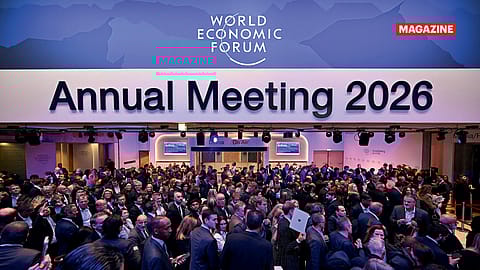
India showcased its economic potential at Davos 2026 | Credits: Getty Images
Davos 2026: India presents a 'certain' answer amid global uncertainties
At the World Economic Forum in Davos, India confidently projected its rise to the world's third-largest economy by 2028. Union Minister Ashwini Vaishnaw and economist Gita Gopinath highlighted India's strong economic momentum, driven by reforms and investments in infrastructure, digital, and green energy. This optimism positions India as a key global growth engine amid geopolitical uncertainties.
This summary is AI-generated, and Fortune India is not responsible for its content or any associated copyright issues.
As global leaders debated a fracturing world order, India staked its claim at Davos as the next global growth power.
India showcased its economic potential at Davos 2026 | Credits: Getty Images
This story belongs to the Fortune India Magazine february-2026-mnc-500-indias-largest-multinationals issue.
CAN INDIA EMERGE as the world’s third-largest economy? At this year’s World Economic Forum (WEF) annual meeting in Davos, India’s favourite question shaped much of its participation. And, the answer didn’t require much deliberation.
Union Minister Ashwini Vaishnaw termed India securing the third rank “a certainty”. Gita Gopinath, former first deputy managing director of the International Monetary Fund (IMF), was quick to concur. “Without a doubt, India will become the third-largest economy in the world,” the Gregory and Ania Coffey professor of economics at Harvard University said, pointing to projections that place the milestone around 2028.
Notably, the debate unfolded amid a renewed optimism triggered by Gopinath’s past organisation. Earlier in January, ahead of the Davos meeting, the IMF raised its India growth forecast for FY26 by 0.7 percentage points to 7.3%, citing strong economic momentum, positioning the country as a key growth engine of the world at a time when global growth is slowing amid trade frictions and geopolitical uncertainty.
India’s rise to the Top 3 is only a matter of time, Apurv Bhattacharya, director, economic services at Grant Thornton Bharat, tells Fortune India. “For decades, large economies moved up the income ladder in a clear sequence. They industrialise first, absorb labour over time, and see productivity and incomes rise much later.” However, in India’s case, he says, the “traditional stages are overlapping wherein productivity gains, services exports, manufacturing scale-up, and domestic demand are advancing together, shaped by competition between states and decided in cities.”
This optimism sealed India’s spot as a preferred investment destination at Davos. The country attracted Memoranda of Understanding worth around ₹30 lakh crore, driven largely by infrastructure, digital, and green energy investments. Nine participating states — debutants Assam and Jharkhand, Gujarat, Maharashtra, Telangana, Karnataka, Uttar Pradesh, Andhra Pradesh, and Kerala — showcased opportunities across clean energy, AI-led manufacturing, logistics, ports, and digital infrastructure. The participating states were integrated with the National Single Window System, a centralised digital platform designed to streamline approvals and clearances for investors.
Setting the narrative
Speaking on the sidelines of WEF, Vaishnaw highlighted that a series of landmark reforms — labour code changes, GST rationalisation, and the opening up of the nuclear energy segment for private participation, among others — have significantly boosted investor confidence. India’s reforms momentum, he said, remained firmly on track, driven by structural changes that have repositioned the country as a high-growth, resilient, and globally trusted investment destination. India also refused to comply with IMF MD Kristalina Georgieva’s classification of a nation merely “watching” AI unfold. “I don’t think your classification in the second tier is right. It’s actually in the first,” said Vaishnaw during a Davos panel titled, “AI Power Play, No Referees”.
More Stories from this Issue
Further emphasising the macroeconomic fundamentals, the minister who handles the railways, information & broadcasting, and electronics and information technology portfolios, said India is currently the fastest-growing major economy globally, with a projected growth trajectory of 6-8% over the next five years. The combination of moderate inflation and strong growth, he noted, reflected the depth of economic transformation achieved over the past decade.
Bhattacharya, however, notes that the model’s success hinges on execution. “The real lever is absorption. If productive urban centres expand fast enough to absorb talent and create quality jobs, incomes rise quickly. If not, low-productivity employment hardens, and the advantage dissipates. That makes this phase both promising and unforgiving.”
A world in flux
From Canadian Prime Minister Mark Carney’s warning about the end of the “old-world order” to high-stakes trade discussions, the year’s WEF marked a decisive moment in global discourse. The four-day summit saw the likes of U.S. President Donald Trump, his French counterpart Emmanuel Macron, European Commission President Ursula von der Leyen, Tesla and SpaceX CEO Elon Musk, and Chinese Vice Premier He Lifeng discuss geopolitical tensions, trade disputes, territorial ambitions, and the future of multilateralism.
{{#most-powerful-women-snapshot-individual.slug}} {{/most-powerful-women-snapshot-individual.slug}} {{^most-powerful-women-snapshot-individual.slug}} {{/most-powerful-women-snapshot-individual.slug}} {{#showRanking}} {{current-rank}} {{/showRanking}} {{#photo.0.url}}
{{name}}
Trump used his late appearance at the annual meeting to outline what he called a “blueprint” for economic growth built on lower taxes, higher tariffs, aggressive energy production, and tighter borders. Citing headline inflation of 2.7% and Q42025 growth projection of 5.4%, he claimed that inflation has been “defeated”. “When the United States goes up, you follow,” Trump told a packed congress hall. He also termed the surge in corporate investment following the 100% expensing provision “a miracle”.
His former ally, tech billionaire Elon Musk, meanwhile, offered a glimpse into a more disruptive future. Speaking alongside BlackRock CEO Larry Fink, he predicted that AI could surpass human intelligence by 2026-end and exceed the collective human intelligence within five years. He said the convergence of AI and robotics would unleash an unprecedented phase of economic expansion, revealing plans to bring humanoid robots to the consumer market by next year.
Blue Davos
Climate and resource security featured prominently at the meeting through ‘Blue Davos’. Amid intensifying extreme events, the forum designated 2026 as the ‘year of water’, elevating water security, ocean health, and the global hydrological cycle as central pillars of economic stability and climate resilience. The agenda also spanned the broader blue economy, including fisheries, aquatic food systems, and water-dependent industries, examining their links to food security, trade routes, urban resilience, and livelihoods.
As the curtains came down in Davos on January 23, the world looked anything but settled. Talks of fragmentation, disruption, and a fading global order filled the alpine air. Yet, India’s narrative cut through with unusual calm. The reforms have been laid, growth continues to hold its ground, and the climb to the Top 3 now feels less like a distant aspiration and more like a question of when.
Follow Fortune India
NEXT STORY