Fortune 500 India: L&T adds to its core
/ 4 min read
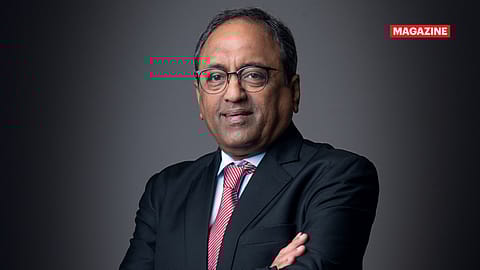
S.N. Subrahmanyan, Chairman & MD, L&T | Credits: Padmini B
Fortune 500 India: L&T adds to its core
Under S.N. Subrahmanyan's leadership, L&T has transformed from a low-margin infrastructure giant to a diversified conglomerate with a strong focus on IT and services. By FY25, the company doubled its profits and significantly increased its market cap, driven by strategic acquisitions and a shift towards high-margin sectors like IT, technology, and retail finance.
This summary is AI-generated, and Fortune India is not responsible for its content or any associated copyright issues.
The conglomerate, ranked 10th this year, powers profit growth through services shift while strengthening its core infrastructure and engineering businesses.
THIS STORY FEATURES
S.N. Subrahmanyan, Chairman & MD, L&T | Credits: Padmini B
This story belongs to the Fortune India Magazine indias-largest-companies-december-2025 issue.
WHEN S.N. SUBRAHMANYAN took charge as chief executive and managing director of Larsen & Toubro (L&T) on July 1, 2017, investors had one persistent concern: despite being India’s largest engineering and infrastructure conglomerate with operations across more than 80 businesses, L&T’s profits did not match its massive scale.
The reason was clear: infrastructure construction, the company’s mainstay, was a low-margin business. In FY18, L&T posted consolidated revenues of ₹1.19 lakh crore on the back of an order book of ₹2.63 lakh crore, but its profit after tax (PAT) was ₹7,370 crore — a modest return for such scale.

Over the next few years, Subrahmanyan — a company veteran who had spent nearly four decades shaping L&T’s infrastructure and marquee projects — confronted a dual challenge: restructuring the group to enhance profitability and steering it through the disruptions of the pandemic.
By the time he assumed the role of chairman and MD in October 2023, the results of that transformation were clear.
“Our services businesses now contribute nearly 25% of total turnover and almost 30% of profit. If they reach 30-35% of revenues, they could contribute 45-50% of total profits,” Subrahmanyan notes.
The numbers validate the strategy. In FY25, L&T’s consolidated revenues crossed ₹2.60 lakh crore, while net profit rose to ₹15,037 crore — doubling from FY18. In the first half of the current fiscal, revenues reached ₹1.31 lakh crore, PAT grew 22% year-on-year to ₹7,543 crore, and its order book stood at a record ₹6.67 lakh crore. Between FY17 and FY25, L&T’s market capitalisation grew 3.3x, revenues 2.3x, PAT 2.7x, and order book 2.2x. Return on Equity (RoE), a key parameter in judging the growth of a company, grew 1.2x.
Thrust on IT, Services
More Stories from this Issue
From the beginning, Subrahmanyan recognised that the path to margin expansion lay in services — specifically IT & technology, financial services, and real estate. The impact has been dramatic. In FY25, IT & technology services contributed ₹47,845 crore to total customer revenues, up from ₹11,188 crore in FY18 — a fourfold rise.
L&T entered the IT sector in 1996 with L&T Infotech (LTI), but the real inflexion point came in 2019, when it acquired Mindtree and later merged it with LTI to form LTIMindtree (LTIM). Today, LTIM is a $4.5-billion global IT consulting major and among India’s Top 5 IT firms.
LTIM grew faster than L&T’s most other businesses between FY17 and FY25 — market capitalisation rose 7.9x, revenue 2.6x, and PAT 3.3x. Headcount grew 4.2x, while global customers increased 3x as the company doubled the number of Fortune 500 clients and spread operations to numerous countries.
L&T Technology Services (LTTS), the group’s engineering R&D arm, has also grown considerably. With $1.35 billion in revenues and more than 450 clients across 25 countries, LTTS has built a reputation as a high-end design and innovation partner. Between FY17 and FY25, its market cap grew 6x, consolidated revenues 3.3x, and PAT 3x. Among other parameters, employee strength increased 2.3x, new global design centres 3.3x and innovation labs 3.2x during the period. “Going ahead, IT and technology services will continue to grow faster,” says Subrahmanyan.
{{#most-powerful-women-snapshot-individual.slug}} {{/most-powerful-women-snapshot-individual.slug}} {{^most-powerful-women-snapshot-individual.slug}} {{/most-powerful-women-snapshot-individual.slug}} {{#showRanking}} {{current-rank}} {{/showRanking}} {{#photo.0.url}}
{{name}}
L&T Finance, founded in 1996, also underwent a strategic reset. Once a diversified financial conglomerate spanning mutual funds, insurance, wealth management and wholesale lending, it has now transformed itself into a retail-focussed lending institution. “That shift in focus has brought terrific results for L&T Finance,” says Subrahmanyan. The company sold off unrelated businesses, and shifted focus to retail finance. Now the retail business constitutes 97% of its book. During FY17-25, L&T Finance’s market cap grew 2.5x, AUM 1.5x, disbursements 1.3x, and employee count 4.4x; PAT margins rose 2.9%.
Meanwhile, L&T Realty is emerging as another growth engine, with 4.4 million sq. metres of residential and 3.1 million sq. m of commercial development underway.
SHARPENING THE CORE
Despite the services thrust, L&T’s foundation remains its infrastructure and engineering portfolio, accounting for more than 65% of the order book. These include EPC projects in buildings and factories, transportation, heavy civil engineering, power transmission & distribution, renewables, water and effluent treatment, and minerals and metals.
The energy business — spanning hydrocarbons, CarbonLite Solutions, and green energy — contributes another 18% of the order book. The hi-tech manufacturing segment is expanding as well, securing orders worth ₹18,282 crore in FY25, a 28% jump year-on-year. Infrastructure projects alone brought in order inflows of ₹1.73 lakh crore, up 21% YoY. In H1FY26, the segment added another ₹52,686 crore in orders.
Subrahmanyan has directed his core teams to stay focussed on competencies, rather than diversifying widely. L&T has also reduced its geographic spread in the Middle East, retaining only hydrocarbon, renewables, and power transmission & distribution operations. Subrahmanyan also brought in separate leaders to manage focussed businesses.
LEAN, FUTURE-READY
The transformation is also financial. Working capital has been reduced, cash flows strengthened, and capital deployment tightened. Return on capital employed (RoCE) improved to 15.35% in FY25, up from 10.73% in FY21, according Capitaline data. ICICI Direct forecasts L&T’s standalone net sales to record a 14.5% CAGR to ₹1.87 lakh crore by FY27, with PAT rising at 19.4% CAGR and Ebitda at 18.9% CAGR.
In manufacturing and heavy engineering — now predominantly international — the company is building reactors, columns, heat exchangers and high-precision systems with advanced factory-automation (Industry 4.0) capabilities. In precision engineering (earlier the defence vertical), L&T is aggressively pursuing large defence orders such as the K9 Vajra, close-in weapon systems, and high-power radars. “In defence, there is a big scope, but we need more policy support,” Subrahmanyan says. In another significant move, L&T recently reached an in-principle agreement with the Telangana government to exit the L&T Metro Rail (Hyderabad) project, where it had invested over ₹25,000 crore. The exit is aimed at reducing exposure to public concessions as part of its Lakshya 2026 plan.
The group employs 230,000 staff and 400,000 labourers across sites, and is investing heavily in digitisation across units. At the same time, it is planting seeds for the future — semiconductor design, 3D printing, artificial intelligence, green hydrogen, and other emerging technologies.
Even as it sheds more non-core and commoditised businesses, L&T aims to build new growth engines. The targets are likely to double revenues, with more profits, and a leaner and tech-driven L&T.
Follow Fortune India
Sign in to read full story
To access our exclusive magazine content, sign in to your Fortune India account.
Sign In NowNEXT STORY