Fortune 500 India: TCS, the tech infra champion
/ 5 min read
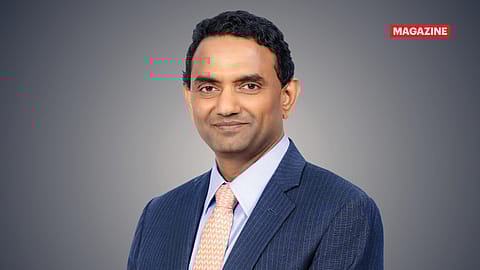
K. Krithivasan, CEO & MD, TCS
Fortune 500 India: TCS, the tech infra champion
Tata Consultancy Services (TCS) is expanding its tech infrastructure with the launch of TCS SovereignSecure Cloud and plans for a sovereign AI data centre. Partnering with TPG Inc., TCS aims to invest ₹18,000 crore in AI and data centres, marking a strategic shift towards AI-led services. This move is expected to enhance India's digital sovereignty and drive AI innovation.
This summary is AI-generated, and Fortune India is not responsible for its content or any associated copyright issues.
At No. 11, India’s largest IT services firm is looking to build AI-ready data centres and a Sovereign cloud infrastructure, which it believes will give it an edge in the next decade.
THIS STORY FEATURES
K. Krithivasan, CEO & MD, TCS
This story belongs to the Fortune India Magazine indias-largest-companies-december-2025 issue.
IN APRIL THIS YEAR, at an event in New Delhi, India’s largest IT services company, Tata Consultancy Services (TCS), launched TCS SovereignSecure Cloud, a native Cloud infrastructure for government institutions, public sector enterprises (PSEs), and regulated industries. Built with integrated AI capabilities, the Cloud services will use the data centres in Mumbai and Hyderabad to store sensitive data within Indian shores and comply with the Digital Personal Data Protection Act, 2023. The company also introduced TCS DigiBOLT, an AI-enabled low-code platform, and a Cyber Defense Suite to empower enterprises to fast-track digital innovation and cyber resilience. Later, during an analyst call after the company’s Q2FY26 results, TCS announced plans to build a sovereign AI data centre with a capacity of up to 1 GW.

The extended scope of TCS (building physical tech infrastructure) is a deliberate extension of the company’s ambition to become the world’s largest AI-led technology services company, says CEO and MD K. Krithivasan. “There is a demand-supply mismatch for AI data centres in India. Understanding and addressing this market gap creates an adjacency for TCS, which we believe will give us long-term returns.”
Subsequent to the announcement, at the end of October, TCS incorporated its wholly owned subsidiary, HyperVault, to establish multiple AI and sovereign data centres for providing infrastructure and technology-enabled services. The company roped in private equity firm TPG Inc. as an equity partner. Together, TCS and TPG will invest up to ₹18,000 crore ($2 billion) in the coming years.
“This is a phased, multi-year investment, and we are structuring it prudently. The first 100-200 MW phase will carry a clear capex envelope, and the broader GW-scale programme is planned over the next five-seven years,” Krithivasan notes. The project’s investment comes in with a three-year lock-in period for both TCS and TPG. “TPG will invest up to ₹8,820 crore ($1 billion), and is envisaged to have a final shareholding between 27.5% and 49% in HyperVault,” Krithivasan adds. The IT major is also looking to deploy India’s largest quantum computer in the Quantum Valley Tech Park in Amaravati, Andhra Pradesh, in partnership with IBM and the state government.
Industry experts believe the move could reshape TCS’s long-standing investment philosophy.
It marks a major strategic shift for TCS, entering a sector known for its heavy capital requirements, says D.D. Mishra, vice president, analyst, Gartner. It is notable because TCS has traditionally followed a conservative capital-allocation approach, maintaining strong cash reserves and very low leverage. “Industry forecasts indicate rapid growth in India’s data centre market, necessitating substantial investment, and TCS’ proactive entry is designed to preempt ‘tech colonisation’ and reinforce India’s digital sovereignty,” Mishra adds.
From a medium-to-long term perspective, TCS expects AI-driven growth from three main vectors — hyperscaler expansion, a new wave of AI-native companies, and rising AI needs of enterprises and PSEs.
More Stories from this Issue
The company is sharpening its focus on the foundational infrastructure required to sustain this momentum.
“We are concentrating on facilities that will exclusively cater to AI workloads where supply lags demand. Our differentiation is coupling infrastructure with services and partnerships, so clients get an integrated path to deploy and scale AI. As these capabilities mature, we’ll export the expertise to other markets,” says Krithivasan, who thinks the AI build-out in India is just beginning to take shape.
The company sees this as an opportunity to deepen its partnerships with hyperscalers/AI companies, deep-tech firms, PSEs, and fulfil government needs. The phased execution of building data centres of 1 GW would likely cost around $6-7 billion, and is expected to reach full capacity in five-seven years. The first revenue stream from the business is expected to flow in from FY27-28.
In a research note dated October 10, analysts at InCred Equities note that the new sovereign AI data centre business is likely to bring in an additional ₹1,800-2,250 crore of incremental revenue per 150 MW annually at full capacity and a potential RoE (return on equity) dilution.
{{#most-powerful-women-snapshot-individual.slug}} {{/most-powerful-women-snapshot-individual.slug}} {{^most-powerful-women-snapshot-individual.slug}} {{/most-powerful-women-snapshot-individual.slug}} {{#showRanking}} {{current-rank}} {{/showRanking}} {{#photo.0.url}}
{{name}}
Analysts at Motilal Oswal Equity Research, on the other hand, see the move as cash deployment, rather than a services-led growth driver. “RoE at the subsidiary level will be lower than TCS’s >50% group RoE, given the capital-intensive nature [of the business]. However, [according to] management guidance, at the consolidated level, it will not be margin-dilutive, as external partners will share funding,” an October 10 report by the brokerage states.
In its quest for AI dominance in the services space, TCS is looking at an AI pivot, both internally as well as externally. Internally the company wants to drive an AI-first culture, build AI solutions, and scale AI for connected intelligence, while at the same time building a future-ready workforce with upskilling, and recruiting top talent in local markets, along with a focus on human+AI services model. At the end of Q2FY26, TCS said it had 160,000 associates trained in higher-order AI skills.
“From a talent strategy standpoint, we are redefining career paths, reimagining roles, and hiring for aptitude: the ability to learn, adapt, and apply creativity in this new context where coding alone is no longer the differentiator. For our associates, this is a moment to lean in and co-create the future. The shelf life of skills is shorter than ever; continuous learning and hands-on experimentation are crucial,” says Krithivasan.
The company also announced key leadership changes to align with the firm’s AI vision. As part of the transformation, it appointed Janardhan Santhanam as the chief digital and chief information officer with effect from July 1, 2025. Amit Kapur was named as the head of AI and Service Integration, a newly formed AI and services transformation unit. “Our artificial intelligence strategy will be led by the right mix of advanced AI, architecture experts and adaptive engineers, who will follow an AI-augmented delivery model to build AI-led solutions at scale,” according to Krithivasan.
He adds that from investing in AI capabilities, building deep skills to strengthening partnerships and democratising access to AI tools, “we have also hired outstanding external leaders and are partnering closely with our customers to deliver artificial intelligence-led solutions. We recently ran the world’s largest AI hackathon with 280,000 participants to embed an AI-first culture across the organisation.”
Taking the lead, TCS is driving modernisation and AI integration across Tata group companies under the One Tata vision. By fostering cross-company collaborations, TCS will tap into group strengths — green power, connectivity — and build capability, while keeping a competitive, open-market posture to ensure best-in-class outcomes. “We will leverage our synergies with the Tata group across Tata Communications, Tata Power, Tata Projects, and Tata Consulting Engineers, creating strong operational advantages, and giving us a competitive edge in reliability, speed, and integration,” the CEO says.
However, a highly commoditised business such as data centre could lead to margin compression and heightened competition from established players in the near term — with execution risks inherent in large-scale infrastructure projects, and a gradual revenue realisation from the investments, cautions Mishra. “Importantly, TCS must drive a fundamental transformation of its legacy business model, which has historically relied on labour cost arbitrage and is increasingly challenged in today’s volatile, uncertain, complex, and ambiguous (VUCA) environment.”
“But, despite these challenges, TCS’s strategic move has the potential to unlock significant long-term advantages by creating differentiated, high-value service platforms that are essential in the emerging AI-driven landscape,” he adds.
Follow Fortune India
Sign in to read full story
To access our exclusive magazine content, sign in to your Fortune India account.
Sign In NowNEXT STORY