Fortune 500 India: The surging steel tiger that is JSW Steel
/ 6 min read
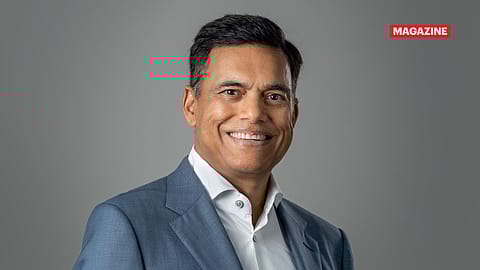
Sajjan Jindal, Chairman & MD, JSW Group | Credits: Narendra Bisht
Fortune 500 India: The surging steel tiger that is JSW Steel
JSW Steel, under Sajjan Jindal's leadership, has become the world's most valuable steelmaker with a market cap of $30 billion. The company's five-pillar strategy focuses on capacity expansion, product diversification, cost reduction, resource security, and decarbonization. With significant investments in green technology and value-added products, JSW is poised for continued growth in India's booming steel market.
This summary is AI-generated, and Fortune India is not responsible for its content or any associated copyright issues.
Ranked 16th, JSW Steel embarks on its next phase of growth, armed with massive capacity build-outs, green energy integration and advanced products.
THIS STORY FEATURES
Sajjan Jindal, Chairman & MD, JSW Group | Credits: Narendra Bisht
This story belongs to the Fortune India Magazine indias-largest-companies-december-2025 issue.
STEEL BARON SAJJAN JINDAL has built his empire around one unbroken thought — growth must never pause. His five-pillar strategy reflects that instinct: expand capacity, enrich product mix, drive down costs, secure raw material, and decarbonise. It draws from a personal philosophy he sums up simply: “Once you ride the tiger, you can never get off it. Otherwise, the tiger will eat you.” For Jindal, stepping off the race is not an option.
The result of the relentless ride is visible. Earlier this year, JSW Steel became the most valuable steelmaker globally with a market capitalisation of $30 billion. In India, it leads the industry with a domestic capacity of 34.2 million tonnes per annum (MTPA), almost double what it was just five years ago. This scale did not appear overnight; it is the outcome of a decade of expansions, integration, and push into value-added steel categories.

Jindal’s resolve not to step off the tiger created a framework that drives every investment decision within the group today. Execution of this strategy, says Jayant Acharya, joint MD and CEO of JSW Steel, is well underway and expanding aggressively.
“JSW Steel announced a 5-MTPA brownfield expansion project at Dolvi, taking the plant’s capacity to 15 MTPA. We are also setting up a 1-MTPA electric-arc furnace (EAF) at a new site in Kadapa, Andhra Pradesh, to produce steel with a lower carbon footprint,” Acharya explains. The EAF is a significant shift — it enables cleaner steel production, positioning the company well into the green transition curve.
Portfolio enrichment forms the second pillar. JSW has sharpened its product mix and downstream capability to move up the value chain. “We acquired Thyssenkrupp’s 50 KTPA (kilo tonnes per annum) cold rolled grain oriented (CRGO) electrical steel facility in Nashik and are expanding it to 250 KTPA. We are also setting up a 100-KTPA CRGO steel facility at Vijayanagar in a JV with JFE Steel of Japan. The total CRGO capacity will reach 350 KTPA, reducing imports, increasing self reliance in India, and supporting growing transformer demand,” says Acharya.
For a country scaling power infrastructure and mobility sharply, advanced electrical steel is a critical material. JSW is not stopping with cold rolled non-grain oriented (CRNO). The company is expanding CRNO capacities used in motors, generators and other engineering applications. It is investing in downstream galvanising lines — one dedicated to automotive lightweighting, another for consumer appliances — and building structural steel capacity for modern construction requirements. Tinplate from JSW now feeds the growing shift towards sustainable and recyclable packaging.
Cost leadership runs parallel. Larger 5-MTPA blast furnaces provide economies of scale and push down conversion costs materially. A slurry pipeline in Odisha is expected to slash logistics cost by ₹900-1,000 per tonne — an improvement with long-term compounding effect. Renewable energy integration is steadily lowering power cost as well. Efficiency gains are not intermittent — they are a continuous discipline woven into plant operations.
More Stories from this Issue
Raw material defines steelmaking resilience. Iron ore and coking coal can swing profitability dramatically, so JSW’s third and fourth pillars — resource security and cost optimisation — interlock naturally.
JSW has acquired 23 iron ore mines through auctions, together holding about 1.6 billion tonnes of reserves across states. These mines are not scattered randomly; they were selected close to steel plants to reduce logistics time, risk and fuel-driven costs. It is a structural hedge against volatility.
On coking coal, the company has taken a similar route. A 30% equity stake in the Illawarra mines in Australia is in place. Another one — Minas de Revuboe in Mozambique — is under acquisition. Domestic linkages add an additional layer of assurance. With these secured, JSW is targeting 50% raw material self-sufficiency in the medium term — a position that can meaningfully alter cost curves in a cyclical market.
The fifth pillar — decarbonisation — is where JSW is pushing for industry leadership. “We are scaling up renewable power to 2.5 GW (gigawatt) in the next two-three years, of which around 1 GW is already operational. We have recently commissioned a 25-MW green hydrogen plant in Vijayanagar, a first for any steel company in India, and launched GreenEdge low-carbon steel solutions,” Acharya says.
{{#most-powerful-women-snapshot-individual.slug}} {{/most-powerful-women-snapshot-individual.slug}} {{^most-powerful-women-snapshot-individual.slug}} {{/most-powerful-women-snapshot-individual.slug}} {{#showRanking}} {{current-rank}} {{/showRanking}} {{#photo.0.url}}
{{name}}
The push does more than reduce emissions. Green steel will shape future capacity growth, export potential and industry positioning. JSW is placing itself in the slipstream early.
OPPORTUNITY HUNT
Jindal sees the current moment in India as structurally different. Not cyclical, but transformative. “India has entered a ‘nation-building phase’. Once steel consumption reaches 100kg per capita, countries have historically seen rapid acceleration. India crossed that mark last year,” he explains.
He likens this stage to phases through which Germany and Japan passed post-war, South Korea crossed through in the 1980s, and China transitioned early this century. Infrastructure, urbanisation, manufacturing — all are rising simultaneously. In such phases, steel demand often grows faster than GDP. India is already showing that trend.
But the tailwind has come with turbulence. Conflict-linked supply disruptions, tariff repositioning and slowing demand in China have sent excess Chinese steel into global markets. Many nations have responded with barriers, but India — being the world’s fastest-growing steel market — has absorbed a significant inflow. Prices weakened even as volumes remained strong.
“These factors have adversely affected global prices, especially in Asia and India. Although India’s steel industry is competitive, it is important we have a level-playing field for long-term capacity investments,” says Jindal.
The company has countered volatility with product diversification and a hard grip on cost structure. “We have a portfolio of value-added products that we have continued to enhance, and we maintain a prudent capital allocation framework through cycles,” he adds.
Financially, FY25 reflected an expansion-heavy year. Revenue stood at ₹1,68,689 crore, while net debt increased by ₹9,803 crore to ₹85,403 crore, driven primarily by a three-year capex outlay of over ₹61,863 crore.
Jindal’s longer worldview aligns with policy signals. The National Steel Policy pegs India’s capacity at 300 MTPA by 2030. “We aim to reach 50 MTPA by FY31, of which 43 MTPA is already board-approved to be built by FY29. Our brownfield options allow expansion at competitive capex of $500-550 per tonne,” he states.
Work is already visible. The greenfield Odisha complex — 13-MTPA capacity — will come up in modules. Slurry pipelines, port-handling infrastructure and pellet units are being prioritised first. “This will make us ready to set up steel-making capacity in phases. We are also planning a 4-MTPA green steel facility at Salav in Maharashtra,” says Acharya.
Today over half of JSW’s sales come from value-added steel categories — sticky segments with better margins and relatively lower cyclicality. This contributes to balance sheet resilience as the company expands further.
Renewable power is scaling in parallel. With board approval for 2.5 GW and 1 GW already commissioned, Jindal’s goal is clear: run JSW Steel’s plants on renewable energy before this decade ends.
DEEP IN DETAILS
JSW’s next leap will not only be about scale, but intelligence. Digitisation and R&D form the structural foundation for the future. “We have leveraged AI to improve asset maintenance and utilisation, equipment reliability and safety,” Acharya says. AI-driven optimisation now shapes inventory management, distributor coordination and demand forecasting. Sales and distribution systems are being rewired for real-time visibility and quicker response cycles.
On innovation, the R&D engine is shifting gears. Teams are designing advanced steel grades for renewable energy components, automotive, white goods and defence. In FY25 alone, the company received approvals for 100 new grades or products.
Through the SEED (Sustainable Energy, Environment and Decarbonisation) framework, JSW has charted a path to cut CO2 emissions by 42% before 2030, targeting net-neutrality by 2050. Waste heat and process gases are being routed into captive power generation. “Both initiatives reduce emissions and deliver cost savings,” Acharya notes.
The 3,800-tonne green hydrogen plant at Vijayanagar — powered by 25 MW of renewable energy — underscores leadership ambitions. JSW has also partnered with BHP and Carbon Clean to evaluate CCU (carbon capture and utilisation) technology for scale deployment. It was also the first global steelmaker in 2021 to raise $500 million via U.S.-dollar sustainability-linked bonds.
Scrap use is rising, too, supported by processing centres coming up in Maharashtra and Tamil Nadu. It reduces input dependence and carbon footprint — another long-term lever.
The tiger Jindal rides continues to gather speed. Capacity is scaling, technology is deepening, product lines are moving upward in complexity, and carbon intensity is falling year after year.
Follow Fortune India
Sign in to read full story
To access our exclusive magazine content, sign in to your Fortune India account.
Sign In NowNEXT STORY