How unicorn IPOs fared in 2025
/ 3 min read
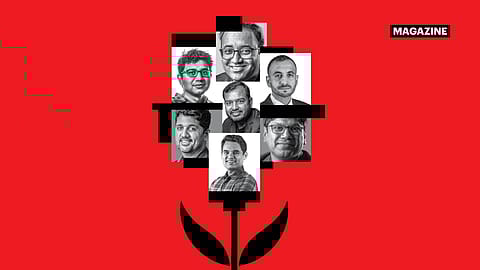
(From top left) Lalit Keshre (Groww), Tarun Mehta (Ather), Karan Virwani (WeWork India), Peyush Bansal (Lenskart), Abhiraj Singh Bhal (Urban Company), Amrish Rau (Pine Labs); (centre) Alakh Pandey (PhysicsWallah). | Credits: Anirban Ghosh
How unicorn IPOs fared in 2025
In 2025, India's startup ecosystem saw a significant IPO surge, with seven major new-age technology companies raising over ₹29,000 crore. Ather Energy led the pack with impressive gains, while others like Groww and Urban Company also performed well. The trend reflects a shift towards valuing unit economics and profitability over inflated valuations.
This summary is AI-generated, and Fortune India is not responsible for its content or any associated copyright issues.
As India’s investors evolve, the year turned into a roller coaster for the country’s new-age giants.
(From top left) Lalit Keshre (Groww), Tarun Mehta (Ather), Karan Virwani (WeWork India), Peyush Bansal (Lenskart), Abhiraj Singh Bhal (Urban Company), Amrish Rau (Pine Labs); (centre) Alakh Pandey (PhysicsWallah). | Credits: Anirban Ghosh
This story belongs to the Fortune India Magazine indias-largest-companies-december-2025 issue.
IF 2024 reopened the initial public offering (IPO) window for India’s startup ecosystem, 2025 proved to be the year of true market testing. As many as seven high-profile new-age technology companies (NATCs) — PhysicsWallah, Groww, Pine Labs, Lenskart, Ather Energy, Urban Company, and WeWork India — marched down D-Street, armed with massive user bases, strong investor backing, and brand equity. Together, they raised more than ₹29,000 crore, pushing the combined market value of new-age mainboard listings to ₹2.9 lakh crore until November 21, 2025. With Meesho, PhonePe, and boAt (Imagine Marketing) having filed the IPO papers with the Securities and Exchange Board of India, the tally is poised to grow further. It will be the highest since 2021, another year when seven major NATCs, including Paytm, Zomato, and Nykaa, mobilised ₹42,826 crore via IPOs.
As companies deferred their plans amid valuation resets, global headwinds, and the weak post-listing performance of early movers like Paytm, Zomato, and Nykaa, 2022 and 2023 saw only three and five NATC IPOs, respectively. The momentum returned strongly in 2024, when 10 NATCs, including Swiggy, Go Digit, Ola Electric, FirstCry, ixigo, and Unicommerce, listed on the bourses, raising about ₹30,000 crore in total.
That said, the triumphant homecoming of India’s unicorns has quickly turned into a tale of contrasts. From Ather Energy’s blockbuster rise to Lenskart’s early stumble, the 2025 batch has shown that the public markets continue to choose unit economics, governance discipline, and consistent profitability over inflated valuations and aggressive social-media-led narratives of new-age firms.
With its stock more than doubling since listing, Ather Energy has been the undisputed outperformer among the 2025 debutants. Groww is a distant second with the stock up nearly 58%. Urban Company and PhysicsWallah — two consumer-facing platforms — have more tempered yet healthy gains at 39% and 23.7%, respectively. At 6.8%, Pine Labs has posted modest gains so far. Meanwhile, despite listing slightly below its issue price, Lenskart has also inched up by 3.8%. The only new-age stock in the red is WeWork India, currently down 4.5%.
The driving factors
Much of the surge in new-age company IPOs can be traced to structural shifts, including maturing of India’s capital market ecosystem, that have been unfolding for over a decade. According to Pranav Haldea, MD at PRIME Database Group, IPO filings are being driven by attractive valuations and a strong investor demand. “If there is no available liquidity, forget new-age companies — even traditional IPOs would not happen.”
Domestic institutional investors, who continue to receive robust inflows from retail investments, unmistakably fuel the demand. With valuation concerns limiting the scope for incremental investments in already-listed companies, institutions are increasingly looking for fresh opportunities through IPOs, Haldea explains.
More Stories from this Issue
The current lot is different from the 2021 tech rush that saw companies listing with high burn rates and hazy profitability timelines. Amit Ramchandani, MD and CEO of investment banking at Motilal Oswal Financial Services, says, “Many new-age firms now operate with healthier margins, more disciplined cost structures, and visibility on Ebitda or near-term profitability.”
Investors have matured, too. “They are focussing on cash-flow visibility, contribution margins, cohort profitability, and governance,” he notes. Safe to say, for the first time in years, India’s public markets are not buying stories; they are buying numbers. And that, more than anything else, may be the most defining shift of 2025.
Follow Fortune India
Sign in to read full story
To access our exclusive magazine content, sign in to your Fortune India account.
Sign In NowNEXT STORY