India’s Best B-schools: For IIM Calcutta, the world is its classroom
/ 3 min read
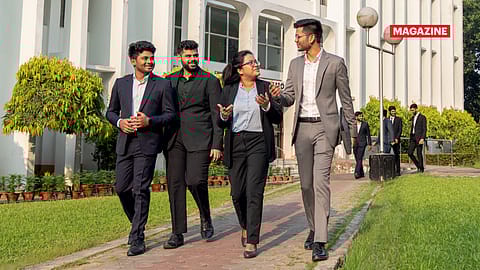
The IIM Calcutta campus. | Credits: Sanjay Rawat
India’s Best B-schools: For IIM Calcutta, the world is its classroom
IIM Calcutta, with its rich legacy, is evolving to meet the demands of Industry 5.0 by introducing innovative programs and strengthening global collaborations. Under the leadership of Alok Kumar Rai, the institute is expanding its curriculum and infrastructure, ensuring its students are well-prepared for top management roles, both in India and globally.
This summary is AI-generated, and Fortune India is not responsible for its content or any associated copyright issues.
As IIM Calcutta, ranked second on the list, steps into its next phase of global expansion, its core ethos remains firmly intact.
The IIM Calcutta campus. | Credits: Sanjay Rawat
This story belongs to the Fortune India Magazine indias-largest-companies-december-2025 issue.
FOR AN INSTITUTION with a legacy spanning over six decades, IIM Calcutta holds its rich history without being weighed down by it. You feel it the moment you enter the campus — an expanse of water bodies, shaded walkways, and buildings that hold stories from the 1960s. One can’t help but picture a young Indra Nooyi along the lakeside on a quiet evening stroll in the suburban Joka of the ’70s.
Alok Kumar Rai, the newly appointed director of IIM Calcutta (IIMC), is well aware of this legacy. Pose a question about what he intends to change at one of the oldest IIMs in the country, and Rai responds with a measured reminder. “I think we should not start with change. We should start with comprehension, appreciation, and extension,” he says, as he cites the robust intellectual infrastructure of the institute. Collaboration is embedded in IIMC’s DNA, reflected in its long-standing programmes with the Indian Statistical Institute (ISI), the IITs, and the Japan International Cooperation Agency.
The institute looks to extend this further. On the anvil are more courses: an AI-based online programme in collaboration with a leading Indian IT company, an MBA in healthcare for doctors, for which talks are underway with three institutions, including AIIMS, and another one with the National Institute of Design. “At IIM Calcutta, we’re conscious of the developments that are taking place in the industry, which we call Industry 5.0. Accordingly, we’re making our education suitable for Education 5.0, by introducing the latest content and pedagogy,” Rai says.
This may be why students like Pranav Tathe feel more confident about their decision to choose an IIM over any premier B-school overseas. “If I’m getting into top-tier colleges in India for MBA, the employment opportunities will include top management roles within India, which is more than what an average person will be getting abroad, especially in the current environment,” says the PGP2 student.
The alumni, spread across the globe, remain IIMC’s most significant differentiator. “The alumni list is shared with everybody once you get into the placement process. You just have to reach out,” says another PGP2 student, Ritikesh Gupta.
The institute saw a 5% and 13% rise in average and median CTC, respectively, in the 2024-25 academic year, says Ritu Mehta, the chairperson of the Career Development and Placement Committee at IIMC. At nearly 60% of the total offers, against almost 51% last year, the consulting and finance sectors witnessed the highest number of placements this year. At a time when business schools are struggling with placements, all 456 students who opted for placements secured jobs.
That said, extension, viz-a-viz growth, is imperative for director Rai. “Our next big growth has to come from the global market.”
More Stories from this Issue
So, is IIM Calcutta opening campuses abroad? Maybe eventually, “once you see the response of the outside world”. But to start with, it will “very soon” have an exclusive programme in entrepreneurship with a U.S. university. Some parts of the programme will be held on the Kolkata campus, while the rest will be held on the U.S. campus. IIM Calcutta has an executive MBA programme in Dubai targeting middle managers working in the Middle East.
But even as academic ambition accelerates, the institute faces a quieter constraint. “We grew, but our [physical] infrastructure did not, say with respect to the student hostel, lecture theatre, etc.... but are in the process of being built,” says Rai. The institute is also taking steps to strengthen its IT infrastructure, integrate AI in classrooms, teaching, and administrative processes, as well as for admissions.
In a world of shifting rules, IIM Calcutta stands steady by choosing to evolve — thoughtfully, deliberately, with an eye on the future.
Follow Fortune India
Sign in to read full story
To access our exclusive magazine content, sign in to your Fortune India account.
Sign In NowNEXT STORY