Milky Mist: Dairy’s dark horse
/ 7 min read
The Erode-based company is reshaping India’s dairy landscape with scale, innovation, and a consumer-first approach.
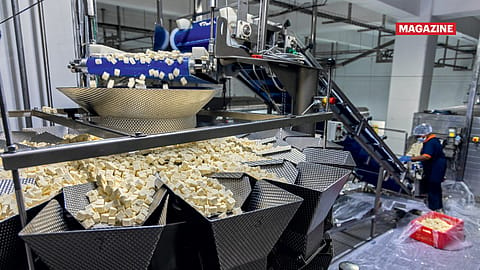
Milky Mist’s first product was paneer, a concept almost alien to South India nearly 30 years ago. | Credits: Sanjay Rawat
This story belongs to the Fortune India Magazine september-2026-indias-top-100-billionaires issue.
FOR DECADES, Dr Verghese Kurien’s Amul model — state-owned cooperatives and private players collecting milk from individual farmers — has been the dairy industry’s playbook. Whether a well-to-do or a marginalised farmer with just one cow, all pour milk twice a day at their village collection centre and get paid for it. The milk is then processed, with more than 80% packed in poly-packs and sold to consumers.
T. Sathish Kumar, founder of Erode-headquartered Milky Mist Dairy Food Ltd, is now rewriting that playbook. He has partnered with farmers in the region to set up contract farms, each with 25-50 cows. Milky Mist has 500 such farms and plans to add another 500, with the newer farms housing 50-100 cows.
Most dairy producing nations adhere to the contract farming model. But in India, contract farming is a niche. The likes of Parag Milk Foods have brands such as Pride of Cows, which source milk from a single farm and sell at a significant premium. Kumar’s plan is to do contract farming at scale. “To be able to give high-quality products, we need to have control on the quality of milk we collect. Also, as a value-added dairy brand, our requirement of milk is much higher,” says Kumar.
For every kilogram of value-added dairy product manufactured, the company needs at least 7-8 litres of milk. And with milk production being uneven for the past few years, Kumar wants to have control over the entire value chain. “We are walking along with farmers in this journey, helping them with bank loans to invest in cows. We are also working on producing silage and TMR (total mixed ration), which functions like a balanced compounded cattle feed,” he explains.
Kumar has always broken stereotypes. The son of a milk trader in Erode, Tamil Nadu, he dropped out of school when he was 15 and chose to manage his father’s business. However, he was clear — he wouldn’t sell liquid milk. Instead, he chose to convert the milk he procured into paneer, a concept alien to South India in the early ’90s. No surprise that in the beginning, a lot of his time was spent in educating trade as well as consumers about paneer.
In the initial days, Kumar made paneer at home and sold to restaurants around. In fact, it was the first product from Milky Mist’s kitty. “As per my knowledge, Amul started making paneer in 2003. I started making paneer in 1993, almost 10 years ahead of Amul,” says a proud Kumar.
Today, the company’s fully automated manufacturing line churns out 70-80 tonnes of paneer every day, and 20 tonnes of mozzarella cheese.
More Stories from this Issue
Kumar’s vision has always been to build a dairy-based FMCG company. He converts one million litres of milk everyday into value-added products. Apart from paneer and specialised cheese (cheddar and gouda), his portfolio includes milk shakes, lassi and specialised yogurts, ice-cream, and chocolates.
At his office in Perundurai, on the outskirts of Erode, Kumar points to the last page of his diary, where he has scribbled his growth story over the last decade. “In 2007, we were just a ₹13-crore company. This year (FY26) we have touched ₹3,145 crore in revenue. We are growing 40-50% year-on-year.” The ambition is to touch ₹5,000 crore in the next couple of years.
Milky Mist, which got listed in August, is currently valued at ₹16,540 crore, while listed peers such as Parag Milk Foods and Heritage Foods have a market cap of ₹2,979 crore and ₹3,443 crore, respectively. India’s most valued listed dairy firm is the Chennai-based Hatsun Agro (known for Arun Ice creams and Arokya Milk) at ₹26,177 crore.
Kumar’s focus on value-added play has allowed him higher margins — 25% to as high as 40% in categories such as yoghurt and cheese. The margins in liquid milk are wafer thin, around 4-5%. “Milky Mist and Sathish have been able to elevate the entire dairy play to a strong packaged foods play. That’s the reason they have been able to scale and create a strong brand, and hence command margins that are very different,” points out Rishav Jain, MD, consumer internet, consumer, retail and agribusiness sector, Alvarez and Marsal.
{{#most-powerful-women-snapshot-individual.slug}} {{/most-powerful-women-snapshot-individual.slug}} {{^most-powerful-women-snapshot-individual.slug}} {{/most-powerful-women-snapshot-individual.slug}} {{#showRanking}} {{current-rank}} {{/showRanking}} {{#photo.0.url}}
{{name}}
The value-added play has made Kumar a favourite among investors. In a pre-IPO round in May, Milky Mist raised ₹482 crore from Temasek’s arm, Jonsong Investments. The company’s initial public offering was oversubscribed 56.12 times with the stock listing at a premium of 17.9% to its issue price of ₹140 on August 18.
A SERIES OF BOLD BETS
Lunch with founders of businesses headquartered in Tier II and III, India often gives you a sneak peek into their local culture. Kumar serves us an authentic Tamil spread served on a banana leaf. A South Indian meal is never complete without a generous helping of curd-rice and pickles. But Kumar adds another course — skyr, a high protein Icelandic yogurt. “A 100-gram pack of Milky Mist skyr contains 11 grams of protein, enough to take care of your body’s protein needs,” he says.
From a product perspective, Kumar has launched the likes of skyr, an industry-first, in line with the current trend of consuming high-protein food. After all, India is among the top protein-deficient countries. A fully automated cream cheese line is on the cards as well.
“Consumers want choices. They also want a healthy and clean label… We want to give a plethora of choices to consumers. So, we need to constantly innovate and try new things,” says Kumar. His recent eureka moment? Entering Gujarat, Amul’s stronghold. “Everyone told me I was entering the lion’s den. But my rationale was that if I offer high-quality choices, consumers will come to me.”
THE PREMIUMISATION PLAY
When Kumar started his business in the ’90s, the consumer playbook was all about penetration and sachets. Kumar talked about premiumisation from day one, and positioned his maiden product, paneer, in that category. But then, the premiumisation narrative requires heavy investment in manufacturing capacity and cold chain, which, says Kumar, often puts him on the firing line with investors. “I am often questioned about return on investment (RoI) because I have a lot of unutilised capacity.”
The company has a manufacturing capacity of 30 lakh litres per day, but only 50% is utilised. It also owns the entire supply chain and logistics network, unlike most of its peers. Kumar’s argument is straightforward — high-quality products require high-end automation.
“I can’t knowingly offer consumers sub-standard products just because I need to explain RoI to investors,” he argues.
As far as unutilised capacity is concerned, Kumar is clear that going sub-scale initially and ramping up along the way doesn’t reduce costs. “The investment is huge and you can’t reduce costs if you bring down capacity. One needs to invest boldly.”
FEET ON THE STREET
It’s hot and humid in Perundurai, but Kumar has made it to office despite a running fever. “I can’t rest,” he says, with a smile. He is in the market every week, talking to retailers, distributors and consumers. “It helps me identify gaps and launch newer products.”
A few years ago, the company acquired Asal, which is into ready-to-cook batters, chapatis and parathas. It has also acquired tofu brand Briyas. The use of the same cold chain used in core dairy products, led to the opportunity. “Retailers also told us that there was demand for batters and parathas. We decided to listen to them,” says Kumar.
The foray into chocolates followed the same logic. The company has a strong presence in categories such as milkshakes. It has also entered ice-creams. Both require chocolate as an ingredient. Instead of buying from the outside, Milky Mist chose to set up its own chocolate manufacturing unit.
“If you travel in Kerala or Tamil Nadu, there are a lot of bakeries, which are almost as big as restaurants. At any given point in time, you will find 10-20 people having tea, cakes and muffins. All these bakeries need chocolate as an ingredient. So, Horeca (hotel, restaurant, and café) was clearly an opportunity,” explains K. Rathnam, CEO, Milky Mist. Incidentally, the former Amul veteran was instrumental in the dairy cooperative’s chocolate foray.
At Milky Mist, Rathnam has launched chocolate brand Capella. “We are focussed on building chocolates as one of the strongest products in our portfolio going forward,” he emphasises. The biggest advantage of running Milky Mist is agility, he adds. “The speed of decision-making is much faster. In cooperatives you have layers of decision-making, so approvals take time.”
Kumar’s dependence on Rathnam for day-to-day operations is evident. Be it chocolates, ice-cream or even the decision to set up contract farms, he attributes them to Rathnam. The ice-cream foray needed completely different capabilities in terms of cold chain. Also, ice-cream is a regional business, with every state having its own brand. To make a dent at the national level required deep investments. But then, Kumar has never shied away from taking risks.
“Ice-cream is a tricky product in terms of distribution. From positive temperature cold chains, we had to move to minus. Also, since there are prominent ice-cream players in every region, we had to launch more SKUs with differentiations. Besides, we had to give 20,000-30,000 freezers to the market, and also advertise heavily,” he explains.
There are three things Kumar is obsessed about — quality, trust and premium. Be it paneer or curd, Milky Mist’s products are 10-15% pricier than competitors. Yet, the company is the market leader in the branded paneer category with a 20% share.
That premium positioning, however, comes with a cost: Milky Mist has had to invest heavily to keep pace with its growth ambitions. The biggest concern for investors is the debt on its balance sheet, which has risen alongside its aggressive capex. As of March 2026, total borrowings stood at nearly ₹1,672 crore, taking total debt to 3.61x of total equity — a high level of leverage for a consumer goods company. Much of the proposed fundraise is, therefore, aimed at bringing down this debt burden.
The market and investors will closely monitor the company’s ability to service its debt. The operating profit, says an analyst, covers the annual interest cost by about 2.5 times. While that provides some headroom, the cushion is not particularly large, leaving the company vulnerable to pressure on profits if it has a weaker year. Reducing debt through fundraising could give Milky Mist greater financial flexibility.
For Kumar, taking bold bets is imperative. “How can I grow the business if I don’t take risks?” asks the school dropout who saw an untapped opportunity in South India’s paneer market and bet big to scale his dairy brand.
Follow Fortune India
Sign in to read full story
To access our exclusive magazine content, sign in to your Fortune India account.
Sign In NowNEXT STORY