MNC 500: Cognizant is back in the winner’s circle. Here’s how it got there
/ 7 min read
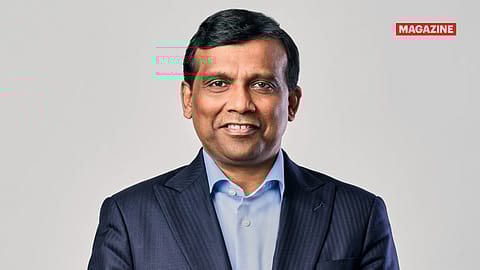
Ravi Kumar S., CEO, Cognizant Technology Solutions.
MNC 500: Cognizant is back in the winner’s circle. Here’s how it got there
Cognizant has made a remarkable comeback under CEO Ravi Kumar, achieving a 6.4% growth in 2025 and setting ambitious AI-driven goals. The company has focused on employee morale, leadership changes, and strategic partnerships to regain its competitive edge. With significant investments in AI and a strong focus on client and investor confidence, Cognizant is poised for continued success.
This summary is AI-generated, and Fortune India is not responsible for its content or any associated copyright issues.
Within three years, CEO Ravi Kumar S. has brought the sheen back on Cognizant—ranked 18—that is now exploring a public listing in India.
Ravi Kumar S., CEO, Cognizant Technology Solutions.
This story belongs to the Fortune India Magazine February 2026 issue.
IN JANUARY 2023, Cognizant Technology Solutions was a company yearning for stability. The American multinational lagged peers in growth rates, and by mid-2021, the attrition rate was north of 30% — the highest in the IT industry. It was then that Infosys veteran Ravi Kumar S. took over as Cognizant CEO. He was expected to head a company that was facing the consequences of a leader at odds with the company’s culture. What’s more, his was one of the rare industry appointments wherein he got an opportunity to head a company whose total revenue was larger than that of his previous firm.
Cut to 2026. Cognizant, which follows the January-December fiscal calendar, delivered a stellar 6.4% growth in constant currency terms with total revenue of $21.1 billion in 2025. The full-year operating margins rose 140 basis points YoY to 16.1%. In 2026, Cognizant expects its revenue growth to be in the 4.0-6.5% range in constant currency terms. In contrast, among its large peers that have provided annual guidance, HCLTech expects its overall FY26 revenue growth to be in the range of 4.0-4.5% YoY. It expects services to grow much better at 4.75-5.25% YoY. Infosys, on the other hand, has a revenue growth guidance of 3-3.5% in constant currency terms for the current fiscal.
No doubt, Cognizant, as the CEO puts it, is back in the “winner’s circle”. “What I mean by winner’s circle is upper-quartile performance among the peer group,” Ravi Kumar explains.
The turnaround, in his words, was about bringing back the heritage of winning and client centricity. A significant part of this transformation was regaining employee morale. “I was very clear from day one that employees have to be on our side. If we can get employees on our side, we can create a multiplier [effect] on clients. If we can get our clients on our side, we will get investors on our side,” says Ravi Kumar says.
Soon after Ravi Kumar stepped into the CEO’s shoes, a leadership rejig followed that saw several internal elevations. While Surya Gummadi became president of Cognizant Americas, Manoj Mehta was appointed the head of business in Europe, the Middle East, and Africa. The company also brought in Wipro veteran Jatin Dalal as its CFO. By May 2023, the company announced the rollout of the ‘NextGen’ programme aimed at simplifying business operations, functions, and realigning work, including eliminating certain roles, expanding the footprint in smaller Indian cities, and trimming its real estate in large cities.
Such changes warrant personal reassurance from the CEO to win client confidence. Ravi Kumar, recalling the early days on the job, says, “I met a lot of clients. In 2025, I met 400-plus clients, and in 2024, I met almost 400. I ran from the front with the clients. They needed that confidence, and we got back that confidence in 2023.”
The AI builder
Alongside the leadership revamp, by mid-2023, the company announced investing $1 billion in Generative AI over the next three years. The AI Lab in San Francisco and, more recently, the India AI Lab and the Cognizant Moment Studio in Bengaluru are the outcomes of this investment. “I believe AI is a winner. This industry is a winner with AI. That’s what we have ended up telling the market over the past three years,” Ravi Kumar explains.
More Stories from this Issue
At the core of this excitement is Cognizant’s aim to be an “AI builder”, for which it has charted out a three-vector strategy. The first vector involves applying AI tooling on traditional software to make it more productive. Or, do more for less. Internally, the productivity use-case now yields results where 30% of code is written and assisted by machines. It believes it could reach 50% in the years ahead.
The second vector is industrialising AI, wherein it is applied in enterprise landscapes and integrated within managed services where Cognizant’s differentiated IP and platforms come into play. The third vector is centred around the AI agent infusion in all domains and verticals in enterprise processes. This approach is how the CEO believes AI and agentic tech would change the IT industry and its role in the chain of value addition. Ravi Kumar sees agentic AI shaping up in two ways: one, where classic, algorithm-assisted programs allow for more software generation and elasticity, effectively driving software consumption. And two, a new kind of LLM-written, action-oriented software that can replicate human efforts and also do things humans cannot.
Currently, some of these AI-based offerings that Cognizant has seen success with include Flowsource, which integrates Generative and agentic AI across the full software development lifecycle and is now being used at over 70 clients with an additional 120 in the pipeline, and Neuro AI Decisioning, a multi-agent orchestration platform that optimises decision-making and drives business value on the operations side. “I’m excited about how the old stuff (traditional software) is going to be done differently. I’m also excited about the new stuff (agentic software),” Ravi Kumar says. With AI agents, he adds, the tech know-how barrier will be lower, allowing for wider adoption of technology offerings.
The AI strategy also hinges on partnerships with hyperscalers and chipmakers.
{{#most-powerful-women-snapshot-individual.slug}} {{/most-powerful-women-snapshot-individual.slug}} {{^most-powerful-women-snapshot-individual.slug}} {{/most-powerful-women-snapshot-individual.slug}} {{#showRanking}} {{current-rank}} {{/showRanking}} {{#photo.0.url}}
{{name}}
With the next wave of big tech and AI native companies built on LLM-written software, Ravi Kumar says “a new set of partnerships with companies that own the frontier models” becomes the need of the hour. Moreover, as companies pour billions of dollars into building AI infrastructure, the ultimate test will be generating enterprise value to reap returns. “That bridge has to be built by companies like us,” he notes.
Cognizant, for instance, has partnered with Google. The company is training its associates to use Gemini for software development assistance and within its internal operations and platforms. It has also integrated Gemini Enterprise with Cognizant Neuro AI and Agent Foundry. A partnership with Microsoft entails co-building and co-selling industry-grade AI solutions, and collaborating on large-scale deals in key sectors, including financial services, healthcare and life sciences, retail, and manufacturing.
The New Jersey-based company has also partnered with Anthropic to integrate Claude into its key corporate functions, engineering platforms, and delivery teams. Then comes the partnership with chipmaker NVIDIA to develop enterprise AI agents and industry-specific LLMs.
Recently, the IT major also announced the adoption of NVIDIA’s AI technology into its proprietary Neuro AI platform.
Talent in the AI world
Amid the growing demand for digital transformation, Cognizant has begun gearing up with serious dry powder (cash reserves) to grow and expand its capabilities in areas such as engineering research & development (ER&D), cloud, and AI. Ravi Kumar is betting on the physical manifestation of AI adoption, be it autonomous technologies or robotics.
“We are building an industry engineering tower around manufacturing, automotive, industrial, aerospace, and that is a muscle I’m determined to build,” he says.
In 2024, Cognizant made a bold bet: it acquired Cincinnati-based digital engineering firm Belcan, LLC for nearly $1.3 billion in cash and stock to enhance its core engineering offering. “They do a lot of work for Tier I aircraft manufacturers and aircraft engine manufacturers. We think there’ll be a significant play for data,” he says.
Over the past three years, Cognizant bought a bunch of firms, including Colorado-based Thirdera — a ServiceNow partner that specialises in advisory, implementation, and optimisation solutions. Last year, it acquired 3Cloud, a gold-certified Microsoft Azure technology consulting firm that provides cloud strategy, design, implementation, and managed services to clients across banking and financial services, healthcare, technology, and consumer sectors.
The AI advancements notwithstanding, Cognizant continues to place people as the core drivers of tech transformation. In 2023, it launched the Synapse programme to build a high-quality, skilled workforce proficient in emerging technologies. The plan is to train two million people globally by 2030.
According to the company’s latest data, in 2025, it had nearly 260,000 employees skilled in GenAI. It rolled out 35,000 promotions this year and more than 110,000 in the past three years. Its latest headcount stood at 351,600 with more than two-thirds based in India.
So, what is Ravi Kumar’s thesis for the AI world when it comes to skilling? The future of skills will be more interdisciplinary than deep expertise. “If you’re a biologist, you could do better drug discovery if you’ve skills around AI technologies. If you’re a historian, you have a better shot at the future; you could be a futurist if you actually embed tooling into the work you do. If you are a finance manager, how you do accounts, how you close your books are going to be very different in the future using AI technologies.”
2026: The year of bold bets
It’s safe to say, Cognizant is back in the game with Ravi Kumar at the helm. Attrition is within the industry range. The CEO attributes this revival to a combination of factors — good teamwork, embracing changes, identifying and spotting opportunities, and investing in them. And most importantly, taking bold bets.
“You know, if 2025 was a breakout year for us, 2026 is going to be a year of bold bets”, says a visibly excited Ravi Kumar. This year, the focus will be on solving the AI velocity gap, or the gap between massive infrastructure spending of the past few years and business value realisation for clients. He believes that the methodologies and tools to harness AI is only emerging, and the value to enterprises hasn’t drifted yet.
Is a possible India listing on the cards? After all, the management did touch upon the topic in the last earnings call. The CEO thinks it is an endeavour to tap into the investor base where tech services are a mainstream industry. “We don’t know where it (the public listing) will go, but we will at least attempt to see whether it is possible,” he clarifies. Market watchers may agree; brokerages like Nomura maintain a buy on the stock — Cognizant is one of the top IT picks. Recently, William Blair’s research division upgraded Cognizant to ‘outperform’ from ‘market perform’ without a price target after hosting meetings with the management that sees a “new phase of growth and profitability,” driven by an accelerated AI-focussed strategy.
No doubt, Cognizant timed its comeback story well to ride the AI wave under Ravi Kumar’s leadership.
Follow Fortune India
NEXT STORY