MNC 500: How Big Blue has emerged as the invisible infra that runs India’s economy
/ 8 min read
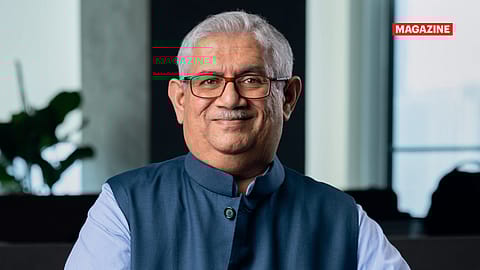
Sandip Patel, MD,
IBM India & South Asia. | Credits: Padmini B
MNC 500: How Big Blue has emerged as the invisible infra that runs India’s economy
IBM India, under the leadership of Sandip Patel, is quietly embedding itself into India's critical infrastructure, from credit card transactions to LPG distribution. With a focus on hybrid cloud, AI, and quantum computing, IBM is positioning itself as a key player in India's tech landscape, emphasising reliability and innovation while fostering strong government relations.
This summary is AI-generated, and Fortune India is not responsible for its content or any associated copyright issues.
From every drop of Amul milk to every credit card swipe, IBM India—ranked 29—has quietly embedded itself into the DNA of India’s digital and industrial IT architecture.
Sandip Patel, MD,
IBM India & South Asia. | Credits: Padmini B
This story belongs to the Fortune India Magazine February 2026 issue.
AS WE WALK PAST the glass corridors of IBM’s new office in Lower Parel, Sandip Patel points to a large town-hall styled meeting in progress in a large conference room. Channel partners, largely systems integrators and consolidators who form IBM’s extended sales network, are sitting in rapt attention. It’s an annual ritual, but one that Patel, the managing director of IBM India & South Asia, has amplified significantly during his tenure. “Every year we do one major event, but we also pull them in when we launch new products. It’s like a refresher course,” Patel tells Fortune India.
Born in Kolkata to a Gujarati family, educated as a chartered accountant who pivoted to technology consulting, Patel embodies the kind of cultural fluency that IBM needs in its most important growth market. “I think both,” he says when asked whether he considers himself a ‘Bengali’ or a Patel. “Having born and grown up in Kolkata has made me partly Bengali,” says Patel, who can speak, read, and write fluent Bangla alongside Gujarati and Hindi.
Patel’s connection to Kolkata runs deeper than language, visiting his maternal uncles who still call the city their home. The last time he attended Durga Puja was five or six years ago, but the memory lingers. Particularly of the authentic celebrations in Bhawanipur and North Kolkata, where artisans in Kumartuli still craft idols from pure clay using traditional methods. “The themed pandals are impressive. But what I love is when they preserve the authentic Kumartuli idols. Those artisans are still there, and visiting them is an experience in itself,” says Patel.
While modernity has turned Durga Puja into a crowded, commercialised affair, Patel gravitates towards preservation and genuine value, similar to IBM’s India approach.
In an industry obsessed with the next shiny innovation, Patel is building a strategy where IBM is fast emerging as the invisible infrastructure that runs India’s economy.
The invisible giant
Ask an average Indian about IBM, and you’ll likely get a blank stare or a vague association with old computers. Yet in the past 24 hours alone, that person has probably interacted with IBM’s tech stack over a dozen times, without knowing it.
Every credit card transaction in India — 100% of them — flows through IBM mainframes. Every litre of Amul milk distributed reaches consumers through IBM services, hardware, and software, a relationship that began in 2008 and continues to grow. Every LPG cylinder distributed by Indian Oil Corporation is tracked through IBM systems. The tax portal that processes India’s GST? The underlying technology is IBM. Passports? While TCS runs the operations, the underlying tech is from IBM. Rajasthan’s entire technology infrastructure? IBM software and hardware.
More Stories from this Issue
This is IBM’s quiet superpower in India, embedding itself into the nation’s critical infrastructure.
While the management did not share the financial numbers, filings with the MCA show that the India operations stood at $3.65 billion as of FY24, with profits of $340 million. (Financials for FY25 haven’t been updated yet.) Interestingly, even as the China operations have been shrinking for the past couple of years, growth in India has been picking up steadily.
A large part of the focus on India’s growth has come about with the arrival of Arvind Krishna, who took over as the global CEO from Ginni Rometty in 2020.
The AK clarity
The new CEO did three critical things that changed IBM’s trajectory.
{{#most-powerful-women-snapshot-individual.slug}} {{/most-powerful-women-snapshot-individual.slug}} {{^most-powerful-women-snapshot-individual.slug}} {{/most-powerful-women-snapshot-individual.slug}} {{#showRanking}} {{current-rank}} {{/showRanking}} {{#photo.0.url}}
{{name}}
“Earlier, it was always difficult to know what to say no to. Arvind actually taught us that there are things — it’s okay to say no to certain things. Because in technology, not knowing what to say no to can be your downfall,” says Patel.
Krishna’s first major decision was strategic focus: hybrid cloud and AI, with investment in frontier technologies like quantum computing. Everything else became negotiable. This included the 2021 spin-off of Kyndryl, IBM’s managed infrastructure services business, a unit that had “atrophied into things where, as a tech company, you would never do them,” according to Patel.
“That took a lot of focus, energy, and conviction. But it served us brilliantly,” says Patel.
Krishna’s second principle: build ecosystems through business partnerships. “He’s always said it’s better to go after 20% of a $3 billion market than 50% of a $1 billion market,” explains Patel. “When you work with business partners, it enables you to do that. Yes, you share revenues, but it enables you to do a lot more,” adds Patel.
Today, IBM India has over 250-plus business partners and continues to grow, with expansion focussed on Tier II and III cities. The company has built software labs in Gandhinagar and Kochi, delivery centres in Mysuru, and is developing one in Vizag, betting that India’s next wave of growth comes from beyond the metros.
The third Krishna doctrine: technical depth everywhere. “He brought this notion that we’ve got to build an ecosystem where technical depth is required — not just in research and labs, but in our sales teams,” Patel says. This led to client engineering teams: pools of deep technologists in every market who can build proof-of-concept at scale in two-week sprints.
There’s also an unspoken fourth principle that Patel has embraced: government engagement. “We’ve got to have a share of mind, share of voice with the government,” he says, noting that he personally spends significant time on government relations.
The $4.5-billion question
While artificial intelligence has been the cynosure of tech giants and clients alike, IBM is showing why AI remains a potent instrument of change. Globally, the company extracted $4.5 billion in cost savings in 2025 through AI-driven automation, money that flowed directly to improved profitability.
“We started this journey about 2.5-3 years ago. We said we wanted to take $1-2 billion in costs out of our operations. We exited last year with $4.5 billion in savings through the use of AI in core operations to drive automation at scale,” says Patel.
This positions IBM uniquely in India’s AI conversation. While competitors race to build large language models and consumer chatbots, IBM has been quietly implementing what Patel calls “augmented intelligence,” using AI to enhance decision-making and automate tasks at enterprise scale.
“AI is not artificial intelligence. I think about it as augmented intelligence. It’s bringing together structured and unstructured datasets — some we’ve known for years, some we’re newly able to capture — to drive enhanced decision-making or automate tasks we couldn’t before owing to a lack of technology,” explains Patel.
The same way IBM’s mainframes invisibly process credit card transactions, IBM’s AI platforms such as watsonx quietly orchestrate agent-based automation across enterprises.
The quantum bet
But perhaps nothing illustrates IBM’s long-game strategy better than quantum computing. While most tech companies are still figuring out Generative AI, IBM is already positioning for the next frontier, and India will be the seventh country to have an IBM quantum computer on its soil.
“It’s not just technology for the heck of it. When we land a machine or build a lab, we build an ecosystem around it: a research ecosystem, a business partner ecosystem,” says Patel.
The practical applications are already emerging. HSBC in the U.K., which deployed quantum algorithms for predictive bond trading, achieved approximately 34% improvement in execution decisions compared to classical AI. IIT Madras has been part of IBM’s quantum network for two years, working on real-life problems with local firms.
“Quantum is where people are now starting to learn,” Patel says, noting interest from major Indian banks such as HDFC and large tech firms. “There’s massive interest. It’s not just banks. Even tech companies are requesting education sessions on quantum,” says Patel.
When will quantum become mainstream? “If you take a conservative view, over the next five to seven years. More optimistically, three to five years,” says Patel.
The hybrid cloud thesis
The technology bet underlying everything IBM does globally — and in India specifically — is what Patel calls the technology trinity: hybrid cloud, AI, and quantum computing.
“Arvind was one of the first proponents of hybrid cloud. He said every enterprise is going to have a hybrid environment — two or three clouds, something on-premises, something on personal computers. It’ll be a mishmash. You can’t think about a utopia where everything moves to one cloud,” explains Patel.
This was a contrarian position when public cloud evangelists promised a single-cloud future. But IBM bet $34 billion on it by acquiring Red Hat in 2019, the largest software acquisition in history.
Today, Patel says, “Pretty much any enterprise you look at in India uses some version of Red Hat somewhere. The government uses it. RBI uses it. All the banks use it.”
Not surprising that IBM India’s clients agree with that view. Venkat Krishnan, chief information officer, Karnataka Bank, says: “With IBM Cloud Pak for Integration on Red Hat OpenShift, we now have an agile and secure platform that allows us to scale operations across India, simplify system management, and reduce costs — all while improving the overall customer experience.”
The $11 billion Confluent acquisition announced in late 2025 completes the jigsaw. Confluent streams data from wherever it sits to wherever it’s needed, the missing piece for enabling AI at scale in hybrid environments. “A majority of banking and financial services institutions in India already use Confluent,” reveals Patel, adding that that the transaction is likely to close by mid-year.
The MNC that acts Indian
Perhaps the most striking aspect of Patel’s tenure is how he’s repositioned IBM’s relationship with the Indian government — a critical evolution given the sector’s regulatory intensity.
“I always say we innovate in India for India and the world. We’re probably more Indian than some Indian companies because of our deep commitment to the market,” says Patel.
This isn’t just rhetoric. IBM recently announced it will skill five million Indians in AI and quantum technologies. Besides the quantum computer landing, IBM’s semiconductor IP is being licensed to companies setting up manufacturing in India as part of the nation’s chip ambitions.
“We’re not in semiconductor manufacturing, but we’re serving as IP partners to companies setting up shop here,” says Patel.
IBM designates certain markets as official “growth markets” based on market growth rates, IBM’s relative performance, solution relevance, and ability to drive year-over-year expansion. India is one of them, alongside select Middle Eastern markets, Indonesia, and a Latin American country.
More importantly, India is becoming a genuine innovation hub rather than just a delivery centre. Software labs in Gandhinagar and Kochi develop products for global markets. The Vizag lab under development will join this network. Maximo, IBM’s automation software platform, sees significant development in India.
The question IBM is solving is: how to preserve what’s essential while embracing necessary change? The Amul engagement is the answer to that. “They’ve (Amul) actually said, ‘We’ll go wherever IBM tells us to go.’ They love our platforms. Things work. Things don’t break down,” says Patel.
This is IBM’s value proposition in India: reliability at scale and the infrastructure that enables both. “We’re in a digital renaissance. If we truly believe in Viksit Bharat, there’s a technology trinity at play: hybrid cloud, AI, and quantum. These aren’t yearly trends. It’s a continuum we’re living through,” says Patel.
Put simply, IBM is like those Kumartuli artisans: doing the essential work that most people never see, but it matters more than anything.
Follow Fortune India
Sign in to read full story
To access our exclusive magazine content, sign in to your Fortune India account.
Sign In NowNEXT STORY