MNC 500: How Siemens is making in India, and building for the world
/ 6 min read
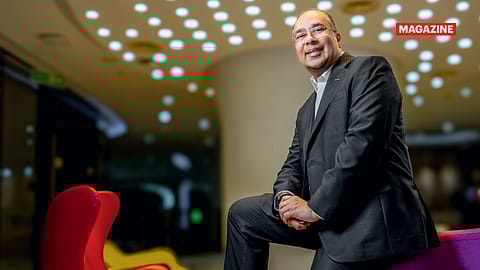
Sunil Mathur, MD & CEO, Siemens Ltd | Credits: Narendra Bisht
MNC 500: How Siemens is making in India, and building for the world
Siemens is revolutionizing its global operations from India, utilizing the GAVATAR platform to optimize real estate management with a focus on sustainability and efficiency. The transformation of its Kalwa site into a digital manufacturing hub exemplifies Siemens' commitment to innovation, producing customized products at unprecedented speeds, and positioning India as a key player in its global strategy.
This summary is AI-generated, and Fortune India is not responsible for its content or any associated copyright issues.
Siemens Ltd, ranked 16, is creating a global powerhouse through innovation and scale, with India at the centre.
Sunil Mathur, MD & CEO, Siemens Ltd | Credits: Narendra Bisht
This story belongs to the Fortune India Magazine february-2026-mnc-500-indias-largest-multinationals issue.
From a modest 120-square-metre room in Kalwa, Mumbai, a team of just eight people can know whether the lights were on in a conference room at Siemens AG’s Vienna office, track an air-conditioning malfunction in Australia, or flag abnormal energy consumption at the company’s headquarters in Munich.
This nerve centre is the Global Automate Virtualise Analyse Transform Augment Reality platform (GAVATAR). Built as an internal, data-driven digital platform, GAVATAR enables Siemens to manage and optimise its vast global real estate portfolio with a focus on sustainability, operational efficiency, and decarbonisation.
Blending the physical world of buildings with the digital realm of data analytics and the Internet of Things (IoT), the Kalwa-based global command hub delivers real-time energy and carbon data across Siemens’ 1,300 locations in 90 countries. From smart building operations and predictive maintenance to data-backed sustainability decisions, the system is redefining how a multinational manages its global footprint.
The Kalwa site itself tells a story of transformation. Once a five-decade-old low-voltage switchgear manufacturing unit, the factory was staring at closure about a decade ago amid intense competition, pricing pressures, and production inefficiencies. In 2017, Siemens undertook a comprehensive overhaul, turning Kalwa into a global benchmark for next-generation manufacturing, as the third such fully digitalised facility in the company’s global network, after Germany and China.
Today, the green campus stands as a showcase of sustainable industrial practices. It features plastic recycled roads, extensive solar power usage, and zero liquid discharge wastewater treatment. On the shop floor, cutting-edge production methods are seamlessly integrated with digital twin, IT/OT (information technology/operational technology) convergence, and manufacturing execution system (MES), enabling end-to-end digitisation across the value chain.
The productivity gains are striking. Before digitalisation, the factory ran three production lines and manufactured 77 product variants. Now, a single line can produce more than 350 customised variants, churning out around 5 million units annually. Where a product once rolled off the line every 21 seconds, production time has been compressed to just nine seconds per unit.
For Siemens AG, which posted a €78.9 billion ($87.3 billion) turnover, India is fast emerging as both a critical market and a global operational hub. Roland Busch, president and global CEO of Siemens AG, visited India four times in 2024, followed by another delegation-led visit in 2025. Most recently, he was part of the German business contingent accompanying German chancellor Friedrich Merz during his India visit — underscoring the growing strategic depth of Indo-German industrial ties.
More Stories from this Issue
“India is the fourth-largest country in the Siemens ecosystem, within the top five revenue-earning countries, the fastest-growing, and the highest-growth market,” says Sunil Mathur, MD and CEO, Siemens Ltd, a position he has held since January 2014. A Siemens veteran of nearly four decades, Mathur also oversees the company’s South Asia operations and serves on Siemens’ global leadership team.
For Siemens AG, India has been a partner almost since the company’s inception. As early as 1867, the firm’s founder Werner von Siemens personally supervised the establishment of the first telegraph line connecting London and Calcutta (now Kolkata), marking Siemens’ entry into the subcontinent. More than a century and a half later, that relationship has evolved into a sprawling industrial and technology footprint. Siemens AG now operates two listed companies and 24 subsidiaries in India, of which 20 are wholly owned. Together, they employ over 38,250 people and run 35 factories across the country.
About 15-18% of what is produced in India goes to the global supply chain. Siemens AG has many back offices, global competency centres for shared services, engineering and R&D support, and software development from India, key to its global play.
The flagship engine
The flagship Siemens Ltd today operates across 23 verticals, with a strategic focus on digital industries, smart infrastructure, and mobility. Its portfolio spans automation and digitisation technologies for hybrid and process industries, intelligent power and building infrastructure, and rail and transport solutions.
{{#most-powerful-women-snapshot-individual.slug}} {{/most-powerful-women-snapshot-individual.slug}} {{^most-powerful-women-snapshot-individual.slug}} {{/most-powerful-women-snapshot-individual.slug}} {{#showRanking}} {{current-rank}} {{/showRanking}} {{#photo.0.url}}
{{name}}
For the year ended September 30, 2025, Siemens Ltd reported revenues of ₹18,352 crore, net profit of ₹2,104 crore, and a robust order book of ₹42,250 crore. The company is transitioning to an April-March financial year, and therefore, comparable full-year numbers are not available, a spokesperson said.
Its energy business — covering power generation and transmission technologies — was demerged from Siemens Ltd into a new publicly listed entity — Siemens Energy India Ltd (SEIL). “The demerger was done to unlock shareholder value,’’ says Mathur, who is also the chairman of SEIL. For the year ended September 30, 2025, the business recorded revenues of ₹7,827 crore.
In parallel, the wind energy portfolio underwent a significant reshaping. In March 2025, Siemens Gamesa, a subsidiary of Siemens Energy, sold 90% of its Indian and Sri Lankan wind operations to Vayona Energy, a TPG-led investor group. Similarly, as part of a global sale, Siemens Ltd is divesting its low-voltage motors business with revenues of ₹967 crore to Innomotics India for ₹2,200 crore. In October 2024, Siemens AG divested its motors and large-drives business to KPS Capital Partners, bringing the business under Innomotics GmbH.
A technology conglomerate
Siemens’ growth in India mirrors the broader trajectory of the Indian economy, particularly over the past five to six years, says Mathur. He points to a structural shift in government execution: Budget utilisation has risen to 80-85% in recent years from 30-40% earlier, significantly improving project momentum. Siemens Ltd operates in almost all focus areas of the government — energy, ports, metros, smart cities, airports, aerospace, and defence.
A defining milestone came in January 2023, when Siemens secured a ₹26,000-crore order from Indian Railways to manufacture 1,200 electric freight locomotives of 9,000 horsepower (HP). It was the single-largest locomotive order in the history of Siemens Mobility globally.
The contract spans 11 years of deliveries and includes 35 years of full-service maintenance, with the entire tender process completed by Indian Railways in just nine months. “This is a game changer — state-of-the-art and among the most powerful freight locomotives in the world, never built before,” says Mathur. “Within two years, we localised over 90% of production.”
In May 2025, Prime Minister Narendra Modi flagged off the first D9-9000 HP electric locomotive at Indian Railways’ factory in Dahod, Gujarat.
Mathur says Siemens is undergoing a fundamental transformation — from an electrical and automation hardware supplier into a pure-play technology and digital solutions provider. “The narrative has changed,” he says. “We no longer go to customers talking about motors or switchgears. We tell them what their biggest problem is — and then solve it. Hardware is a given; technology is the differentiator.”
That shift is reflected in the workforce. At least 10,000 software specialists now work at Siemens in India. For energy-intensive industries such as cement, Siemens offers integrated solutions that combine hardware, domain expertise, and digital platforms to drive efficiency and decarbonisation.
The same model applies to all 23 verticals the company operates in. In 2022, Siemens Ltd launched Siemens Xcelerator, its open digital business platform, in India. It currently has over 200 digital references from India.
For instance, says Mathur, Siemens can design a car, its production process, each of its machines, and design and simulate all the testing that is required. He cites how Siemens has developed a ‘wind tunnel’ simulator for automobile wind screen crash testing, which normally requires manufacturers to invest huge amounts of money in making real wind tunnels. “Manufacturing requires precision, and we are virtually the only company that can do industrial AI,” he says.
The next wave
Looking ahead, Mathur sees strong growth opportunities across railways and metros, data centres, electronics and semiconductors, pharmaceuticals, aerospace, and defence. Among these, mobility — especially railways and metros — remains the biggest bet.
Siemens has long been a leader in railway electrification and signalling, and the scale of India’s rail network only strengthens that position. “Mumbai’s suburban railway alone carries around 8 million passengers daily, more than Germany’s entire railway system,” Mathur notes. By November 2025, Indian Railways had electrified about 99.2% of its network, making it one of the most extensively electrified rail systems in the world. Between 2019 and 2025, over 33,000 route kilometres were electrified — almost equal to the entire rail network of Germany.
Mathur says Siemens has been in India for 157 years and has demonstrated what it can do for the economy, employment, growth of the Indian industry, and society in general. “We are actually an Indian company offering German and other technologies all over the world for the growth of India.’’
For Siemens, that combination of scale, speed, and state-backed investment makes India not just a growth market — but a cornerstone of its global future.
Follow Fortune India
Sign in to read full story
To access our exclusive magazine content, sign in to your Fortune India account.
Sign In NowNEXT STORY