MNC 500: How this Japanese fashion retail brand is taking the slow and steady way to grow fast in India
/ 7 min read
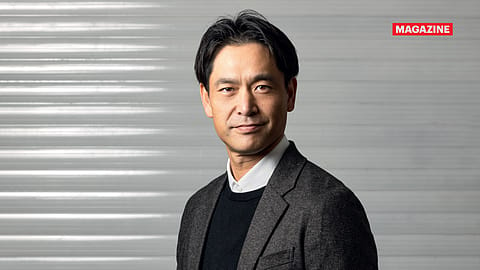
Kenji Inoue, COO & CFO, Uniqlo India | Credits: Sanjay Rawat
MNC 500: How this Japanese fashion retail brand is taking the slow and steady way to grow fast in India
Uniqlo India has quietly become a major player in the fashion retail sector, achieving profitability within three years and maintaining strong margins. With a focus on quality and functionality, the brand has resonated with young Indian consumers, leading to significant revenue growth. Uniqlo's strategy emphasizes long-term trust over rapid expansion, setting it apart from fast-fashion competitors.
This summary is AI-generated, and Fortune India is not responsible for its content or any associated copyright issues.
Ranked 341, Uniqlo is building a brand in India with patience, product trust, and scale that comes after systems, not before.
Kenji Inoue, COO & CFO, Uniqlo India | Credits: Sanjay Rawat
This story belongs to the Fortune India Magazine february-2026-mnc-500-indias-largest-multinationals issue.
SEVENTEEN STORES IN INDIA do not scream dominance, especially for a fashion retailer. Neither are there loud discounts and a blitzkrieg of festival-led promotions, nor is there an attempt to look desi. But beneath this quiet presence sits Uniqlo. True to the name of its parent group, Fast Retailing Group, the Japanese brand has catapulted into one of the fastest-growing fashion retail businesses within six years of opening its maiden store in India.
Profitable, disciplined, and increasingly confident about its place among the Indian consumers — that’s how Uniqlo defines its India game. At a 60% CAGR, Uniqlo India turned profitable within its first three years — an outcome many global fashion brands struggle to achieve — and has maintained double-digit margins since. It has grown into a business that generates over ₹1,100 crore in annual revenue. In FY25 alone, Uniqlo India grew 44% YoY, with profit after tax more than doubling to ₹179 crore and margins holding at a healthy 15%. Its quality, well-made basic clothes have struck a chord, especially with younger Indian shoppers, fuelling a rapid business expansion.
Unfazed by late entry
On a Tuesday afternoon in late 2019, two college students — avid anime and manga fans — set out on a journey from North Delhi to Ambience Mall, Vasant Kunj, at the opposite end of the capital for a reason most shoppers wouldn’t immediately understand: visit the first Uniqlo store in India. “For me, Uniqlo was never about fashion,” says Prateek Rai, one of the students who is now an advocate. “It was about the quality you could trust. I remember buying my first down jacket there. It was expensive for a student, but it has lasted years and works in Delhi winters.”
Uniqlo’s October 2019 debut came well after Zara and H&M had established themselves in the country. Tadashi Yanai, Uniqlo founder & chairman and president & CEO of Fast Retailing Group, had been eyeing the “tremendous potential” of India for long. But the maiden store came without the urgency that typically accompanies foreign brands entering India. Notably, after initially considering a JV with Arvind Brands, Uniqlo chose the wholly owned subsidiary route.
Barely months later came the ultimate test: the pandemic shut malls, paralysed footfalls, and forced retailers into survival mode. “Covid pushed us to accelerate e-commerce much faster than we had planned,” Kenji Inoue, COO & CFO of Uniqlo India, recalls. However, shop-from-home experiments eventually evolved into a full-fledged online channel, giving the brand reach beyond its limited physical footprint. That early discipline is now showing up in the numbers.
However, for Inoue, the numbers reflect more than demand. “For a market of this size, our current scale is still small. That’s exactly why the growth potential is remarkably high,” he says. India, he adds, is “one of the most important markets in the group” over the long term. Yet, unlike its peers who chase rapid store count expansion, Uniqlo has resisted tying its success to the number of PIN codes it occupies. “We don’t chase figures. We prioritise long-term trust with customers rather than short-term profit,” Inoue says.
Product over brand
‘LifeWear’, Uniqlo’s core proposition, revolves around everyday functionality. In Japan, Uniqlo is as routine as groceries, with more than 800 stores woven into daily life. However, India is a market with sharp income gaps and a strong appetite for visible fashion. “We wouldn’t sacrifice quality to meet a lower price segment,” Inoue says. “Global consistency matters. That may be why the brand gets perceived as premium here.”
More Stories from this Issue
But Uniqlo doesn’t wish to be called premium. “We want to be a part of everyday life in India, not something people wear only on special occasions,” the senior executive says. That’s also how industry veterans see it. Govind Shrikhande, former MD of Shoppers Stop, points out that Indian apparel consumption has slowed over the past 12–18 months, with like-to-like growth under pressure across value and mass brands. He cites the moderation seen in brands such as Zudio and Westside that were growing dramatically in the past three quarters, and others like Manyavar that have reported negative like-to-like growth. “In a market where discretionary spending is cautious, basics and functional wear tend to hold up better than trend-led categories.”
It may not be far-fetched to assume Uniqlo’s premium tag as a byproduct of its quality control efforts. In fact, a sizeable portion of Fast Retailing’s profits goes into quality control. For example, Uniqlo dispatches veteran Japanese textile artisans, known as takumi, to factories abroad. This end-to-end control is its biggest differentiator, says Rishav Jain, MD at global professional services firm Alvarez & Marsal. “They are fully integrated, from fabric procurement and design to planning and supply chain. Because they manage costs tightly, they can offer functional, trend-relevant products at reasonable prices.” This discipline, he adds, differentiates Uniqlo from fast-fashion peers like Zara and H&M. In FY25, Zara (operated by Trent Ltd) saw nearly flat revenue at ₹2,782 crore, even as profit jumped 23% to ₹299.47 crore. H&M, which has 67 stores compared to Zara’s 21 in India, reported revenue of ₹3,612.4 crore in FY25 with a 10% growth, according to Tracxn.
Zara and H&M cater to a wider age bracket compared to Uniqlo. Zara also attracts shoppers in the 40-45 age group. “In India, Zara did well because it adjusted its price points to suit the market. Over time, Uniqlo may adopt a similar approach if it wants to expand deeper into lower-tier cities,” Jain says.
The challenge, then, becomes awareness, not pricing. Unlike fashion labels that rely on celebrity-heavy campaigns, Uniqlo’s India marketing is product-first: ‘airism’ for extended summers, ‘heattech’ for winters, and ‘pufftech’ for travellers flying between climates. The brand is not about fast fashion, but as Shrikhande describes, it is a rare large-scale proponent of slow fashion.
{{#most-powerful-women-snapshot-individual.slug}} {{/most-powerful-women-snapshot-individual.slug}} {{^most-powerful-women-snapshot-individual.slug}} {{/most-powerful-women-snapshot-individual.slug}} {{#showRanking}} {{current-rank}} {{/showRanking}} {{#photo.0.url}}
{{name}}
According to Inoue, India is still in the understanding phase of the brand. “In more mature markets, customers already know what Uniqlo stands for. Here, we need to communicate functionality, comfort, and quality clearly.” Indian shoppers are more tactile, he explains. They try more, check fits carefully, and touch the fabric longer, which is “encouraging” for Uniqlo. “It means customers want to understand the product,” he says. Store teams track customer voice daily. If fitting room queues appear repeatedly in feedback, the company expands fitting areas. RFID-enabled self-checkouts were introduced early to reduce billing queues. “We want to avoid stress in the shopping experience,” Inoue says. “Trust is built there, not at the cash counter.”
Growth without rushing the map
Today, Uniqlo’s footprint spans Delhi-NCR, Mumbai, Bengaluru, Pune, Chandigarh, Lucknow, and Zirakpur — a mix of mall stores, high-street locations like Connaught Place, and even a roadside store format, in addition to its fast-growing e-commerce business. Delhi-NCR remains the largest market by scale. Mumbai comes next, followed by Bengaluru. “Bengaluru was one of our top three e-commerce markets even before we opened a store there,” Inoue says. “When we finally launched (in late 2024), the response showed people had been waiting.” E-commerce, far from cannibalising physical retail, has grown in tandem with store expansion. “Our online business is growing at a similar pace as retail,” the CFO says. “As people touch and feel the product in stores, online demand increases as well.”
For now, Uniqlo is resisting the temptation to chase Tier II cities aggressively. The focus remains squarely on the metros, sometimes with more than one store per city. “Accessibility doesn’t mean one store per city,” he says. “Bengaluru is huge. One store is not enough.”
The consistent demand patterns, despite India’s climatic diversity, surprise Uniqlo. “There is strong commonality in what customers want,” says the senior executive. ‘Heattech’ remains a standout performer, even in warmer markets like Mumbai, driven by travel demand. Knitwear, flannel shirts, and winter layers rank among the top categories. Mumbai has, at times, outperformed Delhi in the sale of winter products. This insight reinforces Uniqlo’s global playbook: build versatile products that travel well across climates, regions, and use cases. Product development remains global, with limited localisation. Indian inputs, such as colour preferences or silhouettes, are shared with headquarters and may influence global assortments, but rarely result in India-only lines.
Currently, India contributes less than 1% to Fast Retailing’s global revenue, but the direction is clear. For the year ended August 31, 2025, Fast Retailing reported consolidated revenue of ¥3.4005 trillion (about $23 billion), up 9.6% YoY. Business profit rose 13.6% to ¥551.1 billion, with profit attributable to owners reaching a record ¥433.0 billion. It marked the fourth consecutive year of record performance.
The group expects this momentum to continue. For FY26, Fast Retailing has forecast consolidated revenue of ¥3.75 trillion and business profit of ¥610 billion. Within that global growth engine, India is positioned as a long-term pillar rather than a short-term spike.
Quality over haste
Ask Inoue about store targets, and he gently pushes back. Numbers, he says, can be misleading. “We prefer fewer stores with a strong presence. Big spaces allow us to show the full line-up and provide the right experience.” This explains why Uniqlo has avoided the race to blanket India with small-format stores. Training staff, building supply chains, and maintaining service standards take time, especially for a Japanese brand rooted in operational discipline.
Quality over quantity is Uniqlo India’s organising principle. The model is simple: designing a limited, consistent line of staples, manufactured in high volumes at cost-effective factories. The company is now increasingly sourcing and producing goods locally for India.
Jain believes it’s a deliberate approach. “Their target consumer is 18-35-year-olds. They focus on casual, functional wear.” This clarity makes scaling far easier. “If we grow too fast without infrastructure, the experience collapses,” Inoue says. “Trust once broken is hard to rebuild.”
The company is on track to meet the 30% domestic sourcing requirement under India’s FDI norms from its current 15-16%, while maintaining strict global quality standards. However, that is easier said than done. “The biggest challenge here is maintaining global standards consistently.” As of September 2025, Uniqlo had 252 factories in China, 71 in Vietnam, 34 in Bangladesh, and 32 factories in India and Japan combined.
If growth continues at the current pace, Uniqlo could cross ₹3,000 crore in revenue in a few years. Analysts believe the headroom is significant. “They don’t need to rush Tier II expansion. Even with 40-45 stores, ₹3,000 crore in revenue is achievable over the next three to five years,” Jain predicts. Shrikhande agrees. “For their target customer, Uniqlo works well. Expansion to the Top 30–35 cities and 80–100 stores is possible over time.” In a market obsessed with speed, Uniqlo is betting that patience scales better.
Follow Fortune India
Sign in to read full story
To access our exclusive magazine content, sign in to your Fortune India account.
Sign In NowNEXT STORY