MNC 500: This German auto group finally has a silver lining to its India story. Here’s how
/ 6 min read
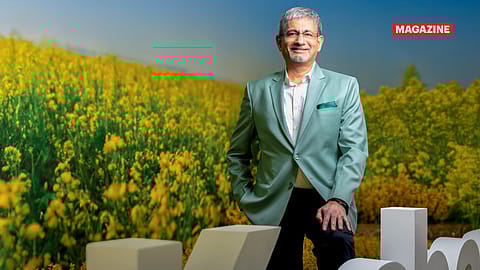
Piyush Arora, MD & CEO, Škoda Auto Volkswagen India. | Credits: Narendra Bisht
MNC 500: This German auto group finally has a silver lining to its India story. Here’s how
Škoda Auto Volkswagen India has achieved a significant milestone in 2025, emerging as the largest European carmaker in the country. Under the leadership of Piyush Arora, the company doubled its sales, driven by the success of the Škoda Kylaq in the subcompact SUV segment. The brand plans to introduce more models to sustain its growth momentum.
This summary is AI-generated, and Fortune India is not responsible for its content or any associated copyright issues.
In India since the past 25 years, the wheel of fortune has finally started to turn for Škoda Auto Volkswagen India, ranked 44 on the MNC 500 list.
Piyush Arora, MD & CEO, Škoda Auto Volkswagen India. | Credits: Narendra Bisht
This story belongs to the Fortune India Magazine february-2026-mnc-500-indias-largest-multinationals issue.
THERE IS A SENSE of satisfaction on Piyush Arora’s face — after a tough few years, 2025 has finally given him some sort of a breather.
Arora’s Škoda Auto Volkswagen India (SAVWIPL), which operates brands such as Volkswagen, Škoda, Bentley, Porsche, and Audi, hasn’t exactly had a smooth run since the group started out in India 25 years ago. Multiple strategies and many models later, 2025 seems to be the defining year, when things are falling in place for the automaker, having finally emerged as the largest European carmaker in the country. Škoda, the company’s lead brand, sold a little over 70,000 vehicles in 2025, marking its best year for Arora and the group. In fact, sales have doubled, from 35,166 units in 2024, marking a significant turnaround.
Much of it was led by the company’s foray into the subcompact SUV segment, one of the fastest-growing in the country, with the introduction of the Škoda Kylaq, which has clocked sales of 45,000 units in 2025. “It has been the biggest year since we came, driven by multiple factors, including strategy and the right product,” Arora, MD and CEO, Škoda Auto Volkswagen India, tells Fortune India. “Introducing a product in the segment [the subcompact SUV], the largest in passenger vehicles, has facilitated that.”
Škoda, which took over as the lead brand for the Volkswagen Group in India in the volume segment, has also been busy scaling up its dealer network, expanding it by about 35% over the past three years. “All brands have their own growth trajectory in their spaces,” Arora adds.
In all, SAVWIPL closed 2025 with domestic sales of 117,000 units, up 36% year-on-year. Total sales, including exports, stood at 159,500 units.
The Volkswagen Group’s India journey began with the entry of the Škoda brand in 2001. Audi and Volkswagen followed in 2007, and Porsche and Lamborghini in 2012. The company offers more than 40 models across the six brand categories via over 700 touchpoints.
With both Volkswagen and Audi now having products well into the third or fourth year of their lifecycle, Arora is betting on product interventions that will help the automaker rebound. Audi, which once even overtook Mercedes in the luxury vehicles segment, sold only 4,500 vehicles in 2025. “We do believe that going forward, with the right product intervention, we will have an opportunity,” Arora says. “Post the signing of the India-U.K. FTA, we will need to evaluate its impact on Bentley. In Lamborghini’s case, we sell whatever we can get, and for Porsche, we must look at product lifecycle changes and give them more products.”
More Stories from this Issue
Škoda on a roll
Much of the success of the India entity is led by Škoda, which has had a remarkable year. The government’s decision to slash GST also led to its growth. “Because of the new product introduction, we had the numbers, but they were still not meeting expectations. So, GST 2.0 helped,” adds Arora.
This year, the brand plans to introduce as many as 10 products, including multiple variants of Škoda Kylaq and Kushaq, to keep the momentum going. “In a competitive market like India, the launch of a new product is essential at regular intervals,” says Puneet Gupta, director, S&P Global Mobility. “While the company has performed better this year compared to its historical track record and has been able to garner volumes, the evolving automotive landscape calls for a comprehensive strategic reset. With intensified competition from established players, sustaining momentum will require the launch of differentiated and compelling offerings on a more frequent basis.”
Since its India launch, the Škoda Volkswagen Group, despite its global might, hasn’t been able to take on Korean and Japanese carmakers in the country. Some of its models have a loyal customer base, including the wildly popular Škoda Octavia and Volkswagen Polo, but they remain one-off successes. In essence, the German automaker could not match the value proposition of many of its rivals, who offered cheaper vehicles with better service networks in India’s price-sensitive market.
Škoda’s India entry came with the Octavia in 2001, followed by the successful hatchback Fabia and SUV Yeti. But the company didn’t localise production and chose to import completely knocked-down units. Volkswagen’s arrival in 2007 enabled the group to manufacture the Polo and Vento. By 2018, the company decided to bank on a new strategy, India 2.0, under which the Volkswagen Group began investing €1 billion to develop new models for the Indian market. The Škoda Kushaq was the first vehicle to emerge from the India 2.0 project.
{{#most-powerful-women-snapshot-individual.slug}} {{/most-powerful-women-snapshot-individual.slug}} {{^most-powerful-women-snapshot-individual.slug}} {{/most-powerful-women-snapshot-individual.slug}} {{#showRanking}} {{current-rank}} {{/showRanking}} {{#photo.0.url}}
{{name}}
“The India 2.0 strategy gave a good impetus to the overall strategy of Make in India and develop in India for India and for the globe,” says Arora. “We have been very successful in taking these products to multiple markets. The product acceptability has been extremely positive.”
Today, the Slavia and the Kushaq from Škoda share the platform with Volkswagen’s Taigun and Virtus. While Volkswagen doesn’t have a Kylaq equivalent, the group is expected to bring a similar model in the subcompact SUV segment. “Each brand evaluates its product strategy based on its best fit, and from that point of view, VW will look at an opportunity to enter more segments… sub-4 metre can be one of them,” Arora says.
While the sub-4 metre segment, which consists of vehicles such as Tata Nexon, Maruti Brezza, Hyundai Venue, Kia Sonet, and Mahindra XUV3XO, has been instrumental in the country’s push towards SUVs, it has also been witnessing a slowdown in recent years. “Right now, we are able to address the market, which is closer to 55-60%,” Arora says. “There is 40% space where there are opportunities for growth. And of course, there is an electric vehicle as we go along.”
What happens now?
That means Škoda hasn’t abandoned its pursuit of market share. For a long time, the company has been trying to achieve a 5% market share in the country. Today, it is around 2%. “We want to grow profitably in this country,” Arora adds. “Today, India sells around 4.45 million vehicles. By the turn of the decade, it might just be around 6 million. While we are not chasing volume, we want to grow profitably, but at the same time we are looking at, in the medium term, a market share of 5%.”
But getting there also entails enormous challenges, including expanding the portfolio and bringing the right power trains. Today, the automaker offers only petrol engines in the country, while many of its rivals offer hybrid, diesel, CNG, and electric options. “In the future, the focus will be electrification, but we are looking at opportunities for the other fuels as well,” adds Arora.
“The problem is that the group relies too much on new models for success, and once the novelty factor fades, you see a dip in sales,” says Deepesh Rathore, founder and head, InsightEV, an automotive research and advisory firm. “With Maruti and Hyundai, you always see the bell curve flatten, unlike the Volkswagen Group’s, which is more like a parabola.”
Rathore also reckons that the company is lagging in the electrification journey, while home-grown automakers have already made significant strides in the segment. Among others, Tata and Mahindra have been scaling up their electric offerings, while the likes of Maruti Suzuki and Toyota have also entered the segment with their first models.
Hyundai has already announced a staggering $5 billion investment in India to expand its manufacturing and research operations. It also plans to launch 26 cars, including its first hybrid vehicle tailored for the domestic market. “They missed the bus in the past [SUV boom], and now [also] with the electric vehicles segment,” Rathore adds.
It’s true that lagging other automakers for years has also come with its fair share of challenges. In 2024, rumours were rife that the company was considering selling a stake to Mahindra. That later gave way to murmurs about a partnership in India for the electric vehicles segment. Both haven’t proven right so far. “We will evaluate all possible opportunities and any partnership has to result in a win-win,” Arora says. “Partnerships, of course, give you an opportunity to scale in the market and learn from each other. We will continue to evaluate that, and at the right time, if we have an opportunity, we will see.”
For now, Arora and his team have finally tasted some success. It’s all about prepping for more ahead.
Follow Fortune India
NEXT STORY