Navigating automation in an AI era, the Honeywell way
/ 4 min read
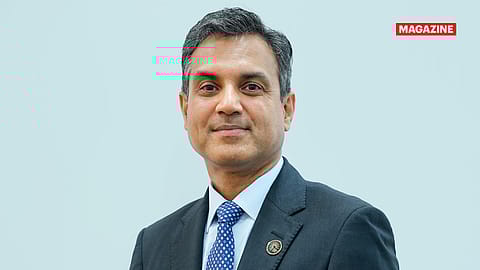
Anant Maheshwari, president and CEO, Honeywell’s global regions.
Navigating automation in an AI era, the Honeywell way
Honeywell is navigating the AI era by simplifying strategies and focusing on local supply chain resilience. Under CEO Anant Maheshwari, the company is undergoing a major reorganisation, splitting into three independent entities. With a strong emphasis on AI adoption, Honeywell is leveraging its expertise in operational technology to drive growth, particularly in aerospace and energy sectors.
This summary is AI-generated, and Fortune India is not responsible for its content or any associated copyright issues.
The U.S. multinational has set its eyes on becoming a pure-play automation company that focusses on the physical delivery of the AI opportunity.
Anant Maheshwari, president and CEO, Honeywell’s global regions.
This story belongs to the Fortune India Magazine february-2026-mnc-500-indias-largest-multinationals issue.
KEEP THINGS SIMPLE. Anant Maheshwari, the president and CEO of Honeywell’s global regions, swears by this strategy, especially amid the current global turbulence. “You need to answer two questions: Is it right for this country? Is it right for Honeywell? If you get the answers right, you’re on the right strategy,” he explains.
Maheshwari joined Honeywell in mid-2023, his second stint at the U.S. multinational. The company, which began as a furnace regulator and underwent several iterations over the past century to keep up with the innovation curve and grow into a technology and manufacturing giant, is now in the midst of a major reorganisation.
In February last year, it announced the business would be split into three independent, publicly traded companies: Honeywell Automation, Honeywell Aerospace, and Solstice Advanced Materials. While the advanced materials spin-off was completed in October 2025, the separation of automation and aerospace — Honeywell’s largest revenue segments — is expected to be completed by Q3CY26. After the rejig, Maheshwari-led global regions would represent the largest chunk of Honeywell’s business. Hence, the focus is on developing and building growth momentum. The Covid-19 lesson in building supply chain resilience has come in handy amid a changing global world trade order. “We made sure that the key markets have a relatively resilient and simple supply chain as local as possible. Certain global capabilities need to be connected across the board. But can we have them at two or three places, so that they can serve different parts of the world?” he explains.
In 2025, Honeywell clocked in 7% organic growth. This year, it expects its sales to be in the $38.8-39.8 billion range, with organic growth between 3% and 6%.
AI adoption
Both operational technology (OT) and information technology (IT) are converging at Honeywell across its verticals, says Maheshwari, who has also led Microsoft India earlier. Aerospace technologies, building automation, and energy and sustainability solutions remain Honeywell’s fastest-growing business segments and prominent touch points of its operational AI use. While billions are being spent on building AI infrastructure amid the rapid evolution of software and use cases, he points out that the AI stress testing in OT is different. “In the IT world, probabilistic models work absolutely fine.” He cites the example of using LLMs in HR functions. “You ask something, you get a response, you sharpen it. It’s a bit of probability playing there. In the OT world, an operator needs [around] 99.9999 determinism to take action. It’s not about ‘let’s try something’.”
However, in the physical AI world, companies with data and domain expertise have the edge. Some industries, especially those in the energy space, use AI for targeted deployment. “The deterministic models that we are creating can see all the experiences and work in the see-think-act-learn loop. That’s how it keeps getting better. It is better today than it was yesterday. It will be much better going forward,” Maheshwari says. On the refinery side, data from nearly 1,000 reactors has led to a significant uptick in capabilities, use cases, and savings, and the RoI started coming within months.
AI adoption at Honeywell accelerated over the past two years, including in coding and creating project planning models fed on proprietary data. “We’ve automated the cycle of projects. Therefore, we can deliver projects much faster to our customers. The effectiveness, or the hit rate of getting it right quickly, is good,” the global regions head says. Pockets like connected plants and petrochemical refineries, which are rapidly adopting AI, are already seeing the impact: saving millions in a short span. In OT, Maheshwari says, the Middle East is leading the way with the U.A.E. and Saudi Arabia pushing the boundaries of AI deployment in large energy value chains.
More Stories from this Issue
As the company’s core strength in automation across buildings, processes, and industries comes into focus, Maheshwari expects physical AI to scale rapidly. “Over the past six years, we have set up Forge (the IOT platform for AI-enabled applications and services) to scale. We are excited about what it does in 2026 and 2027 as we become a pure play automation company focussing on delivering on this opportunity physically.”
India play
Despite an India presence as early as the 1930s and later, a JV with Tata, Honeywell went solo in the country only in the early 2000s. Today, its annual India revenue has crossed around $1 billion. It has a 14,000-strong workforce, including in core engineering and design, across industry verticals such as aerospace and buildings, process, and industrial, besides senior manufacturing, research, and customer-facing roles based in the country.
Hence, India is important not only as its fastest-growing market, but also for its technological innovation. But that’s only one part of the story, says Maheshwari. “The second part is the nature of innovation coming out of India [that] is changing quite dramatically. In the past, it was largely about software innovation. But today, it’s a combination of software, hardware, and the basic research happening within India,” he elaborates. For instance, Honeywell’s Gurugram pilot plant, its biggest outside of the U.S., has scaled over the past decade and a half and develops technology for refineries and petrochemical facilities worldwide.
India is also Honeywell’s test bed for new use cases, especially for biofuel innovations involving basic chemistry and for setting up supply chains. The company has announced a strategic agreement with NTPC Green and AM Green to develop sustainable fuels. “We are likely to announce some more in the near future. Thus, we are becoming a strategic partner of innovation in this value chain, with many customers to co-create,” Maheshwari says. “That is the power of India: being able to work on innovation that is not just for India, but for the world,” he adds.
Follow Fortune India
Sign in to read full story
To access our exclusive magazine content, sign in to your Fortune India account.
Sign In NowNEXT STORY