Exclusive: Swadeshi capital needs to promote India’s startup ecosystem, says Union Commerce Minister Piyush Goyal
/ 7 min read
A focus on innovation, quality, and sustainability is a sure-shot cocktail for success, the commerce and industry minister tells Fortune India in an exclusive interaction at the India's Best CEOs 2025 awards celebration.
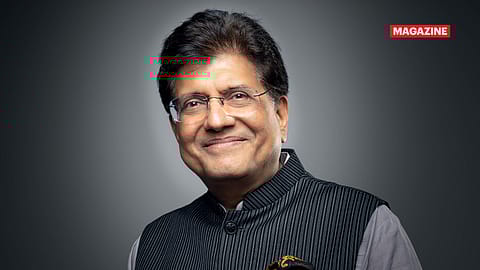
Piyush Goyal: “If children can be given this mindset of being highly conscious of accuracy, meticulous in their work, and focus on quality, the country will get into double-digit growth very quickly.” | Credits: Narendra Bisht
This story belongs to the Fortune India Magazine indias-largest-companies-december-2025 issue.
INDIA IS NOW the world’s fastest-growing major economy, even in the face of a global slowdown. As you look ahead to Viksit Bharat in 2047, what do you see are the three most critical growth levers that India must prioritise over the next decade?
First of all, it’s important that we start adopting technology… With the advent of artificial intelligence, with the shift in global trade, with newer and newer threats coming to the world through cybersecurity, all of these are going to present a huge opportunity for India. We need to adopt that, accept that, and we need to leverage our talent and skill on that. Another area, which, to my mind, is very important for all of India to understand, is quality… anything and everything we do — goods, services, every action of ours should be of a high quality… if we look at hospitality... the sky is the limit... We have very high hospitality standards. Of course, we need to do a lot more skilling and re-skilling and training of our people. But quality always pays off in the long run. Quality is not expensive. It is always cheaper in the long run. And I think this consciousness is coming amongst consumers, amongst Indian industry.
[For instance] everyone is vying to get into L&T Construction... It’s all about quality, and quality is respected.
And third, we cannot but accept the fact that sustainability is going to be at the core of any development agenda in the long run… we, as a responsible global citizen, would like to be a part of the global effort towards sustainable lifestyles, towards reducing waste or recycling waste and reusing as many things as we can. And my sense is that if we focus ourselves on innovation, quality, and sustainability, it will be a sure-shot cocktail for success.
What is the guiding principle that is shaping India’s trade negotiations today, especially as we aim to become a global manufacturing and services hub?
Quality and innovation can also be seen in our trade strategies today. And I’ll explain to you why. For the first time, India today has a standard operating process of how we are going to do trade negotiations, with whom we are going to do trade negotiations. And unless we check the boxes and we are convinced that this can be a good win-win situation, we don’t enter into a trade negotiation. Also, in terms of the kind of countries with whom we are engaging, [it] is far different from the past.
I recall when I first became commerce minister on June 1, 2019, the first issue that I had to address was India joining the Regional Comprehensive Economic Partnership (RCEP)… India was never a part of RCEP negotiations in the first place. It was a group of 15 countries — the 10 ASEAN countries, China, Japan, and Korea, Australia, and New Zealand. They had started negotiations… We already had an FTA with ASEAN... We had a free trade agreement with Japan and Korea… With Australia, we were on the verge of striking an agreement at the point we decided to join RCEP negotiations. And because we joined RCEP negotiations, we aborted the Australia negotiations.
More Stories from this Issue
Country 14 was New Zealand, with whom, at that point of time… bilateral trade was only $300 million… And who was the 15th country? China. I’m not trying to politicise it, but effectively the Congress was putting India and Indian manufacturing and Indian businesses, particularly our MSME sector, at the mercy of China. We were entering into a free trade agreement with China. And I can’t even explain to you, when I got into the files, the kind of horrific stories that I saw on the files, what we were going to be foregoing and what we were going to be offering… I did 200 industry engagements — only three told me we should join RCEP. And it took a lot of courage when Prime Minister [Narendra] Modi stood on November 4 in Bangkok that year to say that the RCEP is not acceptable to India. It does not meet the guiding principles…
Today, who are the countries with whom we are dealing? All developed and advanced countries. We’ve entered into an FTA with Australia... the U.A.E., the U.K., and the four-nation EFTA block — Switzerland, Norway, Iceland, and Liechtenstein. What are their per capita incomes? The four-nation EFTA block ranges from $100,000 to $180,000; the U.K. is at about $50,000; Australia is at about $45,000; the U.A.E…. it’s a big, open market, [with] opportunities galore, and we’ve done well after the FTA. All developed countries with large per capita incomes where our competitive issues are much less. In fact, we complement each other’s economies, and that opens up a floodgate of opportunities.
An agreement is a win-win for both parties. You’ve got to forego something if you want market access in the other country. But then, if on any product that are open to these markets, we are not able to compete… our per capita income is at $2,500-3,000, if we can’t compete with a product being made by these countries with a $45,000-50,000 per capita income, then we jolly well need not make that product unless it’s of strategic importance… we should import it… How long are we going to protect industry and cause our consumers to pay more? Ultimately, if we can’t compete with a $50,000 per capita economy, we better get out of that business. Because all theories of competitive advantage or comparative advantage suggest that we should, in an integrated, globalised world, look at doing what we are best at.
What are the next steps to ensure that Indian startups scale globally, especially in sectors such as deep-tech, defence, AI, and advanced electronics?
{{#most-powerful-women-snapshot-individual.slug}} {{/most-powerful-women-snapshot-individual.slug}} {{^most-powerful-women-snapshot-individual.slug}} {{/most-powerful-women-snapshot-individual.slug}} {{#showRanking}} {{current-rank}} {{/showRanking}} {{#photo.0.url}}
{{name}}
India needs to move over into hi-tech, innovation, encourage the deep-tech startups. For example, we’ve just promised a ₹10,000 crore startup fund of funds, tranche 2. I’m allocating the entire fund to deep-tech startups. There’s enough capital for other industries in the marketplace. Deep-techs do have a difficulty because the horizon is very long. Success ratios may not be very good. And frankly, I have a complaint to many of the billionaires I see before me… that our Indian domestic capital is not coming sufficiently to support Indian startups. I do wish to see Indian companies, swadeshi capital, coming in in a big way to promote the startups, because there’s tremendous potential. Sadly, our startups sell a large part of their equity at an abysmally low price, when they need that first seed capital or early stage funding… The sharks out there just tend to kill these ideas or buy them out very cheap. I want to appeal to all of you, ladies and gentlemen here, let’s look at more domestic pools of capital supporting startups. If we were to do what Silicon Valley did with their innovation ecosystem, supplemented with the ₹1 lakh crore that we have just announced in the research, development, and innovation fund (RDI fund), I think we can do wonders in India. Our talent is second to none. Our young men and women can really do what nobody in the world can. They do all of that in NASA; they do all of that in Silicon Valley…
Very often I’m told that there are family offices, which do these things (back startups). Look, family offices are not going to take big risks… [they] will not be able to reach the people who need that money; and they (the startups) will not be able to reach the family offices. So, we need to have pooled capital, domestic capital, supplementing the money that the government puts up.
And by the way, India can be a great innovation hub. Innovation in India can be done at one-fifth or one-sixth the cost of what happens in Switzerland or America, and that ₹1 lakh crore, coupled with private capital, can lead to ₹15-20 lakh crore of innovation, equivalent to what would be done in Switzerland or Singapore or Saudi or anywhere else. So, we really need to think big.
What do you think is required to be done for India to be considered more of a trusted, high-quality products and services nation?
Gradually and particularly after Covid, India is being looked upon as a trusted partner. The stability in policy, the predictability that India provides today [is] far better than what Europe or America provide. I think we have the talent; we have the ability to produce high-quality goods, offer high-quality services. What we need is just a mindset change, the basic jugaad mindset, and it’s gradually reducing, but that chalta hai approach, if that can be changed… we still really need to significantly change the mindset towards perfection. If our youth can be inculcated the spirit of precision and quality being paramount, of being really focussed on meticulous work… if all the children in school, [and] college can be given this mindset of being highly conscious of accuracy, meticulous in their work, focus on quality, the country will get into double-digit growth very, very quickly.
What role do you expect that the CEOs in the room should play to complement the government’s push towards Viksit Bharat?
You are not going to complement our push. You are going to create Viksit Bharat. We will complement your push… The prime minister often says that this will be a collective commitment and effort of 1.4 billion Indians… [the] government can only play the role of a facilitator, and [the] government… needs to stay out of your hair. In fact, recently… he (the PM) was interacting with exporters, and one of the comments he made after that meeting was that look at the IT sector and how successful it is in India… Because when Mr Vajpayee was prime minister in 1998-99, and [because of] the Y2k bug... we got a huge push and a great opportunity in the IT sector… We’ve never looked back since then. But at that point of time, Mr Vajpayee took the sage decision to leave the IT sector completely on its own… not bring in too much regulation, not try to create too many obstacles to their work. And look at how it has flourished over the last 25 years! We wish to do that… Please ask of us what more we can do to complement your efforts, to help you work better… Some things may happen fast. Some things may have other dimensions… But I can assure you… Our intent is to make your life easier, to make it easier to do business in India, and our intent is to become a facilitator to all of you, so that Viksit Bharat does not remain just the vision of PM Modi or the mission of this government, but it is the collective mission of 1.4 billion Indians. If we all work together as a team, there’s absolutely no power on earth that can stop India from becoming both a developed and a prosperous country on the back of inclusive and sustainable development.
Follow Fortune India
Sign in to read full story
To access our exclusive magazine content, sign in to your Fortune India account.
Sign In NowNEXT STORY