The Indian capital markets are entering a new orbit and the best is yet to come, says BSE MD & CEO S. Ramamurthy
/ 10 min read
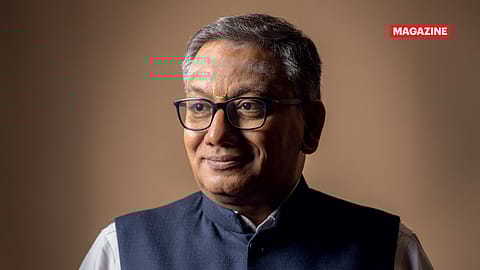
According to BSE MD & CEO Sundararaman Ramamurthy, equity culture is yet to develop in a big way in India, and so, offers huge room for growth. | Credits: Apoorva Salkade
The Indian capital markets are entering a new orbit and the best is yet to come, says BSE MD & CEO S. Ramamurthy
Under the leadership of S. Ramamurthy, the BSE has achieved remarkable growth, with the Sensex reaching an all-time high. Key strategies included cost control, employee support, and technological upgrades. The focus on corporate governance and customer feedback has been pivotal. As India progresses towards becoming a developed nation, the BSE is poised to capitalise on emerging opportunities.
This summary is AI-generated, and Fortune India is not responsible for its content or any associated copyright issues.
The MD & CEO says the domestic capital markets are not at a cyclical high, as he decodes the building blocks of the BSE's operational excellence.
According to BSE MD & CEO Sundararaman Ramamurthy, equity culture is yet to develop in a big way in India, and so, offers huge room for growth. | Credits: Apoorva Salkade
This story belongs to the Fortune India Magazine best-investments-2026-january-2026 issue.
IT’S A RECORD YEAR for the capital markets in terms of fundraising. The Sensex is at an all-time high. In the three years under your leadership, BSE has shown phenomenal operational excellence in terms of revenues and profit. Could you take us through the operational layers that helped you achieve these excellent numbers?
It has been three very eventful years. BSE is completing its 150th celebration. The Sensex is completing 40 years, and we’re in the ninth year of BSE’s listing… it is significant hard work from BSE and cooperation, coordination, guidance, and support from all of my stakeholders — be it my brokers, the investors in BSE, the investors who trade through BSE, the regulators, [and] board members. Every stakeholder has been very supportive, cooperative, coordinating, and guiding. And of course, [we’ve had] a bit of luck as well. In every one of the areas — be it listing mainboard or SMEs, mutual fund operations, our index company, derivatives where we never had any opening at all for 20-plus years — BSE has seen significant growth over the past three years.
What were the building blocks that you looked into to create that operational excellence?
When I joined, the spirits were down. The press was writing it’s a sinking ship. Some friends called me and asked, ‘Are you mad that you’re ready to take up this type of a challenge?’ I took up the challenge, and the key things which helped were:
Cost control: A good amount of money, almost around ₹100 crore per annum, was going out of the system. The liquidity enhancement scheme in derivatives was paying money for order flow with no meaningful trading. Some technology schemes were distributing money to brokers for technology upgrades not resulting in any gains. Around ₹100 crore of cost rationalisation was the first thing we did.
Employee support: There were multiple issues — a lot of unfilled vacancies, a lot of CXOs either retiring or mentally retired or not there at all, and structural deficiencies. If you joined BSE at 21 years and continuously worked, getting promoted every three years, to reach CXO minus one level, you should be working till you are 72 years (you would retire by 60). So, you’re never going to rise through the ranks to the top. I was told there was nothing called a town hall ever held in BSE before. We started showing a career path for people, and the type of cooperation, cultural change, and energy unleashed was huge.
Technology: BSE had a good technology backbone, but infrastructure was very bad. Capacity throughput was very, very bad, and peripheral systems were absolutely outdated. Without technology today, you cannot run a stock exchange.
More Stories from this Issue
Corporate governance: Corporate governance should not be just within the cupboards or rooms of the MDs. It should be felt in the board. Then only the board starts trusting you.
Voice of the customer: You grow when you serve a meaningful purpose of existence by filling an existing gap. Listening to the voice of the customer is the fifth pillar that helped BSE.
What is BSE’s holy grail that will ensure the compounding engine continues to deliver in the coming years?
There are two important points in this situation: First, never, ever presume that there’ll be no more entrants… You should always presume that there’ll be more entrants so that you plan your existence. Second, never juxtapose yourself as a competing person. You juxtapose yourself as a complementing person. The moment you are complementing, at least in major areas of products, you grow together. You don’t get into an atmosphere of toxicity where you think every day, ‘how do I grow or how do I degrow somebody else?’ Third, always consider that you are your own competition. What you were yesterday, today you should be better than that. What you’re going to be tomorrow should be better than what you are today. If that is what you are doing, then you will realise that perfection is a pursuit, not a destination. Once you do that, then you will continue to exist, continue to grow. You’ll find your own new meaning.
{{#most-powerful-women-snapshot-individual.slug}} {{/most-powerful-women-snapshot-individual.slug}} {{^most-powerful-women-snapshot-individual.slug}} {{/most-powerful-women-snapshot-individual.slug}} {{#showRanking}} {{current-rank}} {{/showRanking}} {{#photo.0.url}}
{{name}}
What will be the specific growth drivers in the coming years?
I will divide the answer as known and unknown.
The known is that, today, under the guidance of our Prime Minister, India is marching very fast towards becoming a developed nation — Viksit Bharat — by 2047. We are well positioned to capitalise on it. What are those growth areas? Today we are talking about a billion people of working age. Of that, there are 250 million UCCs (unique client codes), but the actual trading number is lesser.(1) Have we even scratched the surface in the equities market? There is a lot to do. It’s a similar situation in mutual funds. This 250 million has been achieved only in the past four or five years.
How do we unleash this potential? Make our systems more accessible. Talk with all the stakeholders who could add value. We are interacting with mutual fund distributors across the country through our Star MF platform. (2) We’re having quarterly meetings with merchant bankers. REITs and InvITs are becoming important — we’re talking to associations of those asset classes. We involve ourselves in discussions with people like AMFI.
Equity culture is yet to develop in India in a big way. There is huge room available [for growth]. [There is] investor awareness, investor protection under the able guidance of the regulator, who is joining hands with entities like us, and spreading the culture.
In terms of unknowns, today you have only equity and equity derivatives as products. Are these the only products? What type of products will you bring? What type of facilitation will you bring for people to have a bigger kitty and choose whatever suits them? We are coming out with alternative investment funds, [and in] some other areas. We need to think of more products and more channels. You can’t appeal to a 700 million or 1 billion population with existing channels alone.
2025 was a record year in terms of fundraising. Retail investors showed huge appetite complemented by robust SIP flows. Is this a cyclical high or are we structurally moving into a different orbit as a nation?
We are moving into a different orbit. Why do I say that? The median age of India is just 28. The power of the youth, combined with the way the progressive government policies are coming up and the progressive thought process of the regulators, is putting India into a very different orbit and path. Therefore, I do not feel that it is cyclical.
We are just starting to explore our capabilities and growing. India is becoming a consumption capital. The number of VCs, the number of unicorns, the number of startups, people looking into these startups to fund, the slow and steady but very strong emergence of family offices in India, and people who are outside India thinking of setting up shop in India to fund this activity — with a good amount of thought process from the government and funnelling capital creation and all the efforts making business easier in India — I feel it is a growth path and a different orbit, not a cyclical one.
We’ve seen a record number of issues through OFS (offers for sale) in CY25. Is this a wealth transfer from retail to promoters? Will we again see a phase where IPOs come for growth capital rather than exit capital, the way it was in the early years?
I think… [it] is a very static type of analysis. If big companies come and they are exiting through OFS and take a lot of money out of it, are we saying that there are no further opportunities in India, and that this entire money will flow out? That could be possible if the economy is not looking up, but the very fact that there’s a good amount of valuation, multiple times the size of the issue subscription, shows the faith of the general public in the economy about its growth phase.
Why are some promoters coming out with OFS? Naturally, they put risk capital. They find the atmosphere is such that on one hand they’ll be able to take some money out by making some profit, and there is an opportunity created in the economy that will be at the starting levels. If they put their money, the multiplier could be higher. Therefore, I do not see this as just wealth transfer.
About the previous IPO cycle, it was only growth capital because the market was just growing. At that point of time, it had to be growth capital. It is growing now to a level where you can make profit and reinvest in some other place because overall there is growth. So, therefore, it is a natural phenomenon, and it is a very dynamic equilibrium.
We have seen a robust SME ecosystem being created where exchanges have been playing an active role. But there’s concern that there are quite a few companies that may not have the right fundamentals or may just be cashing out. How are you as an exchange ensuring that the filters for an SME IPO only get stricter?
SMEs are very important for our economy. We have around six crore (60 million) MSMEs across various industries and states. The listed number in BSE is only around 670. They were able to raise around ₹13,500 crore in capital. But their valuation today is almost ₹3 lakh crore — they have grown in a big way.
But some of the valuation may be frothy.
Could there be fraud? Of course there will be fraud. In mainboard also, after all the precautions we take with ICDR, LODR, regular monitoring, can we say there is no fraud anywhere? When you churn the milky ocean in the pursuit of nectar, it may not be possible to prevent poison from coming out. But that should not prevent us [from the pursuit of nectar]. How do you improve the process?
Hence, we have bigger ticket size, so it is not meant for retail. Greed should not take over an individual investor who doesn’t know what he’s doing. I always say, trade what you understand, understand what you trade.
We are looking at track record requirements and knowing what is happening with the promoters, what is the purpose for which money is being raised, what is the utilisation level, etc.
There are regular merchant banker meetings being held where we share our experiences, what we see as good and bad. They are the first-level regulators, and it is their professional credibility which is at stake.
Importantly, we are using AI and LLM software with four modules: Module 1 checks compliance with Sebi regulations. Module 2 checks compliance with extra BSE conditions, and Modules 3 and 4 — our own red flags — like too many changes with auditors, everything being called working capital when it’s a fixed capital-intensive industry. All proper names in prospectus are reference-checked with public domain info from MCA website, ED, etc. We are rejecting 25% of the [SME IPO] applications.(3) We tell them, please don’t submit. If you submit, I’m going to reject it. Are we in a perfect state where we live happily thereafter? There is no such thing. Fraud will continue and we need to go one step ahead. It’ll be a continuous process for us.
Repeated studies by Sebi show that investors have only been losing money in F&O, yet investors are still enamoured by returns. We’ve seen recent actions on influencers as well by the regulator. As an exchange, how are you ensuring too much speculation is not encouraged even as it remains a strong revenue generator?
There are two, three things to look at here. The number of investors participating in F&O is a very small fraction of even the number of people participating in equities today. Most importantly, from public domain data, 80% of the individual investors who are participating in F&O are contributing for only 2.2% of the premium traded.(4) So, it’s not clear whether they are habitual traders or testing the waters to understand or just trying to learn.
But a lot depends on how vociferously you educate people through investor awareness campaigns. A lot of public domain material for people to understand the product and take caution is being put in place.
Look, if you want to take lollipops away from kids because it is not good for their teeth, you should at least give a doll in their hand. So, the question is: what’s that doll for people to choose instead of derivatives? The answer is, broad-based mutual funds are very suitable because they’re just trying to get into the equities market.(5) That’s what our interactions with mutual fund distributors across the country is all about. You want to get into the equities market; the best and safest route for you probably at this point of time is a broad-based mutual fund. Not a thematic, not a mid-cap, not a small-cap, but a broad-based, large-cap fund, or an index fund.
But if somebody is greedy and wants to become a trillionaire overnight, it doesn’t work. You are not going to profit based on what your neighbour or relative told [you] is a good investment. Trade what you understand and understand what you trade. Then you are safe, the market is safe, and all of us grow.
You have two more years to go, so what is the vision you have laid for BSE? Do you foresee an extension?
Very clearly there are two fundamental principles: one, what worked yesterday will not work tomorrow; and two, perfection is a pursuit, not a destination.
There are three guiding goals. One, ensure BSE continues to be vibrant. When we started, we said ‘make BSE vibrant’. Today I can’t say it anymore, it’s already vibrant. We have to ensure that it endures. Second, deepen and broaden markets. At different points of time this means very differently: what it means at this point will not be the same way it’ll mean tomorrow, but it’ll still be valid. Third, pursue customer delight.
In terms of operational areas, we are focussed on five key areas: Diversify the revenue streams, technology, technical infrastructure, human infrastructure, and physical infrastructure. You should be better tomorrow compared to what you are [today]. This is the path we have put in place.
As far as my extension is concerned, 65 years is the retirement age as per the current regulations. So, I have nothing to talk about another term because I’ll be completing 65 years in 2027.
Follow Fortune India
Sign in to read full story
To access our exclusive magazine content, sign in to your Fortune India account.
Sign In NowNEXT STORY