After Budget, India-U.S. trade deal, RBI policy seen as next trigger for markets: All you need to know
/ 4 min read
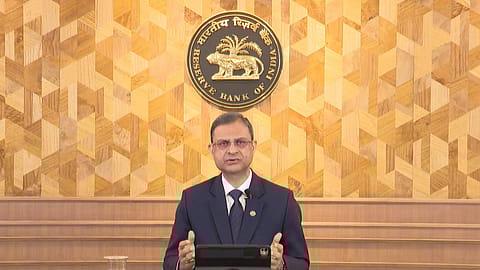
Sanjay Malhotra, Governor, Reserve Bank of India | Credits: Fortune India
After Budget, India-U.S. trade deal, RBI policy seen as next trigger for markets: All you need to know
Indian markets have rebounded after a Budget Day dip, driven by optimism around the India-U.S. trade deal. However, the sustainability of this rally is uncertain, with stretched valuations and a lack of strong fundamentals. Attention now shifts to the RBI's monetary policy decision on February 6, which could influence market momentum amid expectations of a dovish stance.
This summary is AI-generated, and Fortune India is not responsible for its content or any associated copyright issues.
As the India-U.S. trade deal optimism fades, attention turns to the RBI’s February 6 policy for cues on market direction.
Sanjay Malhotra, Governor, Reserve Bank of India | Credits: Fortune India
Indian equities have seen a lot of drama over the last three trading sessions. After taking a hit on Budget Day, markets bounced back strongly, buoyed by optimism around the India-U.S. trade deal. The benchmark Sensex and Nifty, which had fallen nearly 2% on February 1 amid concerns over the proposed STT hike, have made a strong comeback, surging nearly 4% over the last two trading sessions.
Yet, the sustainability of this relief rally remains an open question. Market participants said valuations are still stretched and that the recent upswing lacks strong fundamental backing. With optimism from the trade deal largely priced in, attention is now shifting to the Reserve Bank of India’s monetary policy decision scheduled for February 6, a key event that could determine whether the market’s momentum gathers strength or begins to fade.
“A trigger from monetary policy scheduled on 6th Feb is unlikely since the MPC is expected to retain the rates and stance with a dovish tone. The economy is now in a state where a monetary stimulus is not required. So, it is likely that the MPC will wait to see the monetary transmission play out. The auto numbers on January suggest that the buoyant demand continues,” said VK Vijayakumar, Chief Investment Strategist, Geojit Investments.
He said that Tuesday’s 639-point rally in the Nifty was mainly driven by foreign institutional investors (FIIs) short covering and their buying of ₹5,236 crore in the cash market. Given current valuations, this bullish trend is likely to run out of steam.
“Investors should stick to fairly valued largecaps. The sectors that are expected to gain from exports to US, like textiles and apparels, gems and jewellery and marine processing will witness some more price action," Vijayakumar said.
RBI MPC begins today
The Reserve Bank of India’s monetary policy committee (MPC) has commenced its first policy meeting of 2026 today, with the outcome due on February 6. Market participants widely expect the governor Sanjay Malhotra-led MPC to maintain a status quo on interest rates after an aggressive easing cycle in the past year.
The MPC had cumulatively reduced the repo rate by 125 basis points, including a 25-basis-point cut in December 2025, bringing it to 5.25%. Policymakers are likely to assess inflation trends, global economic uncertainty and domestic growth momentum before deciding on the future rate trajectory, with the focus on balancing price stability and economic recovery.
Here’s what to expect from the RBI policy meeting
With growth concerns lingering, inflation easing and currency dynamics in flux, the February RBI policy meeting is set to be a critical inflection point for the market. Brokerages and research houses are converging on a key question: will the central bank use its remaining policy space to deliver one final rate cut?
BofA Global Research, in its preview note for the February policy, expects the RBI to ease monetary conditions further amid persistent uncertainty around the growth outlook. The brokerage’s base case is a 25-basis-point cut, which would take the repo rate to 5.25%, accompanied by significant liquidity injections and a longer-term assurance on system liquidity.
BofA does not see the recent weakness in the rupee as a major impediment to the rate-cut cycle, noting that the traditional rupee–inflation linkage appears to have weakened. However, it cautions that if the RBI does opt to cut rates in February, it is likely to be the last cut of the current cycle. If the central bank holds rates instead, BofA expects dovish forward guidance to keep the easing option open.
The central bank’s policy stance over the past year has been far from linear. According to analysts, the RBI entered H1 2025 with clarity on macro data trends, backing its policy intent with aggressive liquidity support and cumulative rate cuts of 100 basis points. The picture became more complex in the second half as global volatility intensified, forcing the RBI to balance the need to support growth against external uncertainties, including the outcome of India–US trade negotiations and easing domestic inflation pressures. While recent economic indicators have improved marginally, analysts believe the RBI may still find limited comfort in forward-looking signals.
{{#most-powerful-women-snapshot-individual.slug}} {{/most-powerful-women-snapshot-individual.slug}} {{^most-powerful-women-snapshot-individual.slug}} {{/most-powerful-women-snapshot-individual.slug}} {{#showRanking}} {{current-rank}} {{/showRanking}} {{#photo.0.url}}
{{name}}
A research report by the State Bank of India’s Economic Research Department highlights a key anomaly in the current cycle: despite a 125-basis-point cut in the repo rate and liquidity injections of ₹6.6 lakh crore through open market operations (OMOs) during the current fiscal, bond yields have shown limited downward movement. SBI notes that this is the largest OMO operation in India’s monetary history. When combined with CRR-related injections, buy/sell swaps and currency leakages, total liquidity infusion stands at around ₹5.5 lakh crore, leading to asymmetric transmission across market segments.
Meanwhile, Emkay Global believes the currency will be the dominant short-term trigger for markets, with the Budget impact fading quickly. According to Emkay, the India-U.S. trade deal could act as the primary catalyst for a turnaround in the rupee, which has depreciated nearly 3% over the past three months. A reversal in the currency, it argues, would free the RBI from the pressure of defending the rupee, allowing it to inject liquidity more comfortably into the system.
Follow Fortune India
NEXT STORY