The FAQs are AI-generated, and Fortune India is not responsible for its content or any associated copyright issues.
Bajaj Auto posts record Q3 as margins hold despite EV lag
/ 3 min read
The company's domestic business recorded its highest-ever quarterly revenue, driven by festive sales and the rationalisation of GST rates.
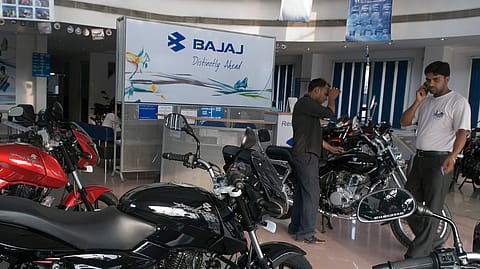
Credits: Getty Images
Bajaj Auto registered a record December quarter for the current fiscal year, with revenue from operations touching a record ₹15,000 crore for the first time, growing 19% year-on-year, led by its highest-ever sales volume and a more diversified product base. EBITDA increased 22% to a record ₹3,161 crore, with margins rising to 20.8%, thanks to the positive impact of currency movements and the production-linked incentive (PLI) scheme.
Speaking to the media after the earnings announcement, CFO Dinesh Thapar said, "The expansion in margins occurred despite continued cost pressures and the lag in electric two-wheelers' profitability compared with the overall portfolio." The company's profit after tax (PAT) touched a record ₹2,500 crore, up 21% year-on-year before exceptional items and 19% after factoring in a one-time adjustment related to the reassessment of the company's obligations for employee benefits due to changes in the labour code.
On electric vehicles, Thapar said profitability has improved meaningfully from earlier levels. “There was a time when we were bleeding at a cross-margin. Today, we’re nearly EBITDA-neutral on electric two-wheelers,” he said, while noting that closing the gap with enterprise margins would take time. Electric three-wheelers, he added, are already profitable.
The company's domestic business recorded its highest-ever quarterly revenue, driven by festive sales and the rationalisation of GST rates. The company's growth was led by double-digit sales increases in domestic motorcycles, electric two-wheelers, three-wheelers, and exports. Electric vehicle sales also registered a record high.
One of the key drivers of the quarter was exports, which crossed 600,000 units, marking a recovery after 15 quarters or nearly four years. Latin America continued to lead, posting fresh highs, while Africa and Asia also recorded double-digit growth. Nigeria, however, remains well below historical levels, operating at roughly half its earlier industry potential, though Thapar said currency stability could support a gradual recovery. In Asia, Bangladesh continued to lag due to ongoing challenges even as other markets performed well.
Within motorcycles, Bajaj Auto reported its strongest-ever quarter in the strategically important 125cc-plus segment. Premium brands KTM and Triumph also delivered record quarterly volumes, helped by product refreshes and an expanded portfolio. The company said it had absorbed the impact of higher GST on motorcycles above 350cc to stay competitive, particularly for Triumph models, until new sub-350cc products are launched.
Commentary on the CNG motorcycle—the Freedom 125
The company also addressed the slower-than-expected adoption of its CNG motorcycle, Freedom 125, which has sold around 4,000–5,000 units so far. The CNG product is an industry-first worldwide. Thapar said that the demand has been constrained by infrastructure gaps. “The CNG infrastructure is constraining what we might have aspired for,” he said. In terms of markets, the motorcycle saw customer response in areas which already have CNG penetration, such as Maharashtra, Gujarat, Delhi, and parts of Kerala.
Recommended Stories
Speaking on the expectations from the product, Thapar said while the gap in incentives between petrol and CNG vehicles is narrowed, the Freedom 125 will remain a part of the portfolio. “There’s no issue with the product itself — it’s an industry-first innovation. What we need is the ecosystem to catch up. We’ll continue working with gas companies, and when the fuel economics turn favourable again, demand should improve.”
Looking ahead, Thapar said demand conditions remain steady. “Industry is currently trending at high single digit,” he said, adding that growth could remain “mid to high single digit” in the coming quarters.