Kalyan Jewellers shares crack 25% in nine sessions, hit 52-week low; here’s why
/ 3 min read
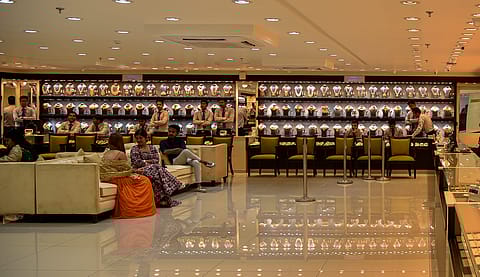
Kalyan Jewellers shares hit 52-week low of ₹390 on the BSE today | Credits: Special Arrangement
Kalyan Jewellers shares crack 25% in nine sessions, hit 52-week low; here’s why
Kalyan Jewellers shares have plummeted 25% over nine sessions, hitting a 52-week low due to a technically driven sell-off. The stock broke below key moving averages, indicating a strong bearish trend. Despite robust Q3 growth, the absence of fundamental triggers suggests continued pressure, with analysts warning of further downside if support levels are breached.
This summary is AI-generated, and Fortune India is not responsible for its content or any associated copyright issues.
Shares of Kalyan Jewellers India declined by as much as 13.64% to a 52-week low of ₹390 on the BSE today, dragging its market capitalisation to about ₹41,860 crore.
THIS STORY FEATURES
Kalyan Jewellers shares hit 52-week low of ₹390 on the BSE today | Credits: Special Arrangement
Shares of Kalyan Jewellers India saw sharp selling pressure on Wednesday, sliding nearly 14% to hit a fresh 52-week low, as the jewellery stock extended its losing streak for the ninth consecutive session. The stock has now eroded about 25% of its market value over the past nine trading days amid sustained selling.
During the session, the scrip fell by as much as 13.64% to a 52-week low of ₹390 on the BSE, dragging its market capitalisation down to about ₹41,860 crore.
The stock has corrected sharply in the near term, sliding nearly 23% in just two weeks, from the ₹520.75 level at the end of trade on January 7. The counter is down more than 35% from its 52-week high of ₹617.30 touched on July 24, 2025.
The sell-off can be attributed to the recent surge in gold prices, which have climbed to record highs of nearly ₹1.58 lakh per 10 grams, making jewellery significantly more expensive. This typically prompts mass and mid-market consumers to defer purchases, raising concerns about volume growth.
Stock breaks below 20–200 EMAs
Notably, the steep decline has come in the absence of any immediate negative fundamental trigger, suggesting a technically driven sell-off rather than a fundamental re-rating.
On the daily charts, Kalyan Jewellers has decisively broken below all key moving averages—the 20-, 50-, 100- and 200-day exponential moving averages (EMAs)—confirming a well-established downtrend. The latest breakdown was marked by a large bearish candle accompanied by a sharp rise in trading volumes, indicating aggressive unwinding by market participants.
According to Aakash Shah, Technical Research Analyst at Choice Equity Broking, the stock’s fall reflects strong bearish momentum and sustained institutional selling. He noted that Kalyan Jewellers has breached its earlier consolidation zone of ₹440–450, which now acts as a strong overhead supply area.
“As long as the price remains below this level, the broader trend bias stays bearish and any bounce should be viewed as corrective rather than a trend reversal,” Shah said.
He added that the EMAs are bearishly stacked and sloping downward, highlighting continued selling pressure and the absence of meaningful short-term support. “The combination of a decisive breakdown and expanding volumes suggests panic selling or aggressive institutional unwinding. The lack of any immediate fundamental trigger further reinforces the technical nature of the move,” Shah said.
On the downside, the ₹390–380 zone is seen as the immediate support area, where the stock is currently attempting to stabilise. However, analysts caution that a sustained break below this band could open the door to further downside, with no clear reversal signals visible at this stage.
Stock under pressure post Q3 business update
The stock has been under sustained pressure since January 8 even after its operational momentum remains firmly intact. For the quarter ended December 2025, Kalyan Jewellers reported around 42% year-on-year consolidated revenue growth, driven by robust festive demand and strong same-store sales growth across geographies. India operations clocked similar growth, supported by healthy demand during and after Diwali despite volatility in gold prices, while same-store sales rose a solid 27%, underscoring strong underlying consumption.
RANK
COMPANY NAME
REVENUE
(INR CR)
(INR CR)
{{#current-rank}} {{current-rank}} {{/current-rank}} {{^current-rank}} {{rank}} {{/current-rank}} {{name}} {{#revenue}} {{revenue}} {{/revenue}} {{^revenue}} {{noi}} {{/revenue}}
International markets also delivered a steady performance, with revenues growing about 36% year-on-year, led by the Middle East business. Overseas operations contributed nearly 11% to consolidated revenue, while the company’s digital-first brand Candere stood out with a sharp 147% surge in revenues, reflecting rapid scale-up and increasing traction in online and omni-channel jewellery retailing.
As of December 31, 2025, the company operated a total of 469 showrooms globally across India and international markets, comprising 318 Kalyan India outlets, 38 in the Middle East, two in the US, one in the UK, and 110 Candere stores.
(DISCLAIMER: The views and opinions expressed by investment experts on fortuneindia.com are either their own or of their organisations, but not necessarily that of fortuneindia.com and its editorial team. Readers are advised to consult certified experts before taking investment decisions.)

NEXT STORY