The FAQs are AI-generated, and Fortune India is not responsible for its content or any associated copyright issues.
Budget 2026: Railway stocks buck weak market as Budget pushes high-speed rail plans; Sensex, Nifty slide over 1%
/ 3 min read
RailTel Corporation of India Ltd emerged as one of the top gainers, rising 3.09% to ₹353.15, as investors bet on higher demand for telecom and digital infrastructure along the new rail corridors
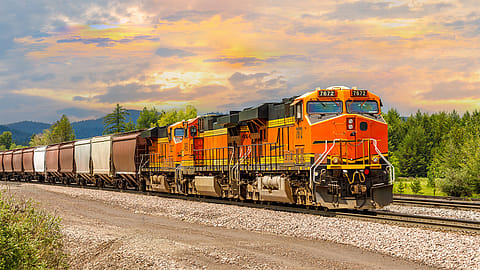
Credits: Shutterstock
Railway stocks traded higher after finance minister Nirmala Sitharaman announced plans to develop seven high-speed rail corridors in the Union Budget, even as broader market sentiment turned sharply negative. The proposed corridors—Mumbai–Pune, Hyderabad–Pune, Hyderabad–Bengaluru, Chennai–Bengaluru, Delhi–Varanasi, and Varanasi–Siliguri—are aimed at improving intercity connectivity, reducing travel time, and supporting economic activity across major urban and industrial regions.
Following the announcement, buying interest was seen across technology, wagon manufacturing, and railway PSU stocks. RailTel Corporation of India Ltd emerged as one of the top gainers, rising 3.09% to ₹353.15, as investors bet on higher demand for telecom and digital infrastructure along the new rail corridors. Rolling stock-related stocks also saw traction, with Titagarh Rail Systems Ltd climbing to ₹825 during the session, above its earlier quoted level of ₹814.
Passenger services provider Indian Railway Catering and Tourism Corporation Ltd traded higher as well, rising to ₹624 from ₹619.50, supported by expectations that faster and better connectivity could lift passenger movement over time.
Among railway PSUs, RITES Ltd gained 1.52% to trade at ₹228.61, tracking optimism around increased project execution and consultancy opportunities linked to large infrastructure plans. Indian Railway Finance Corporation Ltd, however, remained largely flat at around ₹120, reflecting a more cautious market view on near-term funding implications. In contrast, Rail Vikas Nigam Ltd slipped 1.03% to ₹337.95, underperforming the broader railway pack despite the positive sector-specific news.
Overall market sentiment weakens
The gains in railway stocks came even as overall market sentiment swung sharply negative. Investors turned risk-averse as they reassessed the Budget announcements and their immediate impact, triggering a broad sell-off in equities. The BSE Sensex plunged 1,087.43 points, or 1.32%, to 81,478.94, while the Nifty 50 fell 369.75 points, or 1.45%, to 25,049.15, highlighting the contrast between selective sector optimism and weakness in the wider market.
What was mentioned in the Union Budget 2026
Capex saw a bigger push as Sitharaman proposed 7 high-speed rail corridors across India and plans to operationalise 20 new national waterways over five years. Furthermore, the minister announced a 9% increase in public capital expenditure at ₹12.2 lakh crore.
She also announced a new dedicated freight corridor stretching from Dankuni in the East to Surat in the West.
Recommended Stories
“The roughly 9% increase in capital expenditure in this budget underlines the government’s sustained and consistent focus on infrastructure over the last decade, reinforcing continuity rather than signalling a one-off push,” said Raghav Madan, director, Deloitte.
Madan said that the budget outlines an encouraging and forward-looking vision for upgrading India’s logistics ecosystem. “Initiatives like the East–West Dedicated Freight Corridor have the potential to significantly improve freight movement across underdeveloped regions, while the planned operationalisation of 20 new national waterways over the next five years signals a long-term, integrated approach to multi modal logistics development," he said.
According to the Finance Minister, the seven high-speed rail corridors are part of efforts to boost connectivity and infrastructure in India. Key routes include: Mumbai to Pune; Pune to Hyderabad; Hyderabad to Bengaluru; Bengaluru to Chennai.
Additional corridors are planned under the Union Budget 2026–27 to boost regional connectivity further and drive economic growth across the country, while new waterways are aimed at strengthening inland water transport and improving logistics efficiency.
RANK
COMPANY NAME
REVENUE
(INR CR)
(INR CR)
{{#current-rank}} {{current-rank}} {{/current-rank}} {{^current-rank}} {{rank}} {{/current-rank}} {{name}} {{#revenue}} {{revenue}} {{/revenue}} {{^revenue}} {{noi}} {{/revenue}}
In her Budget speech, Sitharaman stressed infrastructure growth with a focus on Tier II and III cities. “We will continue to develop infrastructure in cities with over 5 lakh population, that is, Tier II and III cities,” she said.