India’s EV transition should follow the kilometres, not just the vehicle count
/ 3 min read
India has rapidly expanded its EV charging network and begun incentivising electric freight. The next opportunity is to put charging where high-utilisation commercial vehicles actually move, wait, and work.
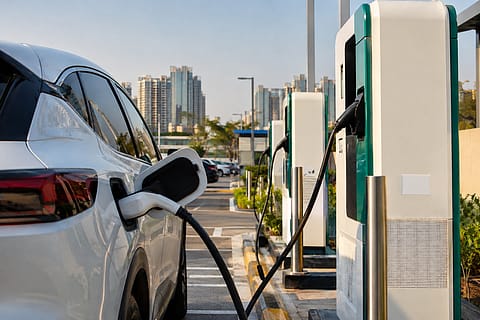
India now has more than 52,000 public EV charging stations, over 10 times the number recorded in 2022, according to the Institute for Energy Economics and Financial Analysis (IEEFA). That rapid expansion changes the question from scale to utilisation: not simply how many chargers India instals, but which vehicles they serve, where they are placed, and how intensively they are used.
A charger serving a lower-utilisation passenger vehicle and one supporting a truck travelling hundreds of kilometres a day do not deliver the same fuel-displacement, infrastructure-utilisation or energy-security value. Yet much of India’s early charging build-out has naturally followed passenger mobility focussed on two- and three-wheelers with low capacity chargers or private passenger vehicles that mostly charge at home.
Freight changes that equation. Trucks travel longer distances, operate for more hours and consume substantially more fuel than private vehicles. The Ministry of Heavy Industries has noted that diesel trucks constitute only around 3% of the vehicle population but contribute 42% of transport-related greenhouse-gas emissions. India, meanwhile, continues to depend on imports for roughly 88% of its crude-oil requirement. For freight, electrification therefore has an unusually high multiplier: one high-utilisation vehicle can displace diesel repeatedly, every day, across thousands of kilometres of annual movement.
Policy push
Policy has begun recognising that leverage. PM E-DRIVE provides direct incentives for electric trucks alongside ₹2,000 crore for public charging infrastructure. Delhi-NCR’s ₹9,585-crore PARIVARTAN scheme is designed to replace more than two lakh older trucks and buses, while replacement light goods vehicles in Delhi must be electric. From January 2027, Delhi will also begin phasing in restrictions on new registrations of conventional N1 light-goods vehicles.
The policy signal is becoming clearer: as commercial fleets electrify, charging infrastructure has to be designed around the operating logic of freight movements, not simply around the geography of passenger mobility.
A delivery van does not behave like a private car. It starts and ends its day around warehouses, mandis, transport nagars, distribution centres, and logistics hubs. Charging time affects route planning, asset utilisation and operating margins. Home charging, which works for many private-car owners, is simply not part of the equation for much of this market.
Yet much of our early charging architecture evolved around the needs of passenger mobility. The requirement for commercial fleets is different: infrastructure has to reflect where vehicles congregate, how long they dwell, the routes they repeatedly travel and the power available at those locations. This is the central implementation issue emerging from the freight ecosystem.
For urban freight, that points towards a cluster-first approach. Instead of viewing charging principally as points dispersed across a city, start with places where commercial demand is already concentrated. Map fleet movement and dwell time. Assess grid capacity. Then deploy the combination of charging speeds that those operating patterns require.
Infra planning
The same logic extends to highways.
A recent ICCT assessment of Delhi’s Sanjay Gandhi Transport Nagar estimated that the terminal could require 1.8–2.3 MW of installed charging capacity by 2030, rising substantially thereafter as electric-truck adoption grows. Kerala is now applying corridor-level planning to NH-66, mapping charging needs against freight movement along a 622-km route connecting ports, industrial clusters and urban centres.
These examples illustrate what freight electrification demands: transport planning and power planning have to happen together.
{{#most-powerful-women-snapshot-individual.slug}} {{/most-powerful-women-snapshot-individual.slug}} {{^most-powerful-women-snapshot-individual.slug}} {{/most-powerful-women-snapshot-individual.slug}} {{#showRanking}} {{current-rank}} {{/showRanking}} {{#photo.0.url}}
{{name}}
Fleet operators determine vehicle demand. Discoms determine connection timelines and power availability. Public agencies influence land and permits. OEMs shape vehicle deployment. Charging operators need sufficient utilisation to make infrastructure viable. Financiers need confidence that both vehicles and charging assets will be used.
If those decisions happen independently, infrastructure can arrive before demand, or vehicles can arrive before power.
Cluster- and corridor-level working groups can help turn that complexity into a sequence: aggregate vehicle demand, identify suitable locations, establish expected power requirements, address land and connection constraints early, and align fleet deployment with infrastructure readiness.
There is a commercial logic to this as well. Charging assets work better when they are used. Freight fleets provide something particularly valuable to charging operators: concentrated and relatively predictable demand. Designing infrastructure around that demand can improve charger economics while giving operators greater confidence that the infrastructure they need will be available.
India’s EV transition has therefore reached a point where charger counts alone tell us less than they once did.
The more useful question is increasingly: How much reliable power is available at economic nodes where charging can actually happen? This shift also inherently addresses the volume of vehicles supported, the distances they can travel, and the corresponding diesel replaced.
For freight, answering that question could bring three ambitions together, cleaner cities, more resilient logistics and greater energy security.
The next generation of charging infrastructure should therefore begin not with the map of where chargers can be installed, but with the map of where freight actually moves, and where trucks actually stop.
(The author is Lead, Freight Decarbonisation Initiative, Sattva Consulting. Sayak Ray and Kevin Abraham, Sattva Consulting contributed to the article. Views are personal.)
Follow Fortune India
NEXT STORY