GTC 2026: Nvidia pegs $1 trillion AI opportunity as Jensen Huang outlines next phase
/ 2 min read
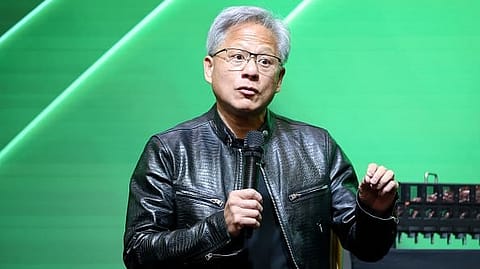
Nvidia CEO Jensen Huang | Credits: Getty Images
GTC 2026: Nvidia pegs $1 trillion AI opportunity as Jensen Huang outlines next phase
Nvidia CEO Jensen Huang announced at GTC 2026 that the company anticipates $1 trillion in AI chip sales by 2027, doubling its previous estimate. This surge is driven by the shift from AI model training to deployment, requiring continuous compute power. The new Vera Rubin platform and Groq technology chip aim to meet this growing demand.
This summary is AI-generated, and Fortune India is not responsible for its content or any associated copyright issues.
The CEO also announced future roadmaps, collaborations and products at Nvidia's annual event
Nvidia CEO Jensen Huang | Credits: Getty Images
Nvidia expects to generate up to $1 trillion in AI chip sales by 2027, CEO Jensen Huang said at the company’s GTC 2026 keynote, doubling its earlier estimate of $500 billion.
“Through 2027, there’s about a trillion dollars’ worth of data centre infrastructure build-out,” Huang said, pointing to ongoing deals and customer demand. The revised estimate comes as companies move beyond building AI models and start deploying them at scale.
Shift in demand as AI moves into deployment
For the last two years, spending has largely gone into training large AI models. Nvidia now sees the next wave coming from running those models continuously.
“The inference inflection has arrived,” Huang said. Unlike training, which happens in cycles, deployed AI systems require constant compute. That changes the nature of demand. It becomes ongoing rather than project-based. Nvidia said this shift is already visible in customer conversations and infrastructure orders.
Vera Rubin platform designed for scale
At the centre of the keynote was the Vera Rubin platform, Nvidia’s next-generation system. It combines CPUs, GPUs and networking into a rack-level setup instead of treating them as separate components. Each rack includes 72 GPUs and 36 CPUs.
The idea is straightforward: build systems that can handle large, continuous workloads without being pieced together across different layers. Rubin will follow the current Blackwell generation and is expected to handle both training and deployment workloads.
New inference chip using Groq technology
Nvidia also introduced a new inference-focused chip built using Groq technology. The Groq 3 LPX chip is expected later in 2026 and will be integrated into Nvidia’s systems to improve response speeds and efficiency.
The inclusion of external technology is notable, given Nvidia typically builds its own stack. The move suggests growing pressure to optimise performance, especially for real-time use cases.
{{#most-powerful-women-snapshot-individual.slug}} {{/most-powerful-women-snapshot-individual.slug}} {{^most-powerful-women-snapshot-individual.slug}} {{/most-powerful-women-snapshot-individual.slug}} {{#showRanking}} {{current-rank}} {{/showRanking}} {{#photo.0.url}}
{{name}}
What are Rubin and Feynman architectures?
The company extended its roadmap with Rubin in 2026 and Feynman in 2028. These systems are expected to handle higher compute intensity while improving efficiency across large-scale deployments.
AI agents become part of the pitch
Nvidia also spent time on AI agents, positioning them as a next step for enterprise use. The company announced OpenClaw, an open framework for developing autonomous AI systems, and NemoClaw, an enterprise version with added security features.
Huang said AI systems are beginning to handle more complex tasks, including reasoning and multi-step execution, rather than just responding to prompts.
How has Nvidia fared in the previous year?
Nvidia pointed to its recent performance to back its projections. The company reported $192 billion in data centre revenue over the past year, with a large share coming from cloud providers. It also indicated that orders tied to its Blackwell and Rubin systems could reach up to $1 trillion over the next few years.
Expanding beyond core data centres
Beyond infrastructure, Nvidia highlighted work in gaming, robotics and large-scale AI systems. This includes updates to its graphics stack, as well as tools for simulation and automation.
These segments are expected to add to demand for Nvidia’s computing platforms.
Follow Fortune India
NEXT STORY