
As phase II expansion progresses in Vizhinjam Seaport, Kerala plans industrial ecosystem development to boost economy, create jobs
ADVERTISEMENT
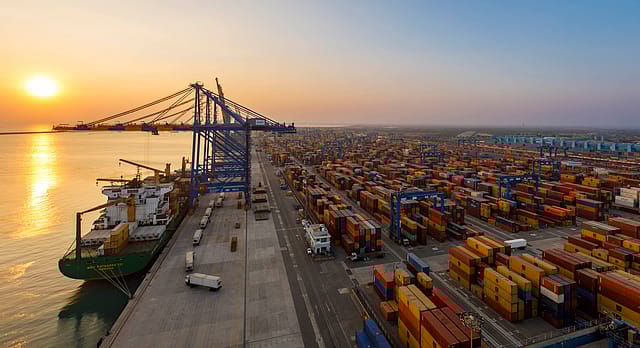
Vizhinjam International Seaport Ltd (VISL), the Kerala State government entity that has partnered with Adani Ports and Special Economic Zone Ltd (APSEZ) to build and operate India’s first mega transshipment container terminal in Vizhinjam near Thiruvanthanapuram, is planning to acquire about 800 to 1000 acres of land to develop an industrial ecosystem that leverages Vizhinjam port to benefit the state economy and create local jobs. VISL expects the acquired land parcels, once readied to be allotted to the industry can attract Rs 100,000 crore of fresh investments in the next five years. “Logistic infrastructure on the land and marine side infrastructure on the coastline in the neighbourhood of the port is what VISL is aiming at”, says Sreekumar K Nair, CEO, VISL.
In an exclusive interaction with Fortune India, Nair said the land area available for industrial ecosystem development could be more as VISL is expecting other government entities like Kerala Industrial Infrastructure Development Corporation (KINFRA) also to pitch in. “Between all of us, we have set a target of at least 3000 acres. It need not be next to the port alone, as long as we have connectivity for smooth container movement”, he says. According to Nair, the Central government can also play a major role in ensuring last mile connectivity to the port as in the case of Vadhavan port development in Maharashtra where National Highway Authority of India (NHAI) and Indian Railways have committed Rs 6,000 crore to provide seamless last mile connectivity even at its planning stage.
The first phase of Vizhinjam port, commissioned in December last year and dedicated to the nation by Prime Minister Narendra Modi in May 2025, is considered to be one of the world’s most modern container transshipment ports. In the last one year it has handled about 1.3 million Twenty-foot Equivalent Unit (TEU) containers against a Phase I capacity of 1 million TEUs. Adani Ports and Special Economic Zone Ltd (APSEZ), the private partner that is responsible for the development and management of the port has already started the work on Phase II development, which is expected to be completed and commissioned by December 31 2028. Nair says that APSEZ has used the most modern port equipment and technology so that even with the original physical infrastructure, the handling capacity has gone up beyond the nameplate capacity. “When I say nameplate capacity is currently 1 million TEU, about 1.4 or 1.5 million TEU can be handled. So though the upcoming capacity will be 3 million TEU, it can easily handle up to 4.5 to 5 million TEUs per annum”, he said.
While Vizhinjam port is doing extremely well in terms of transshipment business, economic benefits for the State depend on the ecosystem that can leverage its presence.
“What is happening now is transshipment. Some vessel from some corner of the world carrying somebody’s cargo will bring it and place it here, and take it from here. When we talk about 1.3 million TEUs handles in 13 months, the reality is that 70% of this cargo movement has nothing to do with India. This cargo is mostly from China, going to either Africa, or to Bangladesh, or the GCC countries, or to any the 100 plus ports across the world. All Indian Ocean countries are today getting benefited by Vizhinjam port. The port has become a reality, and our next priority is to see how best we can leverage the port for the benefit of the State economy, and to create large scale employment”, Nair said.
“Today, a consignment of shrimp loaded in Vallarpadam, Kochi to the East Coast of US takes 66 days to reach New York or Houston. The same will take 26 days from Vizhinjam. For an industrialist, for an exporter, time is money. 66 days v/s 26 days, it is a game changer. But there is nothing on the land side in Vizhinjam to support this. No warehouses, no empty container yards. No system to plug and charge reefer (refrigerated) containers. That is what we are trying to do now”, he explains.
Nair highlights the business opportunity bunkering and ship repairing offers and illustrates with the example of Singapore port, the world’s largest bunkering hub. “India imports 250 million tonnes of crude oil every year for our domestic consumption. Singapore imports 50 million tonnes of processed fuel for ships. A city state, which is three times the area of Trivandrum City Corporation, is importing 20% of India’s annual oil import for fueling the ships. We have a bigger advantage than Singapore because we are sitting bang on the world maritime highway (just 10 nautical miles away). Bunkering itself can attract vessels here. So there could be opportunities for bunkering”, he says. Nair also points out that in the last three months, three vessels developed mechanical problems while they were at the berth. “We have limited berth length of 800 metres. They had to be kept here for almost 20-25 days, which means productive time lost. So we need a roadside repair fellow who will repair the ship. We have no repair facilities,” he said.
It is not that the governments both Centre as well as State are not aware of the potential of Vizhinjam and the role it can play in improving the export competitiveness of goods from the country. In fact, Maritime India Vision (MIV) 2030, the comprehensive roadmap to transform the nation into a global maritime leader by modernizing ports, boosting shipbuilding, expanding waterways, and focusing on sustainability talks about the infrastructure development that needs to happen in the ports sector across the country, including Vizhinjam. “This is all there in the Maritime India Vision document. It is between the state and centre to discuss this and find solutions. We are sitting on a gold mine. We need to realise it. The story is not just about a port, it is about port led transformation to the country’s economy,” Nair says.