
Budget 2026: FM Sitharaman announces five-part support programme for labour-intensive textiles
ADVERTISEMENT
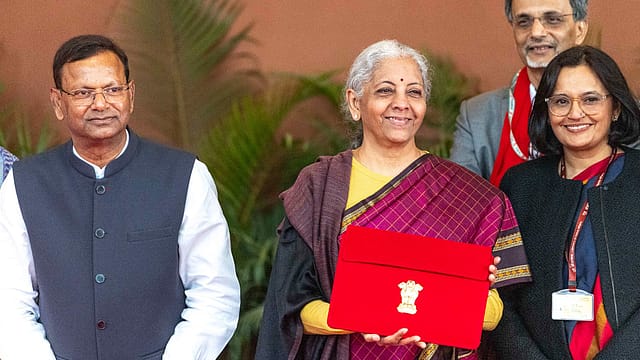
With a clear signal to labour-intensive industries, finance minister Nirmala Sitharaman today announced an integrated, multi-pronged push for the labour-intensive textile sector as she presented her 9th Union Budget. The measures, aimed at employment generation, modernisation, sustainability, and global competitiveness, formed one of the key sectoral announcements of the Budget.
“For the labour-intensive textile sector, I propose an integrated programme with five sub-parts,” Sitharaman said in her Budget speech. The programme begins with a national fibre scheme focused on self-reliance across natural fibres such as silk, wool and jute, alongside man-made and new-age fibres.
The second component is a textile expansion and employment scheme to modernise traditional clusters. This will include capital support for machinery, technology upgradation, and the creation of common testing and certification centres, a move expected to help smaller units improve quality and scale.
The sector remains one of India’s largest employers, particularly in rural and semi-urban areas, and the focus on textiles set the tone for a Budget pitched as growth-oriented but employment-aware.
At the heart of the proposal is a National Fibre Scheme to boost self-reliance across natural fibres such as silk, wool, and jute, alongside manmade and new-age fibres. Sitharaman said this would be complemented by a Textile Expansion and Employment Scheme to modernise traditional clusters through capital support for machinery, technology upgradation, and common testing and certification centres.
She also announced a National Handloom and Handicraft Programme that will integrate existing schemes and provide targeted support to weavers and artisans. “This will ensure focused assistance to those who form the backbone of our textile ecosystem,” she said.
Sustainability and skills featured prominently. The finance minister proposed a Text-eco initiative to promote globally competitive and sustainable textiles and apparel, along with Samarth 2.0 to upgrade the skilling ecosystem through closer collaboration between industry and academic institutions. In a move aimed at scale and value addition, she said the government will set up mega textile parks in “challenge mode”, with a specific emphasis on technical textiles.
Beyond factories and clusters, Sitharaman extended the focus to village industries and crafts. She announced the launch of the Mahatma Gandhi Gram Swaraj Initiative to strengthen khadi, handloom, and handicrafts through better training, skilling, quality processes, and production systems. “This will help in global market linkage and branding,” she said, adding that the initiative would benefit weavers, village industries, the one district, one product (ODOP) programme, and rural youth.