
Fortune India Banking & NBFCs Summit 2026: Strong banks key to PM Modi’s vision of 50 Indian firms among Fortune Global 500, says Shashwat Goenka
ADVERTISEMENT
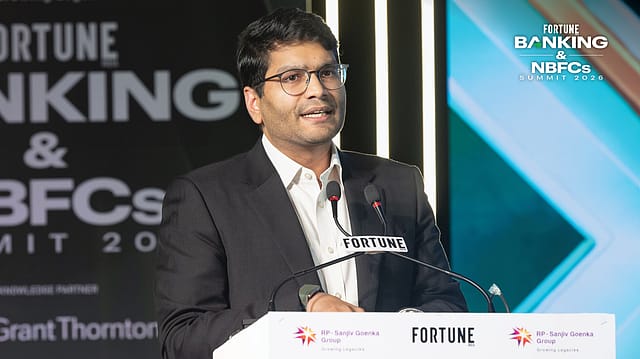
Indian banks will need to become stronger and provide long-term capital to help domestic businesses scale up and compete globally, Shashwat Goenka, vice chairman of the RP-Sanjiv Goenka Group, said, linking the banking sector's role to Prime Minister Narendra Modi's ambition of having 50 Indian companies on the Fortune Global 500 list within the next decade.
Speaking at the Fortune India Banking & NBFCs Summit 2026, Goenka said Indian companies would need financial institutions capable of funding their growth over longer periods, particularly as the country expands its manufacturing, infrastructure, renewable energy, and technology sectors.
“Indian companies will not get there without Indian banks that are big enough and strong enough to back them,” Goenka said.
Prime Minister Narendra Modi, in his Independence Day address on August 15, 2026, called for India to aim for 50 companies on the Fortune Global 500 list over the coming decade. He also said India should have a bank among the world's five biggest banks and called for Indian pharmaceutical, technology and professional services companies to emerge as global leaders.
“It is an ambition that I share,” Goenka said, referring to the target. He added that the question was whether India could build institutions capable of financing the country's growth over the next two decades, rather than focusing only on shorter-term needs.
“The real question for all of us is whether we can build institutions that finance India's growth for the next 20 years and not just for the next five,” he said.
Long-term capital a key challenge
Goenka identified the availability of patient capital as one of the challenges facing Indian businesses, particularly in sectors where investments take years to generate returns.
“Building 20-year companies with five-year money is a challenge India has still not fully solved,” he said.
He cited the energy transition, manufacturing, infrastructure and data centres as areas that would require long-term financing. The need, he added, extended beyond large companies to smaller businesses looking to expand.
“India has lakhs of small businesses that could become medium-sized ones. But what they need most is capital that is patient enough to back their journey from small to medium,” Goenka said.
He said banks would play an increasingly important role as Indian businesses sought to compete in global markets.
Banks remain central to growth
Goenka said banks continued to be the primary source of financing for Indian businesses, despite the development of equity and bond markets.
“Of every rupee that reached Indian businesses last year, 62 paise came from banks,” he said.
He also pointed to the improvement in asset quality, noting that gross non-performing assets stood at 1.8%, which he described as a multi-decade low. The improvement, he said, reflected years of discipline across the banking sector.
However, Goenka stressed that the sector would need to balance expansion with sound governance and risk management.
“In banking, good governance is not a cost. It is what customers are actually buying,” he said, adding that trust remained central to the financial system.
“Trust is the one asset that never appears on a balance sheet. It is slow to build and quick to lose,” he said.