
Fortune India Exclusive: Smartworks shifts gear from co-working to enterprise-scale office infrastructure
ADVERTISEMENT
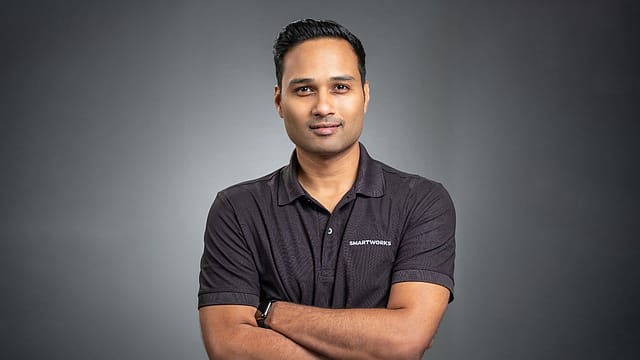
As India’s flexible workspace market enters a more mature phase, Smartworks Coworking Spaces is repositioning itself from a conventional co-working operator to a builder of enterprise-scale office infrastructure. The company is increasingly targeting 300-plus and even 1,000-plus seat mandates, deliberately moving away from smaller, short-term occupiers to create what it describes as enterprise-grade managed campuses.
“We don’t see ourselves as a co-working company. We are building enterprise infrastructure. Our sweet spot is 300-plus seats, and increasingly 1,000-plus seat mandates,” said Harsh Binani, whole-time director & co-founder, Smartworks, in an exclusive interaction with Fortune India.
For Binani, the opportunity extends well beyond incremental growth in shared workspaces. He views the rise of managed office infrastructure as a fundamental shift in the way enterprises strategise, consume and manage real estate, marking a long-term structural transformation rather than a cyclical trend.
“This is a structural shift similar to what IT outsourcing was two decades ago. We are just at the tip of the iceberg. Even at current penetration levels, India could add nearly a billion square feet over the next 20 years,” Binani said.
Today, Smartworks operates over 15.3 million square feet across 63 centres in 15 cities in India and Singapore. Its clientele includes more than 770 enterprises, ranging from Fortune 500 companies and multinational corporations to Global Capability Centres (GCCs) and high-growth startups. The breadth of its client base underscores its transition from flexible desks to full-scale enterprise campuses.
Enterprise infrastructure, not co-working
Unlike traditional co-working operators that depend heavily on small teams and hot desks, Smartworks focuses on mid-to-large enterprises. Large-format contracts — 300-plus seats and increasingly 1,000-plus seats — typically come with longer lock-ins and tenures, enhancing revenue visibility and reducing volatility.
The strategy is already reflecting in its revenue mix. The 1,000-plus seat cohort now contributes around 35% of rental revenue, reinforcing the annuity-like character of the company’s income profile. Bigger mandates also allow Smartworks to design integrated campuses with amenities that rival Grade A office developments.
“When you take very large campuses, you can create highly amenitised workspaces while bringing down costs to a level that becomes a no-brainer for enterprises,” he said.
Binani explained that Smartworks typically signs long-term agreements with landlords, invests in large-format campuses, and then onboards enterprises that take up hundreds — often thousands — of seats at a single location. This scale-driven approach, he argues, differentiates the company from smaller co-working operators that rely on fragmented occupancy.
Macroeconomic tailwinds boosting demand
India’s macroeconomic backdrop is further accelerating this shift. The rapid expansion of GCCs is driving demand for ready-to-move-in, professionally managed office infrastructure.
“India is becoming an attractive destination for global companies to set up GCCs. At the same time, commercial real estate supply has not kept pace with demand. In totality, we are seeing an unprecedented surge,” he said.
Despite managed offices accounting for only about 10% penetration of India’s overall office stock, he believes the runway is immense.
“If 10% penetration can be achieved in less than a decade, imagine where this can go. Even if penetration doesn’t increase significantly, India could add nearly a billion square feet over the next 20 years. That’s the equivalent of building a new New York,” he said.
Financial performance and profitability
Smartworks recently reported profitability on a reported basis, though Binani emphasised that the business has been cash profitable for years.
“We have been cash profitable for the last five years and have even paid income tax. Earlier reported losses were largely due to accounting provisions under Indian accounting standards, which required upfront non-cash adjustments as we expanded rapidly,” he explained.
For the October–December quarter (Q3 FY26), the Gurugram-based company reported a net profit (PAT) of ₹1.2 crore, a sharp turnaround from a loss of ₹16 crore in the year-ago period and a loss of ₹3.1 crore in Q2 FY26. It marked Smartworks’ first profitable quarter under Ind AS accounting standards — a milestone that signals operational maturity.
Total income in Q3 FY26 rose 34% year-on-year to ₹488.14 crore, compared with ₹363.62 crore in the same quarter last fiscal, reflecting higher occupancy and the contribution of large enterprise mandates.
With older campuses stabilising and contributing to operating leverage, margins are expanding structurally. “Earlier, new campuses would temporarily dilute margins. Now the base has matured enough that new additions are not dragging margins. You will see margin expansion quarter after quarter,” he said.
EBITDA touched an all-time high of ₹85 crore in the December quarter, with margins expanding to around 18%.
“This is not a one-off quarter phenomenon. It’s structural compounding,” Binani said.
Following its IPO fundraising of ₹582 crore in July 2025 — including a fresh issue of ₹445 crore — Smartworks has strengthened its balance sheet and turned net debt negative.
“We don’t need additional capital to scale. We can continue compounding our footprint organically,” he added.
Asset-light and tech-driven model
The company operates an asset-light model, leasing large campuses rather than owning real estate — a strategy aimed at mitigating asset-liability mismatches.
“One of the biggest risks in this sector globally has been asset-liability mismatch. We eliminated that risk early on,” Binani said, adding that long-term enterprise contracts provide earnings visibility.
Technology underpins execution. Smartworks has built an in-house full-stack platform spanning CRM, AI-led supply identification, design-to-build execution and client-facing applications.
“Technology has been transformational. It enables us to deliver offices in 90 days and manage operations efficiently at scale,” he said.
Long-term outlook
Looking ahead, Binani expects sustained 30% revenue growth, with margins expanding faster due to operating leverage. The company aims to scale to 30 million square feet over the next few years, adding roughly 3 million square feet annually.
“We believe the next decade is golden. We are at the tip of the iceberg. As India develops and office penetration rises, platforms like Smartworks will benefit disproportionately,” he said.
Calling the model an annuity-based cash flow business, he added, “Get large enterprises, expand with them across India, maintain cost discipline, and the financial metrics will continue strengthening. These are very exciting times for us.”