
Google announces $17+ million in AI, health and clean energy partnerships in India
ADVERTISEMENT
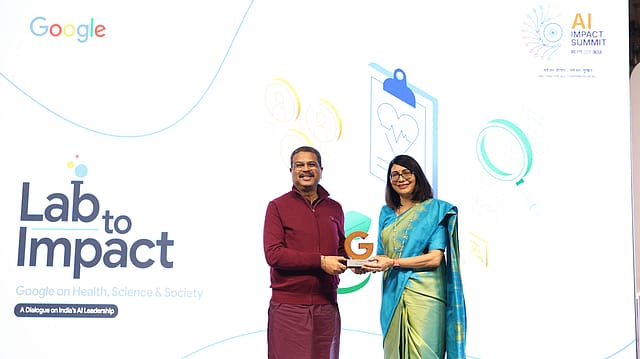
Google has significantly deepened its bets on India’s AI ecosystem, committing fresh funding across healthcare, agriculture, education, language technologies, and clean energy, as it positions the country as a key pillar of its global AI strategy.
At its ‘Lab to Impact’ dialogue in New Delhi today, the company announced a series of financial commitments totalling over $17 million, alongside new partnerships with government bodies, research institutions, startups, and energy companies.
Govt-backed AI Centres of Excellence
A key announcement was Google.org’s $8 million funding support for four AI Centres of Excellence set up by the government - focused on health, agriculture, education, and sustainable cities. The centres include TANUH at IISc Bengaluru for non-communicable diseases, Airawat Research Foundation at IIT Kanpur for urban governance, IIT Madras for education-focused AI, and ANNAM.AI at IIT Ropar for agriculture and farmer welfare.
“India is approaching artificial intelligence as a strategic national capability, not as a short-term technology trend,” said Union education minister Dharmendra Pradhan who attended the event along with senior executives from Google and Google DeepMind.
He added that the Centres of Excellence are part of a coordinated national research mission aligned with India’s long-term development goals, including Viksit Bharat 2047.
Google also announced a $2 million founding contribution to establish an Indic Language Technologies Research Hub at IIT Bombay, aimed at strengthening AI systems for India’s linguistic diversity. The hub has been set up in memory of Professor Pushpak Bhattacharyya, a pioneer in Indic language research.
Healthcare focus
Healthcare emerged as a central theme in Google’s announcements. The company said it will provide $400,000 to support the development of India-specific Health Foundation Models, using its MedGemma framework. As part of this effort, Ajna Lens will work with AIIMS experts to build AI models for dermatology and outpatient triaging, while IISc researchers will explore broader clinical applications.
Google is also working with the National Health Authority to convert millions of unstructured medical records into the globally recognised FHIR format, a move expected to reduce documentation burdens and support data-driven public health policy. In addition, over 400,000 NHA-registered hospitals, clinics, and diagnostic labs will be listed on Google Maps and Search.
“At the National Health Authority, our approach to AI is rooted in public value,” said NHA CEO Sunil Kumar Barnwal. “We are using it to improve access, quality, and efficiency of healthcare.”
Backing startups
Beyond healthcare, Google is expanding support for developers and startups building India-centric AI models. It announced $50,000 grants each for Gnani.AI and CoRover.AI, and another $50,000 grant to IIT Bombay for creating an India-centric trait database using Indic language health and policy documents. All 22 of Google’s open Gemma models have also been uploaded to AIKosh, the India AI Mission’s platform.
In the social impact space, Google.org is providing $4.5 million in funding to Wadhwani AI. This includes $2.5 million to pilot HealthVaani, a multilingual AI assistant for ASHA and Anganwadi workers, and $2 million to develop Garuda, an Indian language model for agriculture that will power the AgriVaani app for farmers.
Separately, Google announced a partnership with ReNew Energy to support a new 150 MW solar project in Rajasthan. Under the agreement, Google will receive environmental attribute certificates to offset emissions across its value chain.
“Long-term agreements of this kind are catalytic, they enable new renewable capacity, support India’s energy transition and help global companies meet ambitious sustainability commitments,” said Vaishali Nigam Sinha, co-founder & chairperson, Sustainability, ReNew.
The deal builds on Google’s earlier renewable energy partnerships in India that added 186 MW of wind and solar capacity.
“From foundational research to scaled deployment, our full-stack approach is equipping India to lead a global AI-powered future,” said Manish Gupta, senior research director at Google DeepMind.