
How EESL—the poster boy of India’s energy efficiency efforts—fell into debt trouble
ADVERTISEMENT
It all circles back to the same question. Must the government really be in the business of doing business?
After all, if anything, the rise and decline of EESL—once India’s poster boy for energy efficiency efforts—only serves as a reminder of the intricacies of doing business with governments and by the government. The Noida-headquartered company, which operates companies such as Convergence Energy Services Limited (CESL) and IntelliSmart Infrastructure, is struggling with massive debt that has spiralled out of control and is now seeking suitors for its lucrative businesses to pare it down.
This, after many years of playing a crucial role in helping to bring down the costs of items that improve energy efficiency. Set up as a joint venture between four public sector entities—NTPC Limited, Power Finance Corporation, Rural Electrification Corporation, and Power Grid Corporation of India—EESL’s job was to identify areas where energy savings are feasible and then throw its weight behind them.
The company was instrumental in driving an LED lamp boom in India, bringing the price of LED lamps from ₹310 to ₹38 apiece. EESL procured bulbs in bulk from private companies and sold them to state governments, thereby achieving economies of scale and lowering prices for consumers over time. The 16-year-old company had previously done the same with fans and irrigation pumps, too. The much-celebrated LED revolution then paved the way towards electric cars and smart meters.
EESL’s mandate was simple. Wherever there were opportunities for energy savings and efficiency, the company would step in to develop, implement, and finance energy-efficiency projects, often using a performance-based model in which payment is based on guaranteed energy cost savings and reduces upfront capital costs. Of course, it also worked with a demand aggregation-price crash model, such as in the case of LED lamps. The growth potential for the company was so staggering that in 2017, EESL had an investment outlay of ₹42,700 crore for the five years between 2017 and 2022.
But all that seems to have withered away, and mounting debt has pushed EESL into something of a letdown in the $12 billion energy-efficiency market. As of March 31, 2025, EESL’s total outstanding long-term borrowings stood at ₹6,044.9 crore, down from ₹7,069.68 crore in the year-ago period. The company is now gearing up to sell IntelliSmart, its smart meter arm, at an enterprise valuation of around $723 million. EESL holds a 49% stake in the company, and the deal is expected to be completed by February or March this year. EESL did not respond to queries from Fortune India.
How did the trouble begin?
Much of EESL's financial trouble dates back to 2019.
Back then, the company was riding high on a massive push from the Narendra Modi government, which was unlocking reforms across sectors after being sworn into power in 2014. For EESL, which had been stuck in a quagmire for five years before the Modi government came to power, the government's push towards energy efficiency and clean energy provided a new lease of life. EESL, which began operations in 2009, reported revenues of only ₹26 crore in 2013-14.
By January 2015, the Modi government launched the UJALA scheme, a flagship programme to distribute 770 million LED lamps by March 2019, across 100 cities, along with energy-efficient fans. A decade later, the government estimates that the programme has successfully delivered 360 million LED lamps. Soon, the programme extended to fans, air conditioners, motors, induction cookers, and tube lights.
Then, as electric vehicles became the flavour of the automobile industry, EESL began by setting up 200 charging stations for electric cars across Delhi and invited tenders to deploy 2,000 charging units across India. The company was also tasked with kick-starting the country's electric vehicles journey when it was tasked with acquiring EVs for the Indian government. A tender process saw home-grown automakers Mahindra and Tata vying to sell electric vehicles, and, in many ways, paved the way for the country's electric vehicles revolution.
In 2018, the company forayed overseas, acquiring UK-based Edina, a supplier, installer, and maintenance provider for combined heat and power (CHP), gas, and diesel power generation solutions in the UK.
The £55 million (₹493 crore) acquisition was the first-of-its-kind venture by an entity under the Ministry of Power. At that time, EESL had set a goal to become a $1.5 billion (₹10,000 crore) company by 2020. By 2019, EESL's revenues grew from ₹708 crore in 2016 to ₹1,837.6 crore, and the company also forayed into the smart meter programme, looking to replace as many as 25 crore meters across the country.
But 2019 also brought with it some difficult times. Regime changes in Rajasthan and Andhra Pradesh, two of the largest markets for EESL, where the company had invested significant funds in street-lighting programmes, had begun to delay payments. “The governments in both states changed, and they stopped paying up,” a senior official who was closely associated with EESL tells Fortune India. “They stopped paying up. And that’s where the problems started. We had about 3 million street lights in AP, and the payment stopped.”
Soon after, Covid-19 hit, and with the state government's attention shifting to managing the pandemic, EESL's revenues were severely impacted. In the meantime, the company had also decided to separate its business into three key subsidiaries: CESL, which would focus mainly on EVs and solar energy; IntelliSmart, a joint venture with NIIF (National Investment and Infrastructure Fund), which would focus on smart meters; and Energy Pro, the UK-based entity.
“The company’s total receivables have gone up significantly from ₹3,194 crore, as on March 31, 2021, to ₹3,482 crore as on March 31, 2022, and it has further increased to ₹3,826 crore, as on September 30, 2022, reflecting continued delays in the realisation from the customers especially the Urban Local Bodies (ULBs) and state power distribution utilities (DISCOMs),” ratings agency CareEdge said in a report in 2022, highlighting the growing difficulty EESL faced in collecting receivables.
It also didn't help that Saurabh Kumar, who had a long tenure as EESL's managing director and, in many ways, was the man responsible for the growth of the company, left it after being elevated to vice chairman. Kumar, a former Indian Revenue Service officer, took over as the managing director of EESL in May 2013.
“Most of the street light projects are now closed,” says the former official of EESL. “So, there is no turnover. And once you get into that mode and you don't do any new work, it all slides down because you have heavy establishment costs, and that's what is happening right now.” Since it began operations, EESL’s street light programme has helped install 1.32 crore lamps, resulting in energy savings of around 8.85 billion kWh per year, a reduction in peak demand of around 1,475.19 MW, and an estimated emission reduction of 6.10 million tonnes of CO2 per year.
What’s the way out now?
Today, the heydays of EESL seem well past it. In 2025, the group's consolidated turnover stood at ₹1,686 crore, down from ₹1,968 crore in 2024. Losses swelled to ₹596 crore against losses of ₹459 crore in the year-ago period.
Among its subsidiaries, EESL EnergyPro made a loss of £1.4 million against a loss of £3.3 million in 2024. CESL’s revenue stood at ₹55 crore in 2025 against ₹50 crore in the year-ago period, while profits stood at ₹64.58 lakh in 2025 as against ₹7.16 crore in the year-ago period. IntelliSmart had total revenues of ₹621 crore with profits of ₹12 lakh.
Now, EESL is planning to sell its stake in IntelliSmart, in a market where private-sector companies are vying to gain a foothold in the smart meter segment. Manufacturers of smart electric meters will see their revenue grow by around 20% this fiscal to touch ₹9,000 crore, according to ratings agency Crisil. EESL is also reportedly planning to exit three other joint ventures: NEESL, a JV with Neev International APS; Energy Efficiency Services Co Ltd, Thailand; and Energy Efficiency Services LLC (UAE) to streamline operations.
“EESL has not made itself amenable to anything in the last four and a half years,” the former official added. “They have done nothing, despite all the opportunities. But selling lucrative businesses certainly is not the solution; it’s a short-sighted approach because in the next few years, you will make a lot of money from the smart meters.”
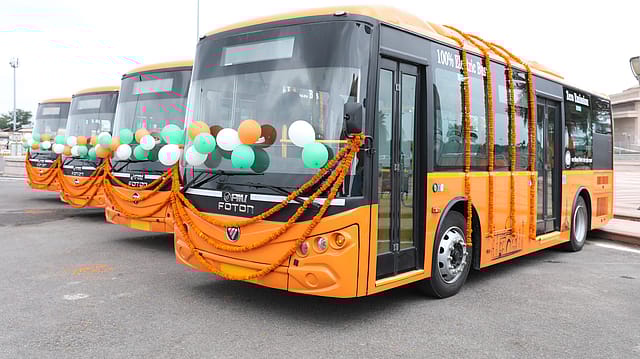
EESL's arm, CESL, is currently in the midst of carrying out the PM E-Drive scheme. The scheme provides upfront subsidies to EV buyers at the time of purchase, and CESL is procuring over 10,000 buses under the E-Drive scheme. “EESL’s problem is also about ownership,” the official adds. “There are four PSUs involved, and the ministry has failed in finding a leader that’s really needed,” the official adds. “As far as the debt goes, it is only a problem that can be solved in 15 days, especially if the government takes an active interest.” Alongside the e-buses, CESL will also be procuring about 5,500 e-trucks.
“Debt protection metrics remain weak, with adjusted interest coverage ratio less than 1 time owing to negative operating profitability,” Crisil said in a report in March last year. “Further, the company remains exposed to refinancing risks on account of large repayment over the next two fiscals. Hence, timely collection of billings/previous dues and regular equity infusion remain critical.”
Of course, being a public sector company also means that government-guaranteed long-term lines from multilateral agencies are expected to be adequate to fund most of the upcoming capex. “Internal cash accrual, unencumbered cash and equivalents, and the ability to raise funds should adequately cover debt obligations and incremental working capital requirements over the medium term,” Crisil noted about EESL last year.
But even if all of that helps tide over the storm, the bigger question remains. Has EESL withered away an excellent opportunity to rewrite India’s energy efficiency programme while building an outlier of sorts in the public sector? The answer most certainly will be a resounding yes.