
How IndiGo flew to become India’s largest airline in two decades
ADVERTISEMENT
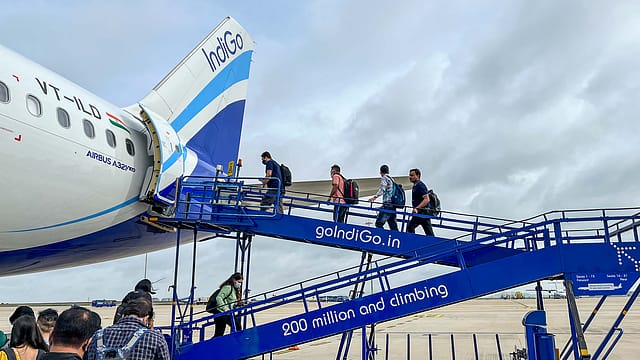
In some ways, it’s an anomaly of sorts. Or perhaps, an exception even.
But in one of the world’s most brutal skies, it’s nevertheless remarkable that the Gurugram-headquartered IndiGo has held its ground for two decades, even as many others around it folded up, to emerge as India’s largest airline by size and market share. Next week, the airline completes two decades in aviation, making it one of the oldest airlines in India, and its most profitable one too.
“What began as an ambitious vision to democratise air travel and make flying affordable and accessible to millions has evolved into one of the world’s leading aviation enterprises, closely aligned to the nation’s growth,” Rahul Bhatia, the managing director of IndiGo, said in the company’s annual report published last week.
Now, over the next decade, as IndiGo shifts its attention to the international market, after cornering as much as 2/3rd of India’s domestic skies, and under a former British Airways veteran roped in to drive the next phase, it is also likely that the challenges will take a new shape and form. But, despite all that turmoil, IndiGo is unlikely to cede.
The airline currently flies to some 45 international destinations and 97 domestic destinations, operating nearly 2,200 flights a day, making it one of the world’s largest.
“The next decade will represent the most significant phase of international expansion in our history,” Rahul Bhatia, the managing director of IndiGo, said in the company’s annual report. “We are investing in fleet, technology, infrastructure, digital capabilities, and talent to build a truly global aviation network originating from India. Our ambition is not only to connect India to the world but also to establish India as one of the most important global aviation hubs of the future.”
That means, strategy-wise, IndiGo is clear where it intends to go. The airline is aiming to grow its international capacity to 40%, with mid- and long-haul operations increasing to 10-15% from about 4% currently. These will be operated by the airline’s Airbus A321 XLR and A350 aircraft. Earlier this year, IndiGo had inducted the first of its 40 A321 XLR aircraft and has an order book of 60 A350-900 aircraft. The Airbus A321 XLR can fly up to 4,700 NM (8,000 miles) with a maximum seating capacity of 244 passengers, helping IndiGo expand its operations from nearby South Asia to longer routes, including the UK and Europe.
The Airbus A350-900 has a maximum flight range of 8,500 nautical miles (over 15,750 miles), carries over 400 passengers, and enables the airline to fly as far as the US. That’s a significant leap considering how IndiGo’s international available seat kilometres (ASKM), which is a measure of an airline's total passenger-carrying capacity, has increased from 16% in FY16 to 32% in FY26.
From 5 destinations and 12 routes in FY16, the international network has expanded to 44 destinations and over 150 routes in FY26. In all, the Rahul Bhatia-controlled airline plans to operate a fleet of over 550 aircraft, carry 200 million passengers annually, and run roughly 3,000 flights a day by financial year 2030.
Humble beginnings
IndiGo began flying on August 4, 2004, with its inaugural flight between New Delhi and Imphal with a stop at Guwahati.
Within a year, the airline expanded its destinations to 13, and in two years, expanded its fleet size to six. India had seen a mushrooming of airlines during that period with the launch of SpiceJet, GoAir, and Paramount Airways among others. Of these, IndiGo, SpiceJet, and GoAir were seen as leading India’s next wave of low-cost airline revolution.
IndiGo, like the other low-cost airlines, intentionally focussed on a single aircraft type to maximise efficiency, reliability and lower operating costs. Much of the success in the early days was also on the back of a focus on high aircraft utilisation, quick turnaround times, and operational discipline. But crucially, it was the pioneering of a sale-and-leaseback model, in which an airline acquires aircraft, sells them to a lessor, and then leases them back for use, that had helped the airline bring in substantial money during the period.
Within a decade, IndiGo had emerged as India's largest airline, flying to 35 domestic destinations and five international destinations. In 2015, the year the company decided to go public, it was making profits of more than ₹1,300 crore annually. Last year, the company posted revenues of nearly ₹85,000 crore, even as it turned to the red, with losses growing to ₹2,502 crore as against profits of ₹7,253 crore in the year-ago period.
The lean mean machine that IndiGo has become over the years is also quite evident when a comparison is drawn up to the other airlines that began operations with the airline. Despite being well capitalized, backed by wealthy promoters and exceptional management, two have folded up, while one is struggling to stay afloat. GoAir, founded by the Wadia group, shut down operations in 2023, while Paramount Airways shut down in 2010. SpiceJet barely corners less than 2% of the domestic market today and is in dire need of funds.
Meanwhile, Jet Airways, India’s largest private airline when IndiGo began operations, shut down in 2019 while Kingfisher Airlines, which grew to become India’s second largest private airline, had also shut operations in 2012, underscoring the bloodied and brutal nature of India’s skies where wafer-thin margins are crucial to survival.
“In 2011, there were six airlines,” Jitender Bhargava, the former executive director at Air India, had told Fortune India. “IndiGo had 20% market share then. Then, Kingfisher collapsed, and that market share grew to 28%. By 2019, when Jet Airways collapsed, IndiGo’s market share grew to 50%. By the time Go First folded up, the market share had grown to 60%. There were other airlines in the market, but none of them could do the same. That’s what makes the airline different. Their foundation is solid.”
Despite that, in December last year, the airline was hit by some heavy turbulence when it cancelled as many as 2,500 flights, affecting some 3 lakh passengers. Eventually, the airline’s CEO, Pieter Elbers, who was busy plotting the airline’s international expansion, resigned, forcing IndiGo to look for a new CEO.
That has also meant that Willie Walsh, the former director general of the International Air Transport Association (IATA) and the former CEO of British Airways, will take charge as CEO on August 3rd , making him the company's most high-profile leader since its inception. Walsh, often called Slasher, is well known for focusing on profit while cutting down costs aggressively.
Going ahead
Today, IndiGo flies over 123 million passengers annually, and has also moved away from a low-cost carrier into a hybrid model that it calls its own. That means sitting somewhere in between a full-service carrier and a low-cost carrier. The airline already offers a frequent-flyer program in addition to its own version of business-class seats, commonly known as IndiGo Stretch.
IndiGo is now planning to offer its Stretch seats to 105 aircraft by FY27-end, up from 53 aircraft at present. That means the airline will quickly ramp up from about 2,700 business-class seats per day to 4,300 by the end of the current fiscal year.
Already, the airline’s loyalty program, BluChip, has crossed 11 million members within 20 months of launch, with IndiGo now expanding it through partnerships across financial services, retail and lifestyle categories. The airline reckons that its loyalty program users are 20% more likely to upgrade seats, reinforcing its premiumization strategy.
The hybrid offerings also put it in direct competition with Air India in India’s duopolistic airline market. Air India itself has been in the midst of a $75 billion makeover, with changes including revamped cabins and the in-flight experience, as well as new aircraft and crew. Together, Air India and IndiGo have as many as 1,000 aircraft on order to cater to the growing demand in the world’s third-largest aviation market.
“Indigo’s competitive advantage continues to be underpinned by its industry-leading cost structure, operational excellence and unmatched network scale, particularly across underserved metro to non-metro and non-metro to non-metro markets, where nearly one-third of the network faces limited direct competition,” brokerage firm Emkay says in a report. “Indigo maintains its strategy of focus on preserving its LCC structure— among the most competitive globally—and expanding into long-haul international markets as well as adjacent opportunities via selective premiumisation.”
Meanwhile, for an airline widely acknowledged for its sale-and-leaseback model, IndiGo is also planning to increase the proportion of owned aircraft in its fleet to 30-40% from about 20% currently. As of FY26, 75% of the fleet was under operating lease, 12% under finance lease, 8% owned, and 5% under damp lease arrangements.
Earlier this month, the airline also signed an agreement with Franco-American aircraft engine manufacturer CFM International to purchase over 1,000 LEAP-1A engines for future aircraft deliveries. The agreement also includes support for engine MRO capabilities and long-term material services, strengthening IndiGo’s maintenance ecosystem and supply-chain resilience.
“Despite continued near-term headwinds from the Middle East airspace disruptions, high fuel costs, rupee depreciation, and higher damp-lease exposure, we remain confident in IndiGo’s growth strategy, anchored by India’s strong domestic demand base and steadily expanding international network,” brokerage firm Motilal Oswal said in a report.
That means, after 20 years, IndiGo is only just getting started. This time, for the long haul, without any stopover.