
How Sharad Sanghi built Neysa into India’s latest unicorn
ADVERTISEMENT
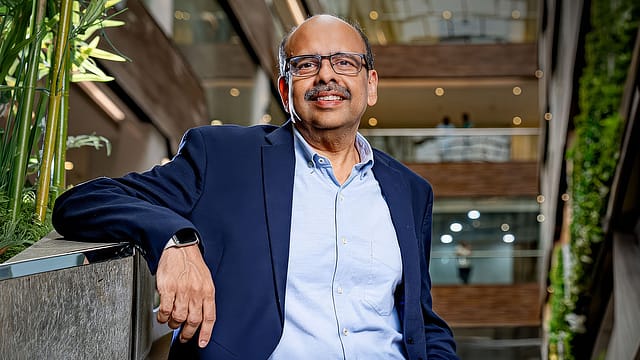
It all unfolded at 2 AM on Sunday, the 15th of February.
The countdown had already begun, and there was barely a day to go before the who’s who in the world of tech and AI were descending into India’s capital city of New Delhi, for the Narendra Modi government’s flagship AI event, the India AI Impact Summit. Sitting in Mumbai, Sharad Sanghi was quite determined that the announcement must be made in time for the AI summit.
For a few days before that, Sanghi, who heads the AI startup Neysa, had been burning the midnight oil, and Saturday was no different. There was extensive back-and-forth with the global private equity giant Blackstone and a group of investors, ironing out differences and concerns for a deal that would see Blackstone and others invest in Neysa and, in the process, make it a unicorn.
“We wanted to make sure that we get the funding done before the AI summit,” Sanghi tells Fortune India. “But there were lots of last-minute things with multiple investors and multiple lawyers. Something or the other needed to be adjusted. So, we were going back and forth.”
Then, as if by divine intervention, Sanghi says, the deal was signed at 2 AM on Sunday morning, the day of the Hindu festival, Mahashivratri. The deal, perhaps the largest of 2026 in India, values Neysa at $1.4 billion, making it the year's second unicorn, and was announced on the eve of the summit. Blackstone and co-investors Teachers’ Venture Growth, TVS Capital, 360 ONE Asset, and Nexus Venture Partners will invest $600 million in the AI infrastructure provider, with an option for Neysa to raise an additional $600 million in debt financing from the investors, as it looks to expand its GPU capacity.
GPUs, or Graphics Processing Units, are critical for AI deployment because they can perform technical calculations faster and more efficiently than CPUs. GPUs feature thousands of small, efficient cores that enable them to process massive datasets simultaneously.
“Blackstone and our belief are that currently in India there are 50,000 to 60,000 GPU’s,” Sanghi told Fortune India. “We believe in the next 2 to 3 years, there will be 2 million GPUs. So, there will be a 30X growth in GPU infrastructure, and we want to leverage, be at the forefront of that, and provide that infrastructure to companies who want to build AI applications and want to do inferencing in India.” AI inference is the process of applying a trained machine learning model to new, unseen data to make real-time predictions, decisions, or generate content, turning model training into useful results.
Founded in 2023, Neysa operates as an AI acceleration cloud platform serving enterprises and government. Its cloud-first approach helps clients securely and cost-effectively build, deploy, and scale AI and GenAI using Neysa Velocis, Overwatch, and Aegis platforms—enabling AI workloads within India by easing GPU access.
Velocis offers GPU-as-a-service, letting enterprises rent high-performance GPUs that are often in short supply. Neysa buys GPUs, installs them in Indian data centres, and provides on-platform access, so enterprises avoid investing in physical infrastructure.
“We are an AI-focused cloud platform, which not only does infrastructure as a service, but also as a platform,” Sanghi explains. “There is a developer platform, an influencing platform, and a marketplace where third-party apps can be used by developers. So that's what we built, and we want to continue to enhance that.”
From Netmagic to Neysa
In many ways, Sanghi had pioneered data centres in India long before it became a fad.
An electrical engineer from IIT Bombay, Sanghi, moved to the US to pursue his master’s at Columbia University. He was hired from campus by the National Science Foundation Network, widely regarded as the backbone of the internet.
By 1995, Sanghi returned to India as the country underwent a tectonic shift in its policies after many years of a protectionist regime, and became a consultant to the VSNL to set up internet services in India. In 1998, the Indian government allowed private players to enter the internet market. “So, I took an ISP (Internet service provider) license and set up Netmagic,” Sanghi says. “Everybody was focusing on doing consumer Internet. I thought, let's use the Internet for mission-critical businesses and not worry about consumers. I am not, and I can't do B2C.” Sanghi says.
In 1998, Sanghi established Netmagic in Mumbai and later expanded into value-added services, including managed networks, operating systems, and security. The business grew organically, attracting investors such as Nexus Venture Partners, Fidelity International, Nokia Growth Partners, and Cisco Systems, especially as data centres gained traction with the rise of cloud in 2006–07.
“Netmagic grew to become India's largest data centre company,” Sanghi says. The company operated seven data centres in Mumbai, Chennai, Noida (Delhi-NCR), and Bangalore, and provided services such as colocation and managed hosting to more than 1,000 customers, as well as ISP and cloud services to many others.
By 2012, the Japanese telecommunications company NTT had acquired a 74 percent stake in Netmagic, with Sanghi appointed to run NTT’s global data centre and marine cable business. “When ChatGPT was released in late 22 or early 23, we started seeing demand for our cloud business in NTT,” Sanghi says. “But I was not running it. I had started it, and it was still running, but I was not responsible for that. I tried to get NTT to invest in GPUs to augment that business.” Sanghi says.
Had they paid attention to his words, Sanghi says, NTT would have been market leaders in the sector. “I took permission from NTT, saying I’m not going to compete, and since you're not doing it, let me do this,” Sanghi says.
That’s when Neysa was born, and for the first year, Sanghi funded the venture out of pocket before raising capital. Neysa had also built a platform that helped clients discover, plan, deploy, and manage their Generative AI projects cost-effectively.
“Then we realised that selling software may not be enough,” Sanghi says. “Customers wanted the full stack approach. They were not going to buy software from one player and hardware from one player, and services from a third player.” That helped with the pivot, and the company then went for an integrated approach. Seed fundraising followed in 2024 for $20 million, and another $30 million in October 2024. With as much as $44 million of the $50 million deployed to GPU infrastructure, the company began seeing significant traction from enterprises nationwide.
“Some of the largest private banks in India were using us,” Sanghi says. “We started seeing a lot of demand from institutions, startups, and global frontier labs. That is when we said we should raise more money because we need more capital.”
Enter Blackstone
Over the past few months, Sanghi and Neysa spoke with as many as 20 investors before deciding to proceed with Blackstone.
“Blackstone was the one that checked all the boxes,” Sanghi says. “They were the largest investors in Neoclouds and the largest investors in Frontier Labs. And we decided that this made more sense.” Neoclouds are AI-first cloud providers offering on-demand, high-performance GPU-as-a-Service (GPUaaS) for AI training, inferencing, and simulations. Frontier AI labs, meanwhile, include organisations such as OpenAI, Anthropic, Google DeepMind, Meta, and Black Forest Labs that focus on developing and scaling advanced foundation models.
That meant, in addition to capital, Blackstone would also support Neysa's go-to strategy and ensure market and supply chain resilience for the company. Blackstone is the world’s largest alternative asset manager with over $1 trillion in assets under management.
“Blackstone affiliates are a significant global investor in the foundational tools, infrastructure, and technologies that drive AI’s development and adoption,” Blackstone said in a statement. “Key investments include QTS, the world’s largest data center platform; AirTrunk, the leading data center platform in the Asia Pacific region; CoreWeave, a specialized cloud infrastructure company; and Firmus, an Australian-based AI infrastructure platform.”
The bulk of the money from the fundraise will be used for capital expenditures on large-scale GPU clusters. “We will also use some money for development of our infrastructure, software infrastructure on top, and we will use some money for the market,” Sanghi says. “We are also targeting a lot of the global frontier labs that want to enter India.”
India has been grappling with GPU supply constraints, a problem even the country’s economic survey highlighted, causing cost concerns. “Surging demand for inputs (driven by higher GPU demand) and constrained supply conditions (due to shortages in the availability of high-bandwidth memory chips and storage) are driving cost concerns,” the Economic Survey notes. “This, in turn, is bound to have a ripple effect on the cost of expanding compute capacity in India, making financial viability a possible bottleneck.”
What's next for Neysa
For now, Neysa has its ambitions clearly set.
While the GPUs serve as collateral for the fundraise, the partnership with Blackstone is certain to open up new frontiers for the company. “We believe the advantage of working with Blackstone, in addition to the capital that they provide, is the experience because they were early investors in this space,” says Sanghi. “Their ability to connect us to their portfolio companies and, last but not least, building supply chain resilience not only in terms of GPU availability but also in terms of data centre availability and in terms of structuring is great.”
The company has now decided to focus on five verticals: enterprise, startups and unicorns, research institutes, government, and independent software vendors. “In terms of anchor demand, we are seeing large demand from the global hyperscalers and the global frontier lab and also from the AI mission,” Sanghi adds. “That’s why we wanted a war chest capital that we could deploy at short notice when we get these demands.”
The company has already ordered a significant number of GPUs and has deployed 1,200 of them. The new orders are likely to be delivered from April this year, and in total, Neysa is expected to source 20,000 GPUs over two years. While GPU infrastructure will deliver the highest revenue growth, other streams are also expected to grow, driving revenue three times over the next year.
So, what does it mean for Sanghi to have become a unicorn in less than three years? “I can't do a business where you may never see profits ever,” Sanghi says. “We have to make the bottom line.”