
India AI Impact Summit: ShikshaNext to deploy ₹170 crore to expand AI-led learning for 13 mn children
ADVERTISEMENT
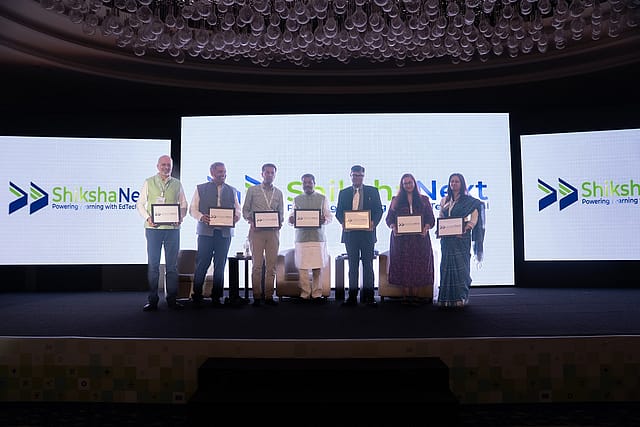
ShikshaNext, a ₹170-crore initiative spread over three years, was launched on Wednesday on the sidelines of the India AI Impact Summit in the national capital. The programme aims to help children from underserved communities learn better by using AI-powered education technology in classrooms.
The project was unveiled in the presence of Dharmendra Pradhan, Union Minister of Education and Sanjay Kumar, IAS, Secretary, Ministry of Education.
The programme seeks to enable more than 13 million children across India to access meaningful, technology- and AI-enabled learning opportunities by 2029.
ShikshaNext is anchored by Reliance Foundation and Gates Foundation as Founding Strategic Partners, with Central Square Foundation as Managing Partner. It is also funded by the Michael & Susan Dell Foundation. The coalition brings together philanthropic capital and sectoral expertise with a focus on execution and measurable impact.
Delivering the keynote address, Pradhan outlined the pathway towards a Viksit Bharat 2047 and stressed the importance of technology and AI in strengthening education systems.
“This is an important platform where Sarkar, Samaaj aur Sanstha have come together to make EdTech truly Sabka EdTech. The next step is to turn this into a Jan Andolan that ensures technology benefits every learner. India will present a model to the Global South that makes quality EdTech affordable and accessible for all,” he said.
Three-pronged programme
ShikshaNext will operate through three interconnected programmes. EdTech ScaleX will focus on scaling proven EdTech and AI solutions that have demonstrated measurable learning gains through integration with state education systems and community-led initiatives.
The EdTech Accelerator will support the development and growth of high-quality EdTech and AI solutions aligned with India’s diverse classroom needs. Meanwhile, the EdTech & AI Innovation Hub will function as a collaborative platform to discover, test and validate emerging innovations, with a focus on India-centric solutions across languages, grades and learning contexts.
All three programmes will be underpinned by rigorous evidence generation to assess what works, for whom and under what conditions, ensuring that technology integration is guided by learning outcomes rather than novelty.
Prachi Jain Windlass, Head of India at the Michael & Susan Dell Foundation, said, “Students catch up and move ahead when learning adapts to their needs. Personalised, technology-enabled tools can make that possible at scale. Entering the AI era, India is building on a decade of education reforms, stronger early learning, and tools that already deliver results in classrooms.”
The launch event brought together senior officials from the Ministry of Education, philanthropic organisations, EdTech innovators and educators, signalling a coordinated push to use AI and technology to strengthen learning outcomes across India’s public education system.
B Srinivasan, Executive Lead at Reliance Foundation, said, “The rapid expansion of digital connectivity and 5G over the past decade has unlocked unprecedented possibilities to deliver quality education to every corner of our country.”