
India aims to become a hub for quality goods, services and forge strong trade pacts with developed nations: Piyush Goyal
ADVERTISEMENT
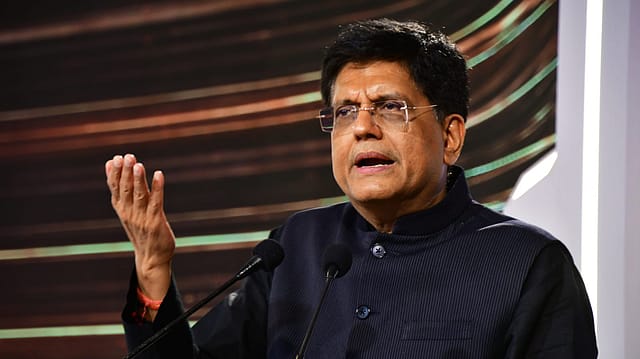
Union Minister Piyush Goyal, addressing the Future Frontiers Forum in London today, stated that the India-UK trade agreement is not primarily about opening doors wider for bilateral trade in goods or services, or even promoting investments, but rather for ensuring stability and predictability in the relationship.
He criticised India's ASEAN agreement with Indonesia, Malaysia, Vietnam, Thailand, Cambodia, and Laos, which was signed 15 years ago before the Modi government came into power, saying it meant "giving or opening up India's market to competitors." Instead, the current government, Goyal said, is focusing on having robust agreements with different countries, as was done with Australia, and is now negotiating with New Zealand.
"What we did with UAE and are now close to closing a second in the Gulf, and may start with other members of the Gulf region. What we did with the UK and with the four EFTA countries, Iceland, Norway, Liechtenstein, and Switzerland, and are in active dialogue with the European Union. We are (also) in dialogue with the United States of America...Peru, (and) Chile, countries with whom we don't compete," the minister said on the second day of his visit to London.
Goyal stated that science and technology will benefit immensely because India has chosen to massively invest in its innovation ecosystem over the next 10 to 15 years. "Government will be supporting people who wish to go down that route in India through subsidies, through grants, through long-term funding...our idea is that India should be at the cutting edge of technology. Just like we did in the digital public infrastructure, innovation in India will happen at a fraction of the cost at which innovation will happen anywhere else in the world."
Goyal said the fact that the costs of any work that has to be done in America, in Europe, or the highly developed countries with high per capita incomes are at least 10 times what they would be in a country like India. Goyal said the government of India is willing to put in $12-13 billion into innovation and expects $150 billion worth of innovation to come out of India.
He said India could provide a much-needed talent pool, which can serve innovation to the world. "That's the direction in which the Indian government is going. It's a win-win for friends and allies like the UK and India, and possibly Oxford would benefit a lot by doing the next vaccine research in India."
Goyal reiterated that India has demonstrated a huge possibility to grow its share in global trade. Over the last few years, the minister said, India's focus would be on being a producer of quality goods or a supplier of quality services. "Our focus [is] on creating capacities to scale. Our focus (is) on entering into robust trade agreements with the developed world. There was a point in time 15 years ago when we were more focused on doing trade agreements with countries that are our competitors."
Goyal also delivered a keynote address at the IGF Mainstage Plenary Session titled “From Agreement to Action: The UK–India FTA,” reaffirming India’s commitment to transitioning the FTA from a negotiated text into a transformative economic partnership.