
India pitches AI-led development solutions for Global South at UNGA
ADVERTISEMENT
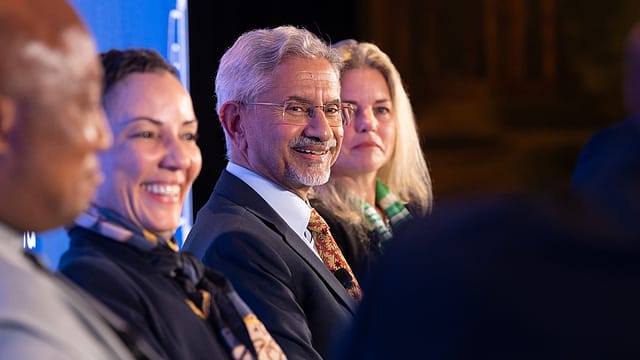
The fifth edition of India Day, organised by Reliance Foundation, the UN in India and ORF, focused on scaling India's AI and digital public infrastructure innovations to address global development challenges.
India's artificial intelligence (AI) and digital public infrastructure innovations took centre stage at the fifth edition of India Day during the 81st United Nations General Assembly (UNGA) week in New York, as policymakers and industry leaders explored how India's development models could be scaled across the Global South.
Organised by Reliance Foundation, the United Nations in India and the Observer Research Foundation (ORF) on September 24, the event focused on AI, digital public infrastructure, women-led development, healthcare and inclusive growth. Discussions centred on accelerating progress towards the 2030 Sustainable Development Goals amid geopolitical uncertainty, climate challenges and rapid technological change.
The event brought together government representatives, multilateral institutions, civil society and private-sector leaders to explore how technology and international partnerships could help address development challenges at scale.
AI and digital infrastructure take centre stage
AI emerged as a central theme, with discussions examining its potential to improve public service delivery, healthcare, education, and energy infrastructure, particularly in developing economies.
Rohit Kansal, Secretary, Department of Rural Development, highlighted India's experience in building digital infrastructure at population scale.
"The real message is not in the numbers, it's the kind of infrastructure that we've built. India's message is at population scale; we democratize access, we build the architecture, and we leave the ecosystem to do the rest," he said, adding that AI should adapt to human languages rather than requiring people to adapt to technology.
Punya Salila Srivastava, Secretary, Ministry of Health and Family Welfare, emphasised the need to combine physical infrastructure with emerging technologies to improve healthcare delivery.
Santosh Kumar Sarangi, Secretary, Ministry of New and Renewable Energy, highlighted AI's potential to strengthen energy infrastructure, improve distribution efficiency and make electricity networks more resilient.
The discussions also examined responsible AI deployment, data governance and the institutional capacity needed to make emerging technologies accessible across languages, sectors and public services.
A special publication examining lessons from India's AI ecosystem was also launched at the event.
Stefan Priesner, United Nations Resident Coordinator in India, stressed the urgency of scaling proven development solutions ahead of the 2030 deadline. "Four years remain until 2030. That is not long, but it is long enough if the solutions India has proven at home can travel the world," he said.
Global cooperation amid geopolitical uncertainty
A high-level ministerial discussion, titled 'Ruptures & Ramparts: Building Bridges for a Changing World', examined how geopolitical, climate and technological disruptions are reshaping international development cooperation.
External Affairs Minister S Jaishankar, alongside foreign ministers from Jamaica, Suriname and Ghana, discussed the need for new partnerships involving technology, finance and innovation.
Jaishankar highlighted the relationship between BRICS and the United Nations, arguing that the grouping had helped bring greater attention to issues such as sustainability and international cooperation. "The UN is central to the international system – BRICS is supportive to the UN system," he said.
Ghana's Foreign Minister Samuel Okudzeto Ablakwa called for more equitable international partnerships, arguing that developing countries should engage with global powers as equal partners rather than being constrained by competing geopolitical blocs.
The broader discussions examined how countries could strengthen cooperation while navigating an increasingly fragmented international environment.
B Srinivasan, Executive Lead, Reliance Foundation, said addressing development challenges would require collaboration across governments, institutions and the private sector. "We need co-operation and collaboration on a scale larger than ever before, where empathy and soft power redefine the way we deliver development," he said.
ORF President Samir Saran emphasised that AI should be viewed as a tool for human development rather than merely a technological breakthrough. "AI is not just a passion project of 'tech bros' but a broader human project that can change how societies prosper and service each other," he said.
The event also featured discussions on women-led development, maternal and child health, education and economic opportunities for young people.
With the 2030 Sustainable Development Goals deadline approaching, the central focus was on translating India's experience in delivering population-scale solutions into development models that could be adapted by other countries, particularly across the Global South.