
L&T eyes $20-30 billion modularisation opportunity over next 5 years as global market grows to $100-150 billion
ADVERTISEMENT
Infrastructure major Larsen & Toubro (L&T) expects to tap a $20-30 billion market opportunity in modularisation over the next five years, as demand for modular construction rises globally amid labour shortages, extreme weather conditions and the increasing number of projects in remote locations.
The company estimates that the global modularisation market could reach $100-150 billion over the same period. L&T Deputy Managing Director and President Subramanian Sarma said the company could potentially target around 20% of this market, subject to improving its competitiveness and evaluating individual opportunities.
“We are seeing an opportunity for modularisation because skillset availability generally across the globe is decreasing,” Sarma said at a media briefing. He added that the availability of alternative trades and employment opportunities was contributing to the shortage of skilled workers.
“A very quick, back-of-the-envelope assessment gives me that $100-150 billion of market opportunity will be available for the modularisation also. And I think that's the share of the market we want to address,” Sarma said.
Asked about L&T's potential share, he said it could be “easily 20%”, while cautioning that the company would have to address the market competitively and evaluate the opportunities.
L&T completes 64,000-tonne Australia modular project
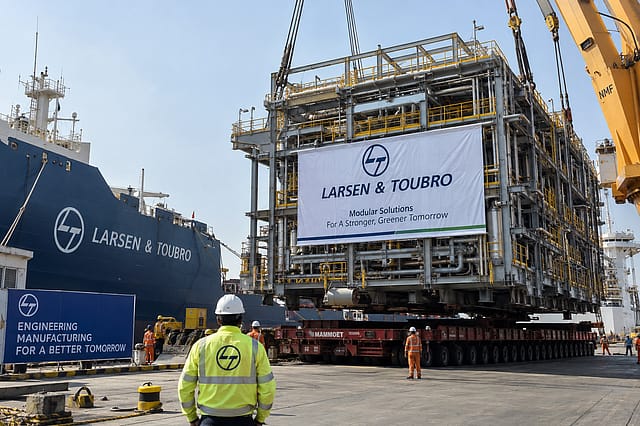
L&T's comments came as the company announced the completion of fabrication and delivery of 110 modules weighing approximately 64,000 metric tonnes for Australia's largest urea manufacturing plant, Project CERES.
The project, being developed by Perdaman Chemicals & Fertilisers in Karratha, Western Australia, has a capacity of 2.3 million tonnes per annum and is being executed by the Saipem-Clough Joint Venture.
L&T's scope included 47 pre-assembled units and 63 pre-assembled racks, all fabricated at its Modular Fabrication Facility at Kattupalli near Chennai.
The modules were transported from India to Karratha through 23 marine shipments in fully tested, pre-commissioned and ready-to-install condition.
The project involved fabrication, equipment installation, integration, testing and pre-commissioning in a controlled environment. According to L&T, this allowed activities to be executed in parallel while improving oversight of safety and quality, project predictability and reducing interfaces at the project site.
A significant portion of the complex equipment integrated into the modules was fabricated at L&T's advanced manufacturing facility in Hazira, Gujarat.
India manufacturing base
Sarma said the opportunity for modularisation was not restricted to a particular geography, as modules fabricated in India could be transported to projects around the world where suitable marine access was available.
“When you are modularising, the beautiful thing is that we are agnostic to the geographical location because we are fabricating in India and we are supplying,” he said.
He added that water access was an important enabler because the large modules could then be shipped to project locations globally.
L&T expects modular construction to gain traction as project developers contend with high labour costs, workforce shortages, extreme weather and the challenges of executing projects in remote locations.
“I think in various parts of the world, whether because of these extreme conditions or remote locations or front-end nature or shortage of workforce, modular concept will become more and more popular,” Sarma said.
He added that hybrid solutions combining conventional and modular approaches could become increasingly relevant, creating opportunities for L&T.
L&T sees global opportunity
The company said its modularisation strategy could help expand India's role in global project delivery beyond conventional manufacturing and fabrication.
“Delivering modular fabrication of this scale, with an excellent safety record, for Australia, demonstrates the depth of India's industrial ecosystem and its ability to meet demanding international standards,” L&T Chairman and Managing Director SN Subrahmanyan said.
He said Project CERES demonstrated India's ability to provide integrated engineering, technology and execution capabilities for complex international projects.
The completion of the Australian project comes as L&T seeks to expand its presence in a modularisation market that it estimates could reach $100-150 billion over the next five years.
With L&T targeting up to 20% of that market, the company could potentially address an opportunity worth $20-30 billion, although the actual share will depend on its competitiveness and project wins.