
The risk is shifting from the customer to the services company: UST chief executive Krishna Sudheendra
ADVERTISEMENT
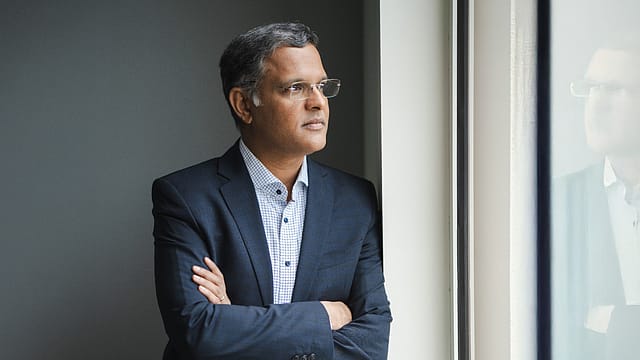
A global technology and digital transformation solutions company, UST, was founded by the late G.A. Menon in California, US, and Kerala. Today, it has evolved into one of the leading IT services companies with a presence in over 30 countries and a workforce of more than 33,000 employees. From reaching $1B in revenue in 2020 during COVID, UST hit $1.92 billion last year. In an interview with Fortune India, CEO Krishna Sudheendra, shares his take on how AI is changing the traditional IT services model and why deal closures will come with a marked difference.
Where according to you are we in the AI evolution cycle?
If you look at how the internet changed the world, we could never have imagined it. Ask Gen Z whether they can picture a world with no phone connections. They can't imagine it. Since then, Uber and Airbnb happened; even the top seven companies on Nasdaq or NYSE never existed before the internet. The internet brought a world of opportunity, and UST's mission has been about using technology to transform lives and make a meaningful, boundless impact on customers, people, and the communities we operate in.
That context matters because after 27 years, I believe we are at the exact same moment as the internet was in 1999. A moment where the world is going to profoundly change, where businesses and business processes are going to be reimagined through the power of AI. With the internet, the marginal cost of information went to virtually zero. Any information is now available at your fingertips. With AI, the marginal cost of cognitive ability, the marginal cost of thinking, is going down dramatically. That power is now in the hands of technologists to reimagine and make a difference in the world.
Right now, most people are looking at AI purely in terms of existing processes: how do we apply it to make things more efficient. But while AI is hyped in the short term, I think it's still under-hyped for the long term. Look at the journey of a patient who needs an insurance claim, treatment, or medicine. AI, applied correctly and reimagined, can make a profound impact there.
This means reimagining ourselves: how we do software engineering, how we go to customers, or how we deliver projects. It will have a profound impact across the board, and we need to disrupt and change ourselves. I tell my team: you now have the power to summon 10 times your brain capacity. How will you put that to use? You'll be the one guiding it to your advantage.
We're looking at this across every industry be it insurance, banking, or drug discovery. Yes, there will be some impact on certain jobs, but [AI] spends would be phenomenal. We've already seen the money spent just building AI infrastructure, and we haven't even gotten to full-fledged applications yet. Trillion-dollar companies have already been created around this. I see it as the biggest opportunity. Yes, it means disrupting our business models. But so long as we learn, adopt, and apply AI to reimagine every business, including our own, we can succeed in the long run.
What about the traditional IT services model?
The old services model is going to be dead very soon. This industry thrived on that model, but it's shifting toward outcome-based models, where we put risk on the table and share it with our customers. There will be a talent shortage until we upskill our people to where they need to be. Those are the things we need to deal with. But I'm very optimistic about the opportunity. I see it as equal to, or bigger than, the internet.
Are clients in a state of flux by holding back on capital allocation because the demand situation isn't clear? Is it still trial-and error as most clients would be experimenting [AI] with pilot projects?
No, it's not just trial and error. Quite a few projects have moved into production. We reimagined a full member enrollment system with an AI-first approach for a large insurance company. We've gone live, and 60 million members in the US are already using it. We took an AI-first approach both in development and deployment, and in how we approached member journeys.
But to answer your broader question: everyone is under pressure to apply AI in their business. Boards are asking what their companies are doing on AI. At the same time, given geopolitics, CFOs are limiting spends. A lot of technology money was already spent during COVID, and CFOs still haven't seen the full benefit of it. So, there's a lot of questioning about whether AI will really work, and that's where the experimentation mode comes from.
Are you referring mostly to SMBs, or large enterprises too?
Mostly enterprise-level and mid-sized businesses, but large enterprises, too, didn't see the full benefit. Take cloud as an example. Everyone said they needed to move fully to the cloud. People committed to a lot of cloud capacity without fully utilizing it; paying billions of dollars on cloud operations without seeing clear business benefit. Did revenue go up? Did cost come down? Are customers happier? Is cash flow improving? When a CFO looks at it through that lens, the promise often wasn't met, and that's where skepticism comes in, which is compounded by current geopolitical tension and inflationary outlook.
So, the world is in a stage where a lot of money has already been spent on technology, and companies want to spend on AI but want to be pragmatic and prudent about it. That's why we now fund proof-of-concepts completely. We go in with a clear idea, showcase our point of view, show the end-to-end journey and its impact. Previously, the services industry said, "This is the time it'll take, just pay me for the time." Now we tell the customer: “This is the price, but you pay only if I'm successful, or only if we achieve the agreed outcome.” The models are changing significantly. The risk is shifting from the customer to the services company.
Customers need to see proof in action, and they want a risk-sharing model so they're not the only ones taking the risk. We're seeing good traction with this approach. I tell my own teams: even if we can do something cheaper, faster, and better, let's pass some of that saving back to the customer even if it cannabilizes our own revenue in the short term because it builds long-term trust.
By offering to take on the cost and only get paid once it's proven, does suggest that the AI value proposition itself isn't fully convincing yet. Isn't "pay us only when you feel it delivered value" a good sales pitch, but far from a convincing AI value proposition?
It is genuinely convincing. We're not talking about full end-to-end outsourcing of operations like in the past. These are smaller projects, in the $30–50 million range. Still substantial, but much smaller than the billion-dollar outsourcing deals of before, and at the enterprise level.
For example, by bringing a proof-of-concept application to a customer, we might say: we will improve your supply chain efficiency by X, or reduce fraud/abuse by Y. Let's measure it for six months and then link payments to that outcome. It's a low-risk model for the customer, and from a board perspective, they're applying AI together with us and disrupting how they look at operations. It's almost like buying a product. Service delivered as a product, with guarantees and outcomes attached. This is the emerging concept of "service as software."
Does this speed up your turnaround time for closing deals, or has the timeline stretched?
Timelines are getting stretched because it's also about winning trust. Initial orders take longer, but once you show success, follow-on orders move faster. The first sale requires due diligence to calculate and demonstrate savings, and a proof-of-concept, usually funded on our own dime, not the customer's. So, there's a high upfront investment cost. But the advantage is that once built, the solution can be taken to multiple customers. So, the sales cycle has gotten longer, deal sizes have come down compared to the old $50–200 million deals, but the velocity of deals has gone up. You're looking at another order in the next three to six months. Deal size is down, but velocity is up, and trust with the same customer compounds over time.
Isn't that frustrating. For the same effort and money, you'd expect a non-linear payoff?
Yes and no. There's no real choice. The model is being disrupted, and if you don't adapt, you'll be disrupted. We're seeing good traction with this approach, and gross margins are much higher, in the 45–50% range, versus the traditional services industry's 35–40%. Yes, initial investment is higher, but bringing in technology at a much better pace raises steady-state gross margins. Second, this is a new model. You have to prove it and win trust. Previously, you'd do a capacity deal or a time-and-materials deal, point to five successful examples, and land a $300–400 million deal easily. That was easier, and everyone got comfortable with it. But the model has been disrupted, clients have woken up, and while this is a harder pill to swallow right now, I believe it will become a new way of working. Every industry gets disrupted at some point. IT had its heyday for 30–35 years with huge margins, but now it's time for us to do some soul-searching and figure out how to remain relevant to the customer. That's going to be key.
Could you give a sense of UST's revenue last year, what you expect this year, and your client mix?
UST has always followed a model of fewer select clients with more attention. We didn't want everything to be to everybody, but everything to a select set of customers, mainly Fortune 500 and Global 1000 companies. Last year we closed at roughly $1.9 billion in revenue with about 160 customers, so our revenue per customer is comparatively high in the industry.
There's a lot of talk about AI democratising IT services. We've seen how Claude plugins decimate valuations across the sector. Do you see Anthropic becoming the new IT services competitor just as Salesforce emerged as the SaaS leader? What does that mean for players like UST?
Not really. Even Microsoft and Google have their own services teams. Anthropic is now looking at getting into services too, but they come from a pure technology perspective. If you get into the weeds of healthcare of understanding regulation, building systems, applications, and the convergence of IT and BPO--that AI is now driving--it requires deep domain knowledge and business understanding.
Even with what Anthropic is announcing, yes, you can build software, but is it fit for the industry? Will it solve real industry problems? Every industry is a complex mesh of legacy systems, regulations, customer preferences, and people. Software alone doesn't magically solve that. Even with Salesforce, you needed services companies to adapt it, to each company's context.
I believe services companies will morph into becoming the domain glue that brings this technology to life. In fact, we're building an Anthropic partnership, strengthening our Microsoft partnership, and our Google partnership because we see this as the necessary connective layer bringing technology from these companies to the industry. Yes, they'll also compete with us at times. We've competed with Microsoft and also partnered with them. It won't be one single technology that changes everything. Domain knowledge, understanding the data within an industry, and how you bring that to bear — that's what matters, whether at the convergence of IT and operations or IT and OT. With AI, we can take solutions to the edge: networking becomes smart, automotive gets ADAS and software-defined vehicles. Hardware and software are converging like never before.
So long as services companies invest in and harness domain and technology capability — deep understanding of both domain and customer — to build these solutions, that will be a game changer for services companies. Yes, the old model of "I'll give you 50 people to do a Java project" is going to change dramatically. Now it's all about helping with supply chain, loan origination, KYC. That's the language of the industry going forward. That's where even companies such as Anthropic, with all their technology, will struggle — understanding what's involved in KYC, operations, IT, and how to build a solution using AI and agents across all of that convergence. That's where real proficiency comes in. I definitely see this as a big opportunity.
But the challenge is if Anthropic can offer something like a "Mythos" tier at $50, that's a completely different pricing game, which may not favour players such as UST?
Can Anthropic offer a $60 licence to JP Morgan? It's just not practical. They can offer that to a small everyday company, absolutely, no problem and we don't even compete in that space. But the complexity of a JP Morgan, a Bank of America, or a large healthcare or retail company, along with their regulatory requirements, is an order of magnitude different. Whether at enterprise or mid-size business level, it's going to be very different. You'd need to add a few zeros to that number.
You've raised $250 million from Temasek. Do you have enough dry powder, or do you need to raise capital? Are you looking at acquisitions for market or capability expansion in the coming years?
We have enough dry powder for our next three-to-five-year roadmap. The good news is you don't have to spend what you used to in order to build a platform. We built Healthproof from scratch for the healthcare industry and later merged it with HealthEdge to form one of the largest platform companies in healthcare. We believe we could now build a platform of that scale for about 25–30% of the original cost. So, we're focused on building industry-led platforms that solve real industry problems, and that's where some of our investment will go.
We're also massively focused on reskilling our talent — training, tools, technology. As soon as ChatGPT launched, we trained 25,000 people in the company on generative AI. Last year we invested in a range of tools — GitHub Copilot, Gemini, Cursor, Anthropic's Claude Code — and we're announcing major partnerships with these companies. We were also one of the frontier firms for Microsoft 365 Copilot.
We're also changing our career architecture — redefining what roles are relevant for the future: domain-oriented roles, solution architecture, governance and ethics. Quality itself is becoming more about governance, guardrails, coding standards, and access controls. Palantir calls this "forward-deployed engineers,” every software engineer now needs strong domain knowledge. We're recalibrating roles and skills accordingly, and even our hiring and recruitment processes have changed.
We're investing heavily in these fundamentals and reinventing our service lines. "AI model and research" is a new service line — deciding what models and LLMs to use, whether to go with a large LLM or build a small SLM to solve a specific problem. Our service lines used to be built around data, cloud, and so on; now they're shifting dramatically toward AI models and research, and model selection. That's where a lot of investment is going, alongside building new platforms.
Do you see a roadmap toward an eventual listing or strategic sale?
Our investors are super long-term. Our primary investor has been with us for 27 years and remains strongly committed to building long-term companies. Temasek is another long-term investor. We did have an aspiration to pursue a US IPO around 2022–2023, but with things changing, we pulled back. Right now there's no active plan for an IPO. We want to reinvent ourselves in the world of AI and use this inflection point to emerge as a strong, AI-native challenger and company — that's our focus. We got some liquidity when we hived off Healthproof, so we have dry powder and no immediate need to raise capital or list. Our investors aren't in a hurry either. The whole focus is on fundamentally changing the company to stay relevant for our customers in the AI world, and I think we're making pretty good progress on that.