
US-China rivalry reshaping global order, middle powers seek to diversify: MEA Jaishankar
ADVERTISEMENT
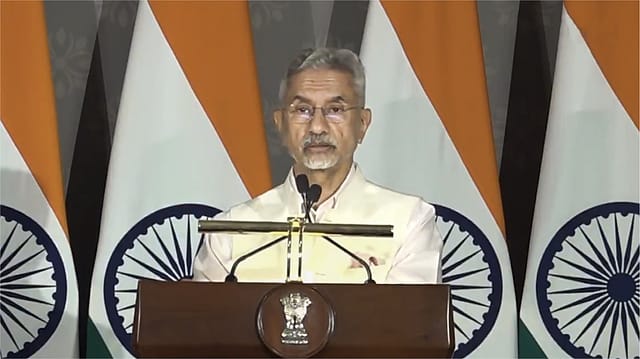
External Affairs Minister S Jaishankar on Sunday said the United States has “deliberately become a lonelier power” as Washington’s changing global posture and the rise of China reshape the international order, with emerging and middle powers increasingly turning to diversification, de-risking and flexible partnerships.
Speaking at the Munich Leaders Meeting in New Delhi, Jaishankar said a “radical repositioning” of the US and China’s growing economic and political influence were the two defining features of the current global landscape.
“No one in the room would disagree with the fact that the landscape today is primarily marked by a radical repositioning of the United States. A repositioning which is a posture of choice and, in a way, it has deliberately become a lonelier power,” Jaishankar said.
He said the second major feature was the rise of China, pointing to the country’s economic strength and its growing ability to translate that strength into political influence.
“We are looking at very sharp competition,” Jaishankar said, adding that the rivalry was no longer confined to Washington and Beijing. “That competition today, not limited to these two countries, has led to a weaponisation of any leverage that any country has. And that competition coexists with the complexity of interdependence,” he said.
Middle powers turn to diversification and de-risking
Against this backdrop, Jaishankar said emerging and middle powers were becoming more conscious of their own interests and were seeking greater self-reliance while maintaining relationships with multiple major powers. “What unites the emerging and middle powers, differentiated as they may be, is a growing self-awareness of their interest,” he said. “All of them, in a way, are becoming more self-reliant. It’s a term, ‘Atmanirbhar’, very much in vogue in India as well,” he added.
According to Jaishankar, these countries are increasingly focused on diversification and de-risking not only in their economies and security arrangements but also in building more resilient supply chains and developing new forms of cooperation. “Today, most of them are focused on diversifying and de-risking in every sense of the term, not just their economy or their security, but also building more resilient supply chains. In many ways, they are working out new arrangements,” he said.
He said countries were increasingly developing “agenda-based cooperation”, where complete alignment on every issue was no longer necessary. “The operating principle for emerging and middle powers should be, and perhaps is already, a reasonable degree of convergence,” Jaishankar said. “The days when you have to have an identity of views or a very strong congruence of interest, I think that’s too high a bar today. If you have enough touch points, that is good enough for countries to work together,” he added.
Jaishankar said this process of “de-risking, diversifying, and hedging” was gradually creating a new global architecture.
Jaishankar calls for flexibility amid US-China rivalry
The minister also described the US-China relationship through what he called a “Goldilocks scenario”, arguing that other countries have an interest in avoiding extremes in the rivalry. “In the context of a US-China rivalry, I think we are looking at what is often called a Goldilocks scenario: You don’t want it to be too hot; you don’t want it to be too good. You want it somewhere in between, at the right temperature,” he said.
Jaishankar said emerging and middle powers could strengthen cooperation among themselves while also maintaining ties with both the US and China, as long as their interests did not directly clash.
He cited the Quad, the India-Middle East-Europe Economic Corridor, the International North-South Transport Corridor, and the Northern Sea Route as examples of new forms of cooperation. He also pointed to BRICS, saying countries could gain greater influence by pooling their collective voice. “BRICS is an example of various parties who feel that their collective voice is much stronger than the individual ones,” he said.
The minister also cited the International Solar Alliance and the Coalition for Disaster Resilient Infrastructure as examples of institutions built around shared interests. “They come together where their interests require them to do so: they find working arrangements, develop an agenda, develop organisations, develop habits of cooperation,” he said.