
‘We are aggressively betting on the baby skincare segment’
ADVERTISEMENT
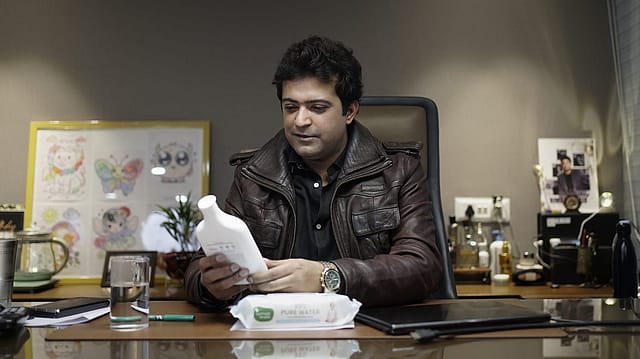
Premium baby and personal care brand Mother Sparsh is eyeing a 40-50% increase in revenue in FY26, after crossing Rs 150 crore in FY25. The company, which sees a lot of room for growth in the baby skincare segment, also recently saw ITC increasing its stake to 49.3% from 26.5%. Co-founder and CEO Himanshu Gandhi talks about product innovations and cracking the baby care market in India. Edited excerpts:
What’s the story behind Mother Sparsh?
We wanted to build a premium Indian baby care brand, one that can solve the real-time problems of mothers. The digital ecosystem is a very strong approach to connect with new-age parents, especially moms, to convey a brand story. Strategically, the entire baby care space, especially the premium offerings, is taken care of by international brands. We wanted to fill that gap.
How do you approach a sensitive category like baby care?
Baby care is not a fancy segment. It is a serious category, one where consumer mindset is key. Let’s take the example of wipes. Traditionally, people used cotton and water for cleaning babies. We told mothers, we will give you something similar to cotton and water. That was the baseline thought. The entire objective was to create a product that had the look and feel of cotton and water. That’s why our wipes are 2x thicker than ordinary wipes. It’s also 100% natural fabric; there’s no polyester. That’s the reason our wipes are priced 3x more than Indian brands.
We are not a fancy brand. We are not a startup either. We are a hardcore FMCG company that believes in fundamentals.
What does your current revenue mix look like?
Wipes are currently 30-40% of our total revenue. Around 60-70% is baby skincare and health hygiene. We are currently in a leading position in the wipes segment.
How did you break through a category dominated by giants like Johnson & Johnson?
When you are a budding company, you have limited weaponry. You have to place it at the right state in the right slot. What really worked for us is the approach of communicating with consumers. It is important to build a consumer mindset first. So, what we did was we educated our consumers—these are our clinical trials; these are our reports, and these are our fabric details. Sampling was very aggressive. Till date, we have done almost 2.5 million sampling.
Also, when we started in 2019-19, e-commerce was at a ‘building’ stage. At that time, we placed ourselves well, and we got good support. It’s aspirational to use Mother Sparsh. That’s what I wanted to build, a brand that is closer to a mother's heart.
What were the biggest challenges in scaling the brand?
The baby care segment gives you all kinds of surprises. The primary challenge was to identify which product to launch, in which segment, how to scale up, because every brand is like a world in itself. A company’s product portfolio needs to gel with its strategy, and we wanted to provide something that has a functional value. Let’s take baby detergent for example. The primary criterion of using any baby detergent is safety. The use of regular detergent leaves behind particles or residues, which can cause irritation to the child. We came up with a very simple communication—non-irritant choice for your baby sans optical brightness. Our campaign was ‘safety before brightness’. Our portfolio has been designed in a way that every segment has a functional benefit.
How strong is your retail footprint?
We are expanding in retail. Almost 15-20% of our sales are from retail outlets like Guardian, Apollo Pharmacy, and baby care shops such as Little Shop. Ours is premium brand, we don’t retail everywhere. For instance, Himalaya sells one sheet for around 90 paise, ours would be around 6.5 paise to Rs 3.
What hurdles did you face while entering offline retail?
In retail, we were selectively available to consumers. There are around 3,000-4,000 baby stores in India. We targeted those first. Second, we targeted pharmacies. We approached the whole market in a systematic manner.
Why did you enter the baby detergent category, and what differentiates your offering?
Baby detergent is an evolving segment that comes under health and hygiene. It’s like portfolio building in a way. We added bio-enzymes in baby detergents. There are milk spits in baby clothes, bio-enzymes help break that chain.
What is your next big focus area?
We are growing from last year, and the brand is always in a position of profitability. Our top line has been growing 30-35% sequentially. Also, 30-35% of our sales come from Tier II and III cities.
We have a very lean portfolio. We are into three segments. One is baby wipes. One is health and hygiene like mosquito range, detergents etc. And the third is baby skincare. So, for us, all three roles are important, but I think there is a lot of headroom in baby skincare, which we are aggressively building right now, for instance, a very small portfolio of baby lotion, shampoos, etc.
How will ITC’s heft add to Mother Sparsh’s growth?
ITC is one of the finest conglomerates and they are helping us with their R&D resources. It’s more like a collaboration, and less like a big brother kind of approach.
Is premiumisation in baby care retail a long-term trend?
There’s a scope to create premium and sub-premium brands. It’s a business ecosystem where expert brands have a more clear future. Segments are also seeing de-segmentation or micro segmentation, and there’s scope to create more premium brands.