
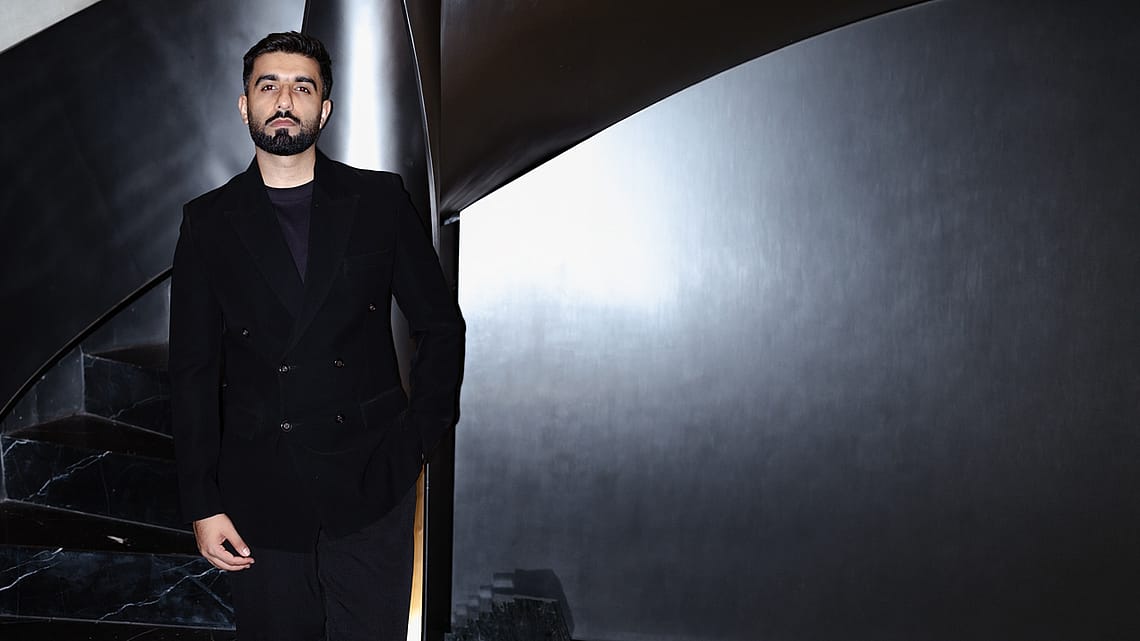
Manav Chhabra: From a small-town law student to a creator living his global dreams
For Manav Chhabra, the most surreal moments of his career have rarely been planned.
One of them came at the 2023 Hungarian Grand Prix, when the content creator found himself standing on the Formula 1 grid alongside drivers, teams, and mechanics minutes before the race began. A Formula 1 grid pass can’t be bought; only a select few receive it by invitation.
For someone who had started out posting random dance videos from college, the moment felt almost unreal. “It’s been hard work for 10 years,” says Chhabra, reflecting on the journey that took him from a small town in Punjab to Formula 1, Wimbledon, La Liga, Tomorrowland, and Coachella.
That journey also mirrors the evolution of India’s creator economy.
Chhabra started his journey in 2016, when he was studying law in Hoshiarpur, Punjab. His first videos were simple dance clips, largely influenced by his involvement in Bhangra and sports. One video unexpectedly brought new viewers to his Instagram account. A few months later, he discovered Musical.ly, experimented with lip-sync videos and found an audience almost immediately. For the next two to three years, he was going viral on the platform.
What began as an experiment slowly became a career.
A law degree, a different plan
Chhabra was not raised with content creation as a career option. Born and brought up in Rupnagar, Punjab, he was the only child of two working parents. His mother worked in administration, while his father was a senior accountant at a semi-government company in Punjab.
The expected route was familiar: study, graduate and find a conventional nine-to-five job. Chhabra was pursuing law with precisely that kind of future in mind.
But outside academics, his interests were elsewhere. He played several sports, danced the Bhangra, and was drawn to activities that gave him a creative outlet. He did not initially know that those interests could become his profession.
Musical.ly changed that calculation.
As the platform grew, so did Chhabra’s visibility. Fan meets and creator events began taking him across the country. He also started building audiences on Instagram and YouTube, giving him a head start when the creator ecosystem began moving between platforms.
By 2019, he had completed his law degree. A month later, he moved to Mumbai.
That was when the hobby became a career.
Learning to survive in Mumbai
Moving from Punjab to Mumbai was not effortless. Chhabra says he lacked confidence coming from a small city and needed time to adjust to the pace of Mumbai, its people and even the practical challenges of finding a house.
Friends already living in the city helped him settle in. But he knew that simply arriving was not enough. “The city needs to accept you,” he says. “And for that, you have to work hard.”
In his first year, Chhabra went to almost every event he was invited to, met creators, and collaborated with brands. He and his friends would sometimes post three, four, five or even six videos a day. At the time, visibility mattered as much as production quality.
The strategy worked.
Over time, the volume reduced and the planning increased. Chhabra’s content moved with the platforms and, more importantly, with his own interests.
From dance to lifestyle
There has been no single niche in Chhabra’s career.
Dance came first. Fashion followed after he moved to Mumbai, bringing fashion campaigns with it. Then came travel, vlogs, sports, beauty, and skincare. Today, he describes his category simply as lifestyle — a broad enough space to accommodate the different things he enjoys creating.
“I don’t want to be in one category because that restricts me to post other stuff,” he says.
That flexibility has become an advantage.
A lifestyle positioning allows him to move between fashion and sport, entertainment, and travel without appearing disconnected from his audience. His collaborations have ranged from Swarovski and Nykaa to Adidas India, Mercedes, Visa, and Azzaro.
The content, however, remains relatively instinctive.
“I do what I love,” Chhabra says. If he is travelling and feels a particular video will work, he makes it. He does not obsessively plan every piece of content around a platform.
The business of staying relevant
Chhabra’s ability to move between platforms has also been shaped by timing.
He started YouTube early, posting long-form content and vlogs, while his audience moved from Musical.ly and TikTok to Instagram. That existing relationship with viewers made each transition easier.
His advice to new creators is equally straightforward: start with what you are good at, then experiment.
He began with dance because that was what he knew he could do well. Once an audience existed, he could show them fashion, vlogs, and other formats without starting from zero.
For brands, the same principle applies.
Chhabra and his management team jointly decide whether a collaboration fits his profile. The brief needs to feel organic, while potential long-term relationships also matter. He says he has worked with some brands for six or seven years, allowing both sides to understand how much creative freedom works best.
If a brief does not work, he is willing to say no. If it can be modified without compromising the campaign, he works with the brand to find a middle ground.
That relationship, he believes, is changing. Brands, he says, are increasingly giving creators greater freedom to decide how a campaign fits into their content.
When the world becomes the content
The biggest change in Chhabra’s career is perhaps visible in the places his work now takes him.
The Hungarian Grand Prix remains his standout experience, but it is part of a growing list. He has collaborated with Bayern Munich, visited its home stadium, and watched a match with the club he has supported since childhood. He has attended Wimbledon, La Liga, Tomorrowland and Coachella, besides international premieres, and events.
These experiences have changed the way audiences see him, too.
Someone discovering him today might simply see a creator standing alongside a global celebrity or attending a major international event. But Chhabra believes the people who have followed him for a decade understand the work behind those moments.
For him, the real story is not the celebrity photograph. It is how a boy from a small town reached the places that once seemed inaccessible.
Learning to ignore the noise
Visibility has its costs.
Like most creators, Chhabra had to learn how to deal with negative comments. Initially, the criticism was difficult. Over time, he began seeing it differently.
More than 99% of the audience, he says, is there to like and enjoy the content. The negative comments represent a much smaller part of the experience.
He now blocks, ignores and moves on. In fact, he sees rising criticism as one possible sign that content is reaching a larger audience.
And international travel and opportunities have put that criticism in perspective. “When you are out travelling internationally, living your dreams, all these things become very small,” he says.
Beyond the creator economy
After nearly a decade in content creation, Chhabra is not looking to leave the space. If anything, he wants to build beyond it.
He expects AI to become increasingly important to creators over the next five years, particularly as a tool for scripting and content development. But he is wary of content becoming too mechanical. For him, the creative element is what will continue to differentiate one creator from another.
His own plans are clearer.
Content creation, travel and international collaborations will continue. Television is a possibility if the right opportunity comes along, but it is not a certainty.
Business is.
Chhabra has been planning to launch his own business for some time and wants it to be connected to a space he understands and can integrate naturally into his life. He expects to make that move within the next year.
After 10 years of adapting to every new platform, trend and format, the next phase of Manav Chhabra’s career may therefore be less about becoming a bigger creator and more about running his own a business.