
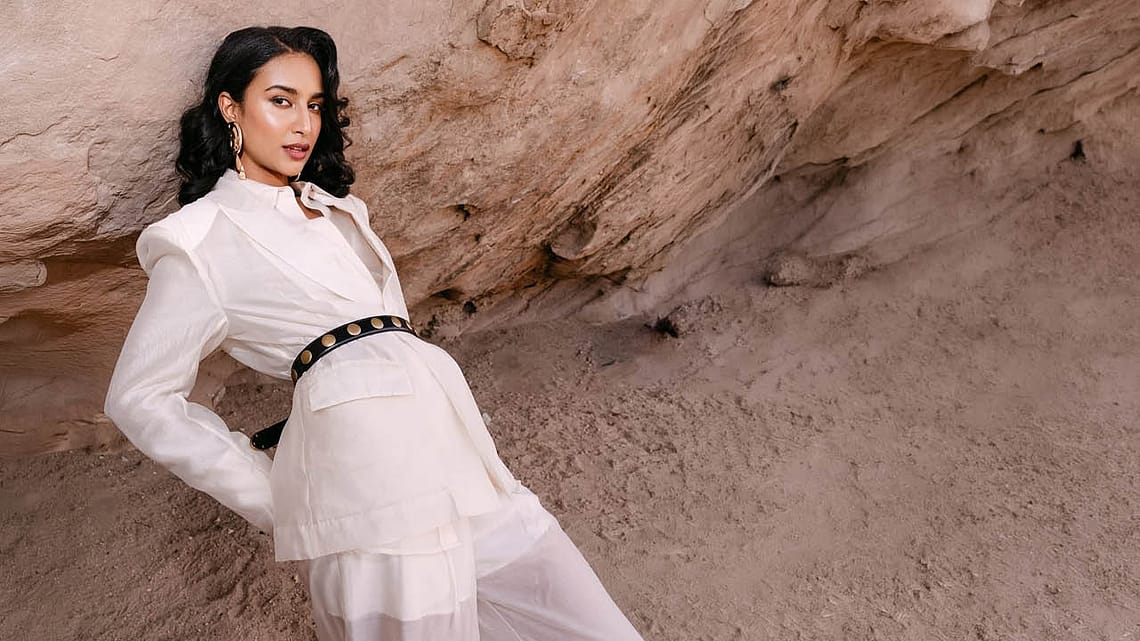
Rida Tharana: From a quiet Coorg village to a creator on the national stage
It was a simple answer. But it hit home. Rida Tharana recalls an evening back home. Her cousins were playing Uno with one of her closest friends, who was visiting from Europe. The friend remarked that the girls in the family seemed unusually independent for a household this traditional.
"The only reason we get to do all this today is because Rida fought for it," said her cousins in response to his remark.
The answer made it all worth. For years, Tharana had believed she was fighting only for herself—for an education, for financial independence, for the right to decide what her life looked like. She hadn't realised those same battles had quietly moved the boundaries for an entire generation of girls growing up around her.
The Bengaluru-based content creator let’s slip this incident while walking through the shape of her life: a childhood on a coffee estate in Karnataka's Coorg district, the fight to study outside her village, the stack of odd jobs that paid her college fees, and the pandemic that turned her, almost by accident, into one of India's most recognisable creators.
And this kind of impact is probably what sets her apart in India's creator economy.
Where many creators build audiences on aspiration, entertainment or lifestyle, Tharana built hers on conversations that begin long before the camera switches on. Colourism. Financial independence. Workplace inequality. Patriarchy. Family expectations. The invisible negotiations that shape women's everyday lives. Her videos feel less like performances than conversations — often shot on nothing more than a phone — and they touch millions precisely because they rarely feel scripted. And that has made her one of India’s fastest-rising digital creators.
But unlike the influencer stories that start with an algorithm or a single viral clip, hers began years before social media entered the picture.
It began in a village where questioning the rules was not encouraged. And questioning became the one thing she couldn’t stop doing.
A coffee estate, a curious child
Ask Tharana about her childhood, and the first word isn’t struggle. It’s abundance — not the financial kind, but the kind only children recognise: coffee plantations, clay toys shaped from anthill mud, paddy fields for playgrounds. “It was absolute bliss,” she says.
The family lived in a modest house ringed by relatives. Her father understood early that farming alone wasn’t enough for the family to sustain on; with little inherited land left, he went to the Gulf, taking odd jobs across Saudi Arabia and Dubai. “There was never any ego about work," she says.
Back home, her mother raised her daughters largely alone — strict, protective, sure that discipline was the only real preparation for adulthood. Tharana doesn’t resent that upbringing. What she struggled to understand was everything that changed later.
When growing up meant growing smaller
As children, boys and girls shared the same world; she climbed trees, played in the mud, roamed the estate. Then puberty arrived, and almost overnight the freedom she’d taken for granted dissolved under expectations she’d never been asked to consider — modesty, marriage, behaviour.
“What do you mean I can’t do that anymore?” she remembers asking. The answer was always the same: because you’re a girl.
Why did her brother never step into the kitchen, while chores fell automatically to the daughters? Unlike many young women who later find feminist writing online, Tharana had access to none — the internet was barely there. She wasn’t reading about gender equality; she was just asking questions — an instinct to interrogate the ordinary that would become the defining thread of her work.
The fight to leave
Education had always mattered. Tharana passed out of school with distinction before moving into biotechnology, but college represented something bigger than a degree — it represented geography. She knew that if she stayed in Coorg, her path would mirror the girls around her: finish school, wait until 18, marry.
Convincing her parents proved harder than earning the admission. Relatives warned against sending a teenage daughter to Bengaluru. She became strategic, choosing a course unavailable in Coorg so she could argue that leaving was unavoidable. When they proposed a compromise — a local degree first, then marriage — she refused, repeating the same line for days: “If you don’t want me to study, then marry me off today. But once I leave this house, don’t ever call me your daughter again.”
Her mother relented. The education loan came through. Her father saw her settled in Bengaluru and went home. She was 16, and entirely on her own.
Bengaluru, and the cost of freedom
If Coorg taught Tharana resilience, Bengaluru taught her survival — everything was unfamiliar. “I felt like my brain chemistry changed,” she says.
But freedom came with bills. The loan covered tuition; everything else was on her. Within months she was picking up weekend promotional work for ₹500 a day, then ₹800, then event hosting, which paid several times as much. For the first time she wasn’t only covering her own rent; she was sending money home, eventually paying for her siblings’ schooling.
Long before Instagram paid her first brand cheque, work and survival had become the same thing — and she was learning, without realising it, to build a career from nothing.
The accidental voice
If Bengaluru taught Tharana to survive, the pandemic taught her to be heard. By early 2020 she’d carved out a steady niche in events, earning nearly ₹10,000–15,000 a gig. Then COVID-19 arrived, events shut overnight, and years of work vanished. Tharana joined a call centre but soon realised she wasn’t built for it.
As work dried up, the pressure she thought she’d escaped resurfaced: in her parents’ eyes, it was finally time to marry. She needed somewhere to put the frustration. That somewhere turned out to be Instagram.
A journal that found an audience
Most creators can name the moment they decided to become one. Tharana can’t — she wasn’t studying influencers or the algorithm. “I saw it as my diary,” she says.
Before work she’d record short clips straight into the camera. No scripts, no lighting rig — just extensions of arguments she’d been having with herself for years. Why were daughters expected to sacrifice more than sons? Why did skin colour still decide who counted as beautiful?
At first the response was polarising — many read her questioning of gender roles as an attack on men. But women began writing in, thousands of them, turning the comments into a shared diary of controlling families and unequal homes. “I wanted people to tell me this only happened to me,” she says. Instead, everyone could relate to it. She hadn’t found a niche — she’d found a community.
From a diary to a creator brand
Her content never ran on entertainment for its own sake, but on lived experience, spoken plainly. “I’ve never been able to fake aesthetics,” she says with a laugh. “If I try too hard, it doesn’t feel like me.” Her videos felt familiar, giving voice to conversations women had with close friends but rarely aired in public.
That authenticity proved commercially valuable, too. In the years since, she’s fronted campaigns across beauty, fashion, fintech and travel, collaborating with names as varied as Louis Vuitton, Omega, Mercedes, H&M, Airbnb, d’Alba India and Senco, and becoming a recognisable face for brands courting India’s young, digitally native women. Even so, she stays selective, turning down far more offers than she signs. “If I stop sounding like myself,” she says, “people will know immediately”.
More than a brand deal
Tharana has quietly built a business that reaches well past sponsored posts — affiliate marketing, workshops, speaking, consulting, digital education — always testing ways to earn that don’t depend on a single algorithm.
The impulse isn’t greed. It’s memory: growing up where financial instability shaped every big decision taught her that leaning on a single income is a luxury few can afford. “I’ve never seen money as big or small,” she says. “Money is money” — a philosophy inherited from her father.
Today, her income supports her parents, backs a younger sibling’s education, covers medical costs, and is helping build a new home in Coorg. The family that once struggled to finance her degree now looks to her as its breadwinner. Success, for her, has never been counted in luxury purchases — it’s counted in responsibility.
When Coorg met Cannes
One defining moment unfolded far from the coffee estates where she grew up: walking the red carpet at the Cannes Film Festival. But it carried something heavier than prestige: the girl who once climbed trees to hunt for mobile signal was now on one of the most photographed carpets on earth.
And yet her ambitions stayed grounded. She talks less about international recognition than about work that can outlast Instagram, which gave her visibility but isn’t where her story ends.
The price of being visible
If the first half of Tharana’s journey was about convincing people her voice deserved to be heard, the second has been about protecting it from the internet.
She’s urged women to speak openly about relationships, colourism, financial independence and mental health, and audiences have rewarded her with extraordinary trust — trust that comes with expectations. “I think people confuse content with knowing a person,” she says. “They’ve seen 90 seconds of my life and feel they know everything about me. Somewhere along the way, your personal life becomes public property.”
Holding that scrutiny at arm’s length took time. Tharana says she’s gone to therapy several times — not over her relationships, but over social media itself. “It was affecting how I looked at myself,” she says. It helped her separate the creator from the person.
These days her notifications stay off, and she avoids measuring herself against others. “If I keep comparing myself, I’ll stop enjoying why I started,” she says. She’s gone back to treating Instagram as a journal — which is, not coincidentally, when her work resonates the most.
A life beyond the algorithm
Unlike the first wave of influencers who built their careers on social media, Tharana increasingly talks about what comes after it. She has no intention of staying tethered to a single platform; she’d rather build businesses that outlive the algorithm, and mentor younger creators in the skills she had to pick up by trial and error.
She also sees herself moving into mainstream entertainment; her appearance in the second season of The Traitors signals an appetite for formats beyond short-form video. Yet Bengaluru remains home. Friends ask why she hasn’t moved to Mumbai, where much of India’s creator industry sits; her answer is simple: Mumbai is speed, Bengaluru is balance. “I’ve worked too hard to build a life,” she says. “I don’t want to spend all of it chasing the next thing.”
Ask her what she’s proudest of, and she’ll more likely tell you about the young girls in Coorg who now believe their futures can look nothing like the generations before them. In an industry driven by trends and fleeting virality, that kind of influence is the hardest to measure — and the most enduring.