
‘India does not allow monopoly’: Scindia tears into Musk’s Starlink allegations
ADVERTISEMENT
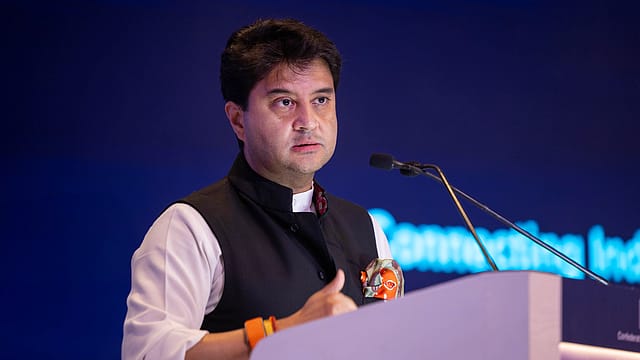
Union Communications Minister Jyotiraditya Scindia on Friday rejected Elon Musk’s allegations that Starlink is being held back from launching in India by powerful business interests, saying India does not allow monopolies and that all satellite communication players must meet the same regulatory and security requirements.
“There is a lot of conversation about one specific company, but three companies have got satcom licences,” Scindia said during a media interaction on at the India Mobile Congress 2026.
Scindia said Starlink, Jio Satellite Communications and Eutelsat OneWeb have already secured licences, while Amazon is also interested in obtaining one. However, obtaining a licence does not automatically allow a company to commence commercial operations, he said. “India does not allow a monopoly in any sector,” Scindia said, adding that each licensed operator would have to independently fulfil the required security conditions and other milestones before beginning operations.
His comments came a day after Musk accused “certain oligarchs” of blocking Starlink’s India launch in order to maintain a “monopolistic chokehold” over consumers.
Scindia said the government’s position is clear and that the regulatory process applied uniformly to all players. He said spectrum charges were yet to be finalised and that security compliance was being assessed individually. “Once the revenue charges system is finalised, once each one of these parties, party A, B, and C, all three, individually based on their achievement of milestones with regard to security concerns and prerequisites, have fulfilled the requirements, then obviously they can start operations,” he said.
The minister also pushed back against the suggestion that Starlink was being singled out, saying three companies had already received licences and that another company was pursuing the process.
Mittal says OneWeb is waiting too
Bharti Enterprises chairman Sunil Bharti Mittal also sought to counter the suggestion that Starlink alone was facing delays. Speaking on the sidelines at IMC, Mittal said Bharti-backed Eutelsat OneWeb was itself awaiting approvals to begin satellite services in India. “We’re waiting for our own approvals,” Mittal said, adding that satellite services from the group would begin “hopefully soon” in India.
The comments came after Musk’s allegations and as the government said Starlink, OneWeb and Jio Satcom were broadly at the same regulatory stage, with security assessments underway.
Scindia said the government remained “technology agnostic” and its role was to create a predictable regulatory framework that allows customers to choose between competing technologies and service providers.