
Infosys shares slump continues despite AI-led strategic push; IT stock down 17% in Feb
ADVERTISEMENT
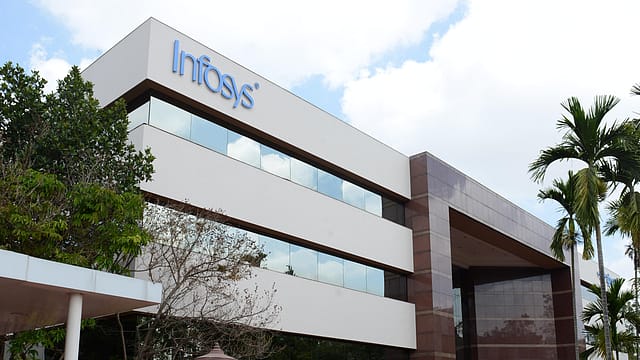
Shares of Infosys resumed their losing streak on Wednesday after a brief pause in the previous session, despite the company unveiling a new AI-focused growth strategy and announcing partnerships to expand its enterprise artificial intelligence capabilities.
On Wednesday, Infosys shares fell as much as 3.3% to hit an intraday low of ₹1,345.20 on the BSE, with nearly 9 lakh shares changing hands. At the time of reporting, the country’s second-most valued IT company was trading 1.58% lower at ₹1,369.25, taking its market capitalisation to ₹5.55 lakh crore.
The stock had ended Tuesday’s session 1.83% higher at ₹1,391.20, snapping a four-session losing streak after the company announced a strategic collaboration with Anthropic to develop advanced enterprise AI solutions.
So far in February, Infosys shares have declined nearly 17%, broadly mirroring the correction across the IT sector. The sell-off has been triggered by investor concerns over the rapid rollout of advanced AI tools, including those developed by Anthropic, which are expected to automate traditional IT services such as application development, maintenance and testing. Investors fear this could reduce billable hours and shift the industry from manpower-driven models to AI-led efficiency.
Infosys eyes $300-400 bn global AI opportunity
Infosys recently unveiled its AI-first strategy at its Investor AI Day in Bengaluru, positioning itself to capture an estimated $300-400 billion global AI services opportunity by 2030. The event featured co-founder, and non-executive Chairman Nandan Nilekani and CEO Salil Parekh, who outlined the company’s transition towards an AI-first services model as enterprises move from static digital systems to dynamic, agent-driven AI operations.
The company has structured its AI-first value framework across six key focus areas: AI strategy and engineering, AI-ready data foundations, process transformation, agentic legacy modernisation, physical AI, and AI trust.
As of December 2025, AI-led programmes contributed around 5.5% of Infosys’ revenue. The company is currently executing more than 4,600 AI projects and providing AI services to nearly 90% of its top 200 clients.
Infosys is leveraging its Topaz Fabric platform to scale AI deployment and has filed 155 AI-related patents as of January 2026. Its broader ecosystem partnerships include collaborations with NVIDIA, Amazon Web Services, Microsoft Azure, OpenAI and Anthropic.
Management noted that nearly 60–80% of enterprise IT budgets are currently allocated to maintaining legacy systems, which has historically constrained AI adoption. The company believes AI-led modernisation tools are making large-scale transformation more viable and expects AI-driven services expansion to offset potential revenue compression arising from productivity gains in traditional IT services.
Brokerages remain optimistic despite correction
Brokerages have largely maintained a positive outlook on Infosys despite the recent stock correction. Axis Securities has retained a ‘Buy’ rating with a target price of ₹1,820, valuing the stock at 23 times its December 2027 earnings. Nuvama reiterated its ‘Buy’ call with a target price of ₹1,900 based on 23 times FY28 earnings, while Emkay Global maintained a ‘Buy’ rating with a target price of ₹1,750, valuing the stock at 22 times its December 2027 estimated earnings.
Brokerages broadly view the recent correction in IT stocks as excessive, suggesting that fears around generative AI disruption may be overstated. While they expect short-term revenue pressure due to productivity gains, analysts remain constructive on medium- to long-term growth driven by AI-first services, legacy modernisation, and enterprise transformation demand.
They also noted that the AI transition is structurally different from earlier technology shifts such as cloud migration. Unlike previous cycles, which involved layering new technologies onto existing systems, AI adoption requires enterprises to fundamentally redesign operating models, processes and data architectures.
(DISCLAIMER: The views and opinions expressed by investment experts on fortuneindia.com are either their own or of their organisations, but not necessarily that of fortuneindia.com and its editorial team. Readers are advised to consult certified experts before taking investment decisions.)