
'India’s AI adoption moves from experimentation to enterprise deployment,' says Anthropic’s Irina Ghose
ADVERTISEMENT
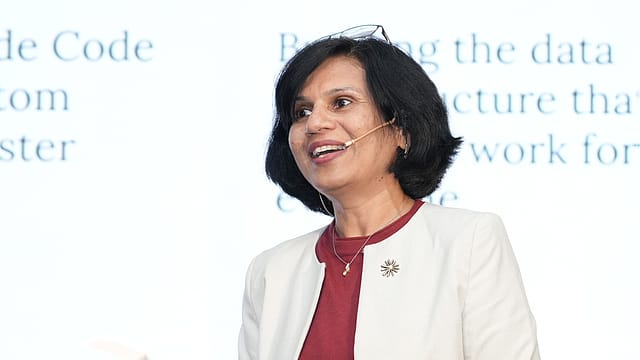
India’s artificial intelligence adoption is moving beyond experimentation, with enterprises increasingly looking at AI to improve efficiency, automate processes and create capacity for innovation, according to Irina Ghose, managing director, India, at Anthropic.
Ghose said the biggest change in the enterprise conversation has been the shift from questioning whether AI works to figuring out where it can create value. “A couple of years back, the question was not to do with what can they do here,” Ghose said during a fireside chat at the Global Fintech Fest 2026. “There was not the experimentation because the validation of the outcome wasn’t there.”
That has changed significantly, she said. “From then to now, the validation, the outcomes, the desires are coming in, and hence the intent of the industry, whether it is banking, manufacturing, insurance, healthcare across the board, the overall intent is to engage in AI to make [things] better.”
According to Ghose, enterprises are now broadly falling into two groups—those that have already decided to move ahead with AI and those still assessing the timing and technology.“One [group] has just decided to take a bet and move ahead, and the others are cautious to see whether it is the right time, is it the right technology, is it the right way to go forward,” she said.
For companies already adopting AI, the focus is no longer limited to efficiency. Ghose said productivity gains are increasingly being viewed as a way to free up capacity for innovation “Essentially, AI is what everybody is measuring—how have we made the existing system better, how have we saved or created resources,” she said. “The other is always getting ahead of the curve. Efficiency is bringing in head capacity for innovation.”
Legacy systems offer a major AI opportunity
Ghose said AI is particularly useful in enterprises dealing with complex legacy applications and interoperability problems—an important consideration for sectors such as banking. “We really find that Claude shines in places where complex legacy applications, interoperability come into play,” she said.
Banks and other large organisations often have systems that have been in place for years and can be difficult to understand or modify. Ghose said AI can significantly reduce the time required for some of this work. “When you put these processes in front of the more advanced models, things that you don’t know [about]—that is where the intelligence shines,” she said.
Tasks that previously required months and highly experienced users can, in some cases, be completed in days, she added. “Even conceptualisation of [systems] which have taken months, which should have taken a very high level of experienced users to do, can now be done in days.”
The larger impact, she said, is on how employees spend their time as routine work becomes increasingly automated.
India’s scale and diversity create a distinct AI opportunity
Ghose said India presents a particularly complex environment for AI because of its population scale, diversity and multilingual requirements. “India’s complexity lies in the diversity of the population itself, the scale, the multilingual language that they really have to solve for,” she said.
AI’s potential, she added, extends beyond large corporations into sectors such as education, healthcare and skilling, where technology could help address problems at population scale.
“India’s priority sectors, whether it’s education, healthcare, skilling, in each of them it really matters because they’re trying to solve population-scale problems by making it available to the last mile.”
Enterprises are shortening AI experimentation cycles
Another significant change is the speed at which companies are testing and deploying AI.
Ghose said organisations are moving away from lengthy technology evaluation cycles and towards shorter experiments in which they test a use case, assess the outcome and iterate. Instead, organisations are “doing shorter, testing the quality, putting out something, and learning from testing.”
She said this is particularly relevant in India, where developers and early adopters across organisations are increasingly willing to experiment with AI.
AI is changing the skills companies value
The shift is also affecting talent. Ghose said curiosity and the willingness to learn are becoming increasingly important as employees adapt to AI-enabled workplaces. Employees, she added, need to be willing to work alongside rapidly changing technology rather than view AI purely as a replacement for existing roles.
Safety and data governance remain central
As enterprises deploy AI at greater scale, Ghose said privacy, security and governance will remain critical, particularly in India where data residency is an important consideration. “We consider safety and capability two sides of the same point,” she said.
She added that making AI work at scale requires cooperation between technology companies, customers, regulators and the wider ecosystem. “It absolutely is involved in the way we’re all kind of coming across, and you’re always wanting to work across the customers, regulators and the entire founding ecosystem to make it work in that manner.”
For Ghose, India’s significance therefore extends beyond being a large market for AI. It is also a place from which the technology industry can learn how to build AI systems for scale, diversity and real-world complexity.