
No nation can build chips alone: Vikram Misri calls for global partnerships with India
ADVERTISEMENT
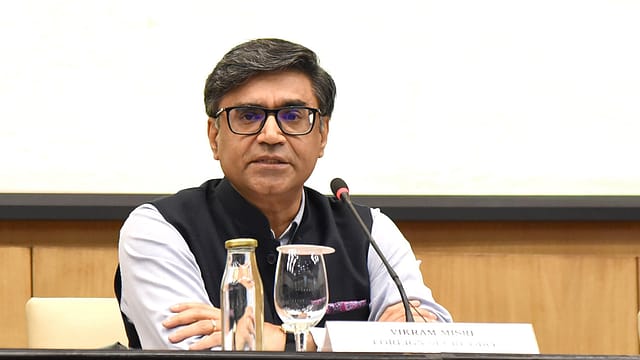
India’s semiconductor ambitions will depend on building strong global partnerships alongside domestic capabilities, Foreign Secretary Vikram Misri said on Friday, as he called on companies to “build with India, not merely in India.”
Speaking on Day 2 of Semicon India 2026 in New Delhi, Misri said no country, regardless of how advanced its semiconductor ecosystem is, can build a chip entirely on its own. The highly distributed nature of the semiconductor value chain makes international partnerships essential, he said. “For me, this occasion is about one thing, and one thing alone… And that is partnership,” Misri said. “No nation builds a chip alone.”
He said semiconductor manufacturing involves design talent, equipment, fabrication, materials and assembly spread across different geographies, making the chip “the most collaborative object industry has ever produced.”“The nations that will lead this century are those that know precisely what to build at home and whom to build with abroad,” Misri said.
'Atmanirbhar does not mean building everything in India'
Misri said India’s semiconductor self-reliance, or Atmanirbharta, should not be interpreted as an attempt to recreate the entire global semiconductor supply chain domestically. “Self-reliance does not mean building everything within our own borders. No nation on Earth does that, and no nation should try,” he said.
Attempting to build every component domestically could result in higher costs, slower innovation and a more isolated industrial base, Misri said. Instead, India should identify the capabilities that need to be sovereign while working with trusted partners where international collaboration makes greater sense.
“For India, that means an honest audit of both,” Misri said. “We are investing to build genuine, indigenous strength in design, packaging, and the specific manufacturing steps where our advantage is real, while also inviting the world’s leading equipment makers, materials suppliers, and design houses to build alongside us.”
Misri pointed to India’s engineering and design talent, large domestic market, political stability, democratic credibility and policy momentum as key strengths.
He cited the ₹76,000 crore Semicon India 1.0 programme, 12 approved projects and three projects already in production as signs of progress.
At the same time, he acknowledged that India remains dependent on imported semiconductor equipment and materials and needs to build greater fluency across regulatory environments. “Above all, we must sustain consistency, policy steady, over years, not showcased for a season,” Misri said. “Trust is built on accurate expectations, not on enthusiasm.”
Diversification, incentives and standards will shape chip partnerships
Misri identified the structure of the semiconductor value chain, supply-chain concentration, government incentives, and technical standards as key forces driving global partnerships.“No geography holds every single link,” he said, noting that design, equipment, fabrication, materials and assembly are distributed across countries.
He also argued that excessive concentration in critical parts of the supply chain creates a single point of failure. “The sensible response is not confrontational, but building credible alternatives,” he said.
Government incentives are also reshaping the semiconductor landscape, with Misri pointing to the US commitment of more than $50 billion through its CHIPS Act, China’s investment in domestic capability and Europe’s ambition to capture a fifth of global manufacturing capacity. “This is also the sentiment behind India’s own Semicon India programme,” he said. “For a company, this is a landscape thick with incentives and willing partners.”
Misri also highlighted technical standards, certification regimes and interoperability protocols as an important source of long-term influence in the semiconductor industry.
Misri lays out three principles for companies
For companies evaluating semiconductor partnerships, Misri said they should look for complementarity rather than duplication, weigh predictability alongside price, and invest in relationships before they are needed. “First, look for complementarity, not duplication,” he said, arguing that the strongest partnerships combine capabilities that complement each other.
He also urged companies to weigh predictability heavily when choosing partners, given the long timelines involved in semiconductor investments. “Where a facility can take years to build and decades to pay off, the ability to plan confidently is itself valuable,” Misri said.
Finally, he called for companies to build relationships through joint research, shared training and sustained collaboration. “Trust, once earned, is among the most durable assets a company can hold,” he said.
Misri said India’s ambition was not to dominate the semiconductor industry but to become a reliable partner for companies looking to expand their global operations. “India’s ambition in this spirit is not to compete for dominance in this industrial sector. It is to be a partner to companies that they want to build with,” he said.