
Iran-UAE thaw in Delhi? Pezeshkian, Abu Dhabi Crown Prince meet amid Hormuz tensions
ADVERTISEMENT
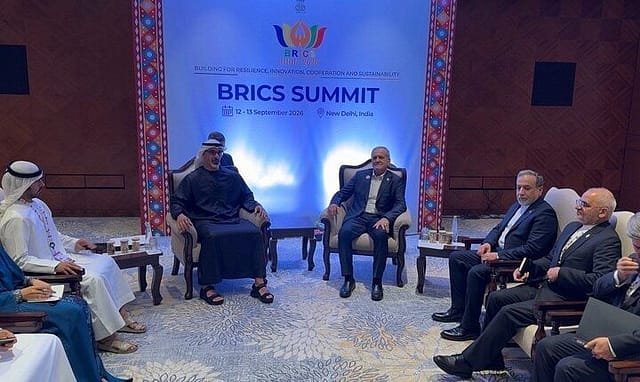
A major diplomatic development took place in New Delhi on Saturday as Iranian President Masoud Pezeshkian and Abu Dhabi Crown Prince Sheikh Khaled bin Mohamed bin Zayed Al Nahyan held talks on the sidelines of the BRICS Summit, opening a potentially important channel between Tehran and Abu Dhabi amid escalating tensions in West Asia and growing concerns over the security of the Strait of Hormuz.
Iran’s embassy in India said in a post that Pezeshkian held talks with UAE President Sheikh Mohamed bin Zayed Al Nahyan on the sidelines of the BRICS Summit. "H.E. Dr. Masoud Pezeshkian, President of the Islamic Republic of Iran, held a meeting and talks with H.H. Sheikh Mohamed bin Zayed Al Nahyan, President of the United Arab Emirates, on the sidelines of the BRICS Summit," Iran's embassy in India said.
The meeting comes at a critical juncture for Iran and the UAE, which have seen ties deteriorate amid the wider US-Iran conflict and Iranian attacks in the region.
Hormuz could be key to easing tensions
The Iran-UAE engagement could have implications beyond bilateral ties, particularly for the Strait of Hormuz, one of the world's most important energy chokepoints.
Any reduction in military tensions between Tehran and Gulf Arab states could help lower the risk of further disruption to shipping through the waterway, through which a major share of global oil and LNG supplies passes. The UAE is among the major Gulf economies whose energy exports and maritime trade depend on secure access through the region.
Pezeshkian has also indicated that Tehran is moving towards a new arrangement with Oman on the strategic waterway. According to media reports, the Iranian president told Indian media that an agreement between Iran and Oman on a joint route through the Strait of Hormuz will be signed on Monday in the presence of foreign ministers of Gulf Arab states.
If implemented, greater coordination between Iran, Oman and Gulf Arab countries could provide a diplomatic mechanism to keep commercial shipping moving and reduce the risk of miscalculation or escalation around the strait.
Implications for India
For India, which relies heavily on imported crude oil and has significant trade and energy interests in the Gulf, any easing of tensions around the Strait of Hormuz could help reduce risks to energy supplies, freight costs and the wider economic fallout from the West Asia conflict.
The combination of Iran-UAE dialogue and a possible regional arrangement around Hormuz could be particularly significant for New Delhi. Any credible mechanism to keep the waterway open and reduce military risks would provide some relief to energy-importing economies at a time when the conflict has heightened concerns over crude prices, shipping costs, and inflation.
Meanwhile, Prime Minister Narendra Modi announced the unanimous adoption of the New Delhi Declaration 2026 at the 18th BRICS Summit. Presenting the draft declaration before BRICS leaders, Modi said it encapsulated the bloc’s discussions and reflected its perspectives on key global and regional issues, while outlining priorities for strengthening cooperation. Modi then asked whether any member had objections to the declaration. After no objections were raised, he declared the New Delhi Declaration 2026 unanimously adopted.
Iran’s attacks have strained ties with UAE
The meeting between Pezeshkian and the UAE leadership in Delhi is particularly significant given the sharp deterioration in relations in recent months. Iran has repeatedly launched missiles and drones at targets in the UAE amid escalating tensions in the Middle East. The UAE has condemned the attacks as a violation of its sovereignty and territorial integrity and has warned that it reserves the right to respond.
In March, Emirati officials said the country was in a state of defence but stressed that Abu Dhabi did not want to be drawn into a wider conflict. Its position hardened further in May, when the UAE described the attacks as an “unacceptable act of aggression” and a direct threat to its security and territorial integrity. Abu Dhabi also said it held Iran responsible for the consequences of the attacks.
The UAE’s proximity to the conflict is particularly sensitive because the country hosts US military facilities, making it an important strategic location in the wider confrontation between Tehran and Washington.
Delhi meeting may create room for de-escalation
Against this backdrop, the Pezeshkian-UAE meeting could provide an avenue for limited de-escalation even if the broader geopolitical differences remain unresolved.
The reported Iran-Oman initiative, if backed by other Gulf states, could also strengthen such a mechanism by giving regional countries a direct role in maintaining maritime security rather than leaving the issue solely to the US and other external powers.