A year ago, Ola Electric was on a roll. Can it find its magic once again?
/ 5 min read
For many months now, the Bhavish Aggarwal-led Ola Electric has seen its market share slip away to legacy automakers
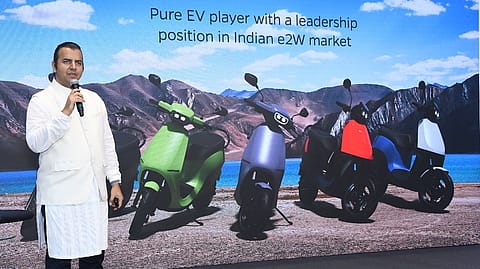
Ola Electric founder and chairman Bhavish Aggarwal
There are very few parallels for what Ola Electric is going through in India’s automotive world.
The company was launched with much fanfare, backed by powerful investors, riding a nationalist sentiment, and, in some ways, also projecting itself as India’s answer to Tesla, owned by Elon Musk. It had a blockbuster public listing and seemed on track to challenge incumbents in the world’s largest two-wheeler market.
Then, it all came crashing down. For many months now, the Bhavish Aggarwal-led Ola Electric has seen its market share slip away to legacy automakers, who have reclaimed their position in the country’s fast-growing electric vehicle market.
Chennai based TVS Motors and Pune-based Bajaj Auto now sell far more vehicles than Ola Electric every month, while another homegrown electric vehicle maker, Ather, has claimed the third spot.
Amidst all this, Ola Electric has also seen its market capitalisation collapse, from about Rs 42,000 crore in December last year to about 15,000 crore this year, a fall of over 60 percent. Last week, Ola Electric said that its promoter and CEO, Bhavish Aggarwal, had sold a small portion of his personal shareholding to fully repay a promoter-level loan of around Rs 260 crore.
While that has helped revive sentiment for the two-wheeler maker, the reality remains that it has slipped to fifth in the pecking order, a far cry from a year and a half ago, when it was the largest electric vehicle maker, selling as many as 53,000 units a month. Today, it sells fewer than 9,000 units a month.
Finding the trust
“Trust of the customers has been lost,” Arun Malhotra, the former managing director of Nissan India, says. “It’s not that the legacy players have done anything different. It’s more of Ola’s own doing, and all their attention now must be on meeting that trust deficit.”
Last month, the government of Goa suspended Ola's vehicle registration in the state. It issued a show-cause notice to the company after buyers approached the transport department, alleging a lack of after-sales service, unavailability of spare parts, and a pile-up of scooters awaiting service.
The move also followed an investigation earlier this year by the Central Consumer Protection Authority, which stepped in after a rise in complaints against the EV maker. The committee had conducted an enquiry into the debacle and had even sent its report to Ola Electric regarding alleged violations of consumer rights, service deficiencies, and misleading advertisements.
“For any Indian two-wheeler buyer, a purchase of a two-wheeler is a significant one. They use it for their livelihood or for commercial purposes,” Deepesh Rathore, the founder and head of InsightEV, a research and advisory firm for the global electric two-wheeler market, says. “When your vehicle is parked in a service centre for a long time, as a customer, you tend to be angry.”
Can it stage a turnaround?
During the calendar year, Chennai-based TVS has already leapfrogged into the country’s largest two-wheeler maker, pushing Ola into the fourth position during the year.
{{#most-powerful-women-snapshot-individual.slug}} {{/most-powerful-women-snapshot-individual.slug}} {{^most-powerful-women-snapshot-individual.slug}} {{/most-powerful-women-snapshot-individual.slug}} {{#showRanking}} {{current-rank}} {{/showRanking}} {{#photo.0.url}}
{{name}}
“See, our brand proposition to the customer is a great product, competitive product in terms of performance, range, technology, superior value, so that the customer gets a good product at a reasonable price, which is very important in case of a two-wheeler, and ownership experience,” Bhavish Aggarwal, the CEO of Ola, said in November this year. “Now, two out of these three have been very good for us. We are working on the ownership experience, which is a service network. It has been slightly more challenging. And some of the challenges are not just company-linked.”
In October this year, the electric vehicle maker entered the country’s battery energy storage systems market with the launch of Ola Shakti, a residential power backup solution. The Bengaluru-based company introduced four variants of the product, priced between Rs 29,999 and Rs 1,59,999 for the first 10,000 units. The battery systems are available in capacities from 1.5 kWh to 9.1 kWh and are designed for homes, farms, and small businesses.
“In terms of numbers, see, the average selling price for this product is at the upper end, a ₹2 lakh product, at the lower end, a ₹50,000 product,” Aggarwal said during the conference call. “So, an average selling price of about, you know, ₹1.25-₹1.50 lakhs would be the average blended selling price. So, then if you just add that next quarter, we have said Q4, which is when it launches, we should do about a ₹100 crore revenue, which means about 7,000-8,000 products sold through the quarter, which we feel confident in doing.”
Yet despite its ambitions in the energy storage business, Ola has reportedly struggled to raise additional funds from investors. In October this year, Ola Electric’s board had approved a proposal to raise Rs 1,500 crore through a mix of equity shares and convertible securities.
“India’s automobile customers are large-hearted,” adds Rathore. “From Tata to Mahindra, everybody has staged a comeback. But it took them a generation of products. It’s never too late to do a good thing, and the focus must be on incremental gains. Ola still functions in a startup mode, which needs to change.”
Start with sorry?
Ola is also in the midst of what it calls Operation Lakshya to bring down its cost structures, and on the last count, brought reduced monthly auto operating expense from Rs 178 crore to Rs 105 crore. The company has already reduced the turnaround time at its service centres to an average of 1.1 days, and is now focusing on sales productivity per store.
Ola, which moved at breakneck speed amidst the global pandemic to capitalise on the tectonic shift in global mobility, had signed a memorandum of understanding with the government of Tamil Nadu to set up a manufacturing plant in the state to produce electric vehicles, and within a few years, built what it called the world’s largest two-wheeler factory. By August 2021, it had launched two models: Ola S1 and Ola S1 Pro, at introductory prices of ₹99,999 and ₹129,999, respectively. The two models were based on the AppScooter, made by Etergo, a Netherlands-based company founded in 2014, which Ola acquired in May 2020.
But complaints from buyers soon mounted, and by late last year the brand faced serious trouble after the consumer watchdog, Central Consumer Protection Authority (CCPA), ordered a probe into alleged deficiencies in the company’s services and products.
“Maybe they can start by saying sorry to all those who were affected,” an industry veteran says about what Ola needs to do to win back the market. “Secondly, instead of chasing market share now, the focus must shift to satisfying those who own an Ola, and improving their services.”
If anything, Ola can find inspiration in the phenomenal turnaround at Tata and Mahindra in India. The question remains: Is Ola willing to go the extra mile?
NEXT STORY