Alternative fuels overtake petrol in India’s PV retail market in August for first time; Maruti leads CNG, Tata tops EVs: FADA
/ 3 min read
CNG, hybrid and electric vehicles together capture 41.95% of passenger vehicle retail, edging past petrol/ethanol at 40.85% as buyers increasingly gravitate towards lower running costs
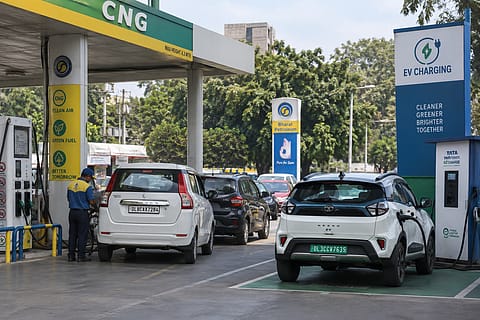
Maruti Suzuki continues to dominate the factory-fitted CNG passenger vehicle segment, while Tata Motors tops the EV charts
Alternative-fuel passenger vehicles overtook petrol-powered cars in India’s retail market for the first time in August, marking a significant shift in the country’s Passenger Vehicle (PV) powertrain mix. Compressed Natural Gas (CNG), hybrid and electric vehicles together accounted for 41.95% of PV retail sales during the month, compared with 40.85% for petrol/ethanol, according to data from the Federation of Automobile Dealers Associations (FADA).
CNG remained the biggest contributor to the alternative-fuel basket, with a 25.28% share of PV retail, followed by hybrids at 9.04% and electric vehicles at 7.63%. Diesel accounted for 17.21%. While petrol remained the largest individual fuel category, its lead over the combined alternative-fuel segment disappeared in August.
The transition is being shaped by different manufacturers across individual powertrain categories, rather than a single player leading the entire alternative-fuel market.
Maruti rules, Tata reigns over EVs
Maruti Suzuki continues to dominate the factory-fitted CNG passenger vehicle segment, accounting for about 71% of the market, followed by Tata Motors at around 17% and Hyundai at about 9%, according to industry data.
The competitive picture is different in electric passenger vehicles. Tata Motors led August EV registrations with 12,983 units, giving it a 42.8% share of the electric PV market. Mahindra followed with 6,367 units and a 21% share, while JSW MG Motor India registered 4,568 units, accounting for 15.1%.
The numbers show that India’s shift away from conventional petrol vehicles is not being driven by EVs alone. CNG and hybrids together accounted for 34.32% of PV retail sales, while EVs added another 7.63%.
Petrol’s lead erased in just over a year
The speed of the transition becomes clearer when compared with last year. Petrol/ethanol accounted for 46.37% of PV retail sales in August 2025, while CNG/LPG stood at 21.47%, hybrids at 7.96% and EVs at 5.83%.
FADA President Sai Giridhar described the crossover as a structural change in the passenger vehicle market.
“For the first time in India’s history, alternative fuels — CNG, hybrid and electric combined — overtook petrol in the Passenger Vehicle market, at 41.95% against petrol’s 40.85%,” Giridhar said.
“A little over a year ago petrol led this contest by nearly eleven percentage points; that lead has now been erased,” he added.
Running costs, E20 concerns influence buying decisions.
{{#most-powerful-women-snapshot-individual.slug}} {{/most-powerful-women-snapshot-individual.slug}} {{^most-powerful-women-snapshot-individual.slug}} {{/most-powerful-women-snapshot-individual.slug}} {{#showRanking}} {{current-rank}} {{/showRanking}} {{#photo.0.url}}
{{name}}
The changing fuel mix comes as consumers increasingly weigh ownership costs alongside upfront vehicle prices. Giridhar said dealers were attributing the movement towards CNG, hybrids and EVs to running-cost economics and continued consumer hesitation around the E20 transition.
The broader PV market also posted strong numbers in August, with retail sales rising 16.14% year-on-year to 4,02,398 units, making it the best-ever August and the first time PV retail sales crossed the four-lakh mark in the month. Rural PV retail grew 24.99%, significantly faster than the 10.93% increase in urban markets.
Beyond the fuel mix, however, Giridhar cautioned against reading too much into the August year-on-year numbers, given the soft base last year when buyers had deferred purchases ahead of the GST 2.0 rate cut.
“The true test of the season lies in showroom conversion through September to November, not in year-on-year optics,” he said.
With the festive buying period now underway, the next three months will offer a clearer indication of whether August’s fuel-mix crossover represents a lasting change in Indian car-buying preferences and whether alternative powertrains can widen their lead over petrol.
Follow Fortune India
NEXT STORY