Back from the garage: Why India’s automakers are reviving dead brands
/ 5 min read
From Tata Motors’ Sierra and Bajaj Auto’s Chetak to Kinetic Green’s e-Luna, Renault’s Duster, Stellantis-owned Jeep, LML’s return and Mahindra-backed Classic Legends’ revival of Jawa, Yezdi and BSA, automakers are increasingly turning to legacy brands as a strategic advantage in an industry undergoing rapid technological change.
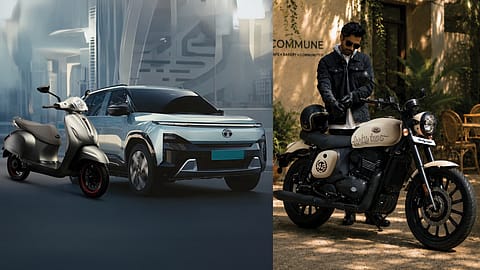
Bajaj Chetak, Tata Harrier and Jawa revived over the last decade | Credits: File Photo
When Tata Motors unveiled the Sierra in its modern avatar during Auto Expo 2025, it wasn’t merely bringing back a familiar nameplate. It was reviving an icon that had remained etched in the minds of Indian consumers for nearly two decades.
The Sierra is part of a growing list of automotive brands making a comeback in India. Bajaj Auto has successfully reinvented the Chetak as an electric scooter, Kinetic Green has revived the Luna as the e-Luna, LML is preparing to return with an electric mobility portfolio, while Mahindra-backed Classic Legends has breathed new life into Jawa, Yezdi and BSA.
French carmaker Renault, too, has brough back the Duster, banking on the enduring appeal of one of its most successful nameplates. Hero MotoCorp has revived the Karizma badge, while the Jeep brand, under Stellantis, has re-established itself in India after years away from the market.
More than nostalgia
According to brand experts, one should look beyond the sentiment and the revival of legacy brands begins to resemble a calculated business strategy rather than an exercise in nostalgia.
As the automotive industry navigates one of its biggest transitions—from internal combustion engines to electric mobility, connected vehicles and software-defined cars—manufacturers are rediscovering the commercial value of heritage. Launching a new automotive brand demands years of investment in awareness, trust and recall. A dormant brand, by contrast, already carries decades of equity that even the biggest marketing budgets struggle to create.
For Tata Motors, the Sierra’s comeback is rooted in precisely that thinking.
“Bringing back this brand after nearly 25 years was a strategic decision rooted in its emotional connect and legacy. Sierra was ahead of its time and expressed ownership in a manner that gave customers a superior sense of feeling,” a Tata Motors Passenger Vehicles spokesperson told Fortune India.
The homegrown carmaker believes today’s consumers seek products that combine authenticity with sophistication. It is positioning the Sierra as the cornerstone of its premium mid-SUV strategy, while retaining the spirit of the original. “Reviving Sierra has enabled us to harness its strong equity while introducing a vehicle that captures the ethos of the original for a new generation of customers,” the spokesperson said.
The same philosophy is visible across the industry. Rajiv Bajaj-led Bajaj Auto did not recreate the petrol-powered Chetak; it transformed it into one of India’s best-known electric scooters. Kinetic Green has repositioned the Luna for urban electric mobility, while LML is reinventing itself as a premium electric mobility company instead of recreating the scooters that once dominated Indian roads.
Classic Legends has perhaps taken the strategy furthest. Rather than create an entirely new motorcycle marque, the Mahindra-backed company has built its portfolio around heritage brands such as Jawa, Yezdi and BSA, pairing their legacy with contemporary engineering, safety and technology.
According to a Classic Legends spokesperson, reviving these brands was a strategic decision because authenticity cannot be manufactured overnight.
{{#most-powerful-women-snapshot-individual.slug}} {{/most-powerful-women-snapshot-individual.slug}} {{^most-powerful-women-snapshot-individual.slug}} {{/most-powerful-women-snapshot-individual.slug}} {{#showRanking}} {{current-rank}} {{/showRanking}} {{#photo.0.url}}
{{name}}
"While the motorcycles retain familiar design cues and character, they have been re-engineered with modern platforms, fuel-injected engines and contemporary safety features, allowing the company to blend globally recognised heritage with modern Indian engineering, stated Classic Legends spokesperson in response to queries sent by Fortune India.
Renault’s decision to revive the Duster follows a similar logic. Although the SUV returns on a new platform with modern features, the Duster badge continues to evoke ruggedness and practicality among Indian buyers.
Why heritage still pays
For branding experts, nostalgia alone does not explain the resurgence. What companies are monetising is accumulated brand equity.
Harish Bijoor, business and brand strategy expert, believes companies are recognising the commercial value of legacy. “Reigniting legacy is the new norm,” he says, arguing that heritage brands enjoy a marketing advantage because companies need only rebuild relevance rather than awareness.
He believes automotive memories often travel across generations. “Motoring is a memory… the motorcycle your grandfather rode or the scooter your father owned often becomes part of a family’s collective memory,” he says.
That emotional equity has tangible commercial value. As automakers invest heavily in batteries, software and connected technologies, a familiar badge can reduce customer acquisition costs and accelerate consumer acceptance. LML Group Managing Director Yogesh Bhatia says a trusted brand can become a strategic asset if it lowers the effort required to build consumer confidence.
Classic Legends believes authentic heritage has become a competitive advantage as consumers increasingly seek products that reflect individuality rather than conformity.
Prathap Suthan, chief creative officer and managing partner at ‘Bang In The Middle’, believes the timing is no coincidence. Vehicles today increasingly resemble one another in technology and features, making differentiation harder. “In such an environment, a legacy nameplate arrives with recognition and trust that a new brand would take years to build,” he noted.
Can old brands win new buyers?
The larger question is whether revived brands can appeal to consumers who have little or no memory of the originals.
Bijoor believes family stories and shared experiences help legacy brands remain relevant across generations. Suthan agrees but argues that companies must “reinterpret heritage” rather than merely recreate the past.
That belief is echoed by Classic Legends, which argues that as technology becomes increasingly standardised across motorcycles, differentiation will come less from specifications and more from authenticity, design and emotional appeal.
Avik Chattopadhyay, founder of Expereal, offers a more measured assessment. According to him, “Legacy brands undoubtedly benefit from positive associations built over decades, particularly among discerning consumers who value heritage. But nostalgia alone cannot guarantee commercial success after years of absence. Ultimately, the product has to justify the badge.”
That explains why most recent revivals have avoided recreating their predecessors. Chetak is electric. Sierra has been reimagined in both ICE and EV avatars. Jawa, Yezdi and BSA combine classic styling with modern engineering. According to Renault India MD, the Duster is expected to be radically different from the SUV that first established the brand in India.
Who could be next?
Industry observers continue to point to Ambassador, Contessa, Rajdoot and Premier Padmini as brands that still command remarkable recall despite disappearing from Indian roads.
Bijoor believes India still has a vast “graveyard of automotive brands” waiting to be rediscovered. “Digging up those graves may yet yield great dividends for the companies that still own the wherewithal to make these brands happen,” he says.
Yet heritage alone cannot sustain a business. Recent examples such as Hyundai Santro have shown that reviving a familiar name is only the beginning. As Suthan observes, the stronger the memory, the higher the expectation. “Nostalgia may draw customers into the showroom, but only a compelling modern product can keep them there’’ he maintained.
As India’s automotive industry embraces electrification, software-defined vehicles and changing consumer preferences, manufacturers are discovering that their most valuable competitive advantage may not be the newest technology, but a familiar name that still resonates across generations.
NEXT STORY