Budget 2026: EV industry calls for tax fixes, localisation push and long-term capital support
/ 3 min read
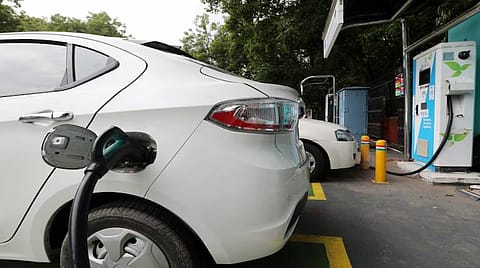
EV makers urge Budget 2026–27 to prioritise GST rationalisation, localisation, charging infrastructure and long-term capital | Credits: Pixabay
Budget 2026: EV industry calls for tax fixes, localisation push and long-term capital support
As EV adoption surges, industry leaders urge the 2026–27 Union Budget to focus on structural reforms over short-term subsidies. Key demands include tax rationalisation, domestic manufacturing support, and long-term capital access. Industry voices highlight the need for GST alignment, localisation, and a robust charging infrastructure to sustain growth and meet electrification goals.
This summary is AI-generated, and Fortune India is not responsible for its content or any associated copyright issues.
EV makers urge Budget 2026–27 to prioritise GST rationalisation, localisation, charging infrastructure and long-term capital to sustain India’s clean mobility momentum
EV makers urge Budget 2026–27 to prioritise GST rationalisation, localisation, charging infrastructure and long-term capital | Credits: Pixabay
As Electric Vehicle (EV) adoption accelerates across segments, industry leaders are urging the Union Budget 2026–27 to shift focus from short-term subsidies to deeper structural reforms. With demand gaining traction—particularly in two-wheelers—manufacturers say sustained growth will hinge on tax rationalisation, domestic manufacturing support, resilient supply chains and access to long-term capital.
Ajinkya Firodia, Vice Chairman & Managing Director of Kinetic Watts & Volts, said India’s electric mobility transition has entered a decisive phase. “The sun has truly risen over India’s electric mobility industry,” he said, crediting timely policy interventions for driving adoption amid rising environmental and urban pollution challenges.
According to Firodia, EV adoption has been driven by value creation through lower operating costs, reduced maintenance and connected technologies. Ahead of Budget 2026, he expressed hope that the government would continue flagship demand-side initiatives such as PM E-Drive, while also considering “a calibrated pollution-linked tax on high-emission vehicles” and higher incentives for scrapping older ICE vehicles. He also called for a dedicated PLI framework for startups and mid-sized manufacturers to strengthen domestic innovation and manufacturing depth.
Inverted GST Structure a Persistent Bottleneck
Tax inefficiencies remain a major concern for manufacturers. Madhumita Agrawal, Founder and CEO of Oben Electric, said while 2025 marked a milestone year with EV sales touching 2.3 million units—anchored by 1.28 million two-wheelers—the industry’s long-term health depends on structural tax reforms.
“While finished EVs attract a 5% GST, raw materials are taxed at 18%, creating a 13% disparity that traps working capital and strains liquidity,” she said. Aligning GST on EV components to a uniform 5%, Agrawal added, would support Make-in-India manufacturing and improve mass-market affordability.
Electric motorcycles and new growth segments
Agrawal said the next phase of adoption will be led by electric motorcycles. “Motorcycles dominate nearly 70% of India’s two-wheeler landscape but remain significantly under-electrified,” she said, calling for targeted subsidies to meet 2030 electrification goals.
Uday Narang, Founder and Chairman of Omega Seiki Mobility, described 2025 as a year of consolidation. “The market has moved from exuberance to execution, where scale and unit economics matter more,” he said, noting that financing has been the biggest challenge for startups. Narang expects growth in 2026 to be driven by electric three-wheelers, SCVs and e-trucks, with financing conditions easing after mid-2026.
Localisation, charging and supply chain resilience
Sameer Moidin, Founder and CEO of EVeium Smart Mobility, said Budget 2026 must prioritise EVs that are “designed, manufactured and scaled in India,” not merely assembled. He called for incentives supporting battery localisation, affordable financing and mass-scale production, alongside sustained investment in accessible charging infrastructure.
Saket Mehra, Partner and Auto & EV Industry Leader at Grant Thornton Bharat, said global supply-chain disruptions and tariff pressures underscore the need for policy continuity. “Budget 2026 is an opportunity to align localisation, MSME support and clean-mobility goals,” he said, while highlighting the ₹1 lakh crore RDI fund as a critical step towards deep-tech innovation.
Kunal Arya, Co-founder and MD of Zelio E-Mobility, added that component-specific PLI support, GST rationalisation and a clear national charging roadmap—including 50,000 public chargers by 2027—would be more effective than one-time incentives in driving mass adoption.
Follow Fortune India
NEXT STORY