Cut dependence on China for EV components, build a domestic manufacturing ecosystem: PMO Advisor Tarun Kapoor
/ 2 min read
Kapoor says India must localise batteries, magnets and other critical EV components while indicating the government is open to extending support for electric trucks and buses under the PM E-DRIVE scheme.
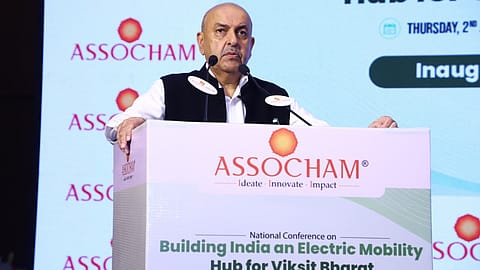
PMO Advisor Tarun Kapoor Tarun Kapoor says recent geopolitical developments have reinforced the importance of electric mobility not just as a decarbonisation strategy but also as a means of strengthening India's energy security and manufacturing competitiveness. | Credits: ASSOCHAM
India should progressively reduce its dependence on China for critical Electric Vehicle (EV) components by building domestic manufacturing capabilities across the value chain, Prime Minister's Office (PMO) Advisor Tarun Kapoor said on Wednesday, stressing that the country's clean mobility ambitions must go hand in hand with greater supply-chain resilience.
Addressing ASSOCHAM's National Conference on Building India an Electric Mobility Hub, Kapoor said recent geopolitical developments have reinforced the importance of electric mobility not just as a decarbonisation strategy but also as a means of strengthening India's energy security and manufacturing competitiveness.
Localisation key to India's EV ambitions
"We have to see how our dependence on China goes down," Kapoor said. "While complete self-reliance may not be practical, we should manufacture as many critical components as possible within the country and steadily increase domestic value addition across the EV ecosystem."
He said India should simultaneously accelerate EV adoption while localising the production of batteries, magnets and other critical components to reduce exposure to global supply-chain disruptions. The government, he added, would continue to support initiatives that strengthen domestic manufacturing capabilities as the country's EV ecosystem matures.
Calling electric mobility "a mission for all of us", Kapoor said even a modest reduction in petroleum consumption would significantly strengthen the economy by lowering crude oil imports and insulating India from global energy market volatility.
"We want to promote electric vehicles across the country. All stakeholders, whether state governments or industry, have an important role to play. We want to reduce our dependence on imported oil," he said.
Kapoor noted that while India has achieved self-sufficiency in electricity generation and made significant progress in renewable energy, the transport sector remains the country's largest consumer of imported energy.
"We are self-sufficient in the power sector and have also done good work in renewable energy. It is important to transform the transport sector because it accounts for the largest share of our energy imports. Achieving this will require collective efforts from all stakeholders," he added.
Government open to additional support
Speaking to mediapersons on the sidelines of the conference, Kapoor said the Centre is open to providing additional support for electric trucks and buses under the PM E-DRIVE scheme if required.
"As we move along, if there is a need, then certainly," he said when asked whether further incentives for heavy electric vehicles were under consideration. "Innovative financing methods, efforts by the industry to bring down prices, introduce more models and better understand customer requirements will help accelerate EV adoption."
Kapoor identified electric two-wheelers as the immediate priority because they account for the largest share of petrol consumption, while electric buses and trucks should be the next focus area to curb diesel use. He also underlined the importance of battery ownership models, charging infrastructure and targeted electrification of commercial transport corridors to drive wider EV adoption.
{{#most-powerful-women-snapshot-individual.slug}} {{/most-powerful-women-snapshot-individual.slug}} {{^most-powerful-women-snapshot-individual.slug}} {{/most-powerful-women-snapshot-individual.slug}} {{#showRanking}} {{current-rank}} {{/showRanking}} {{#photo.0.url}}
{{name}}
On reports that the proposed Parivartan scheme could offer full road tax rebates for EVs in NCR states, Kapoor clarified that such incentives fall within the jurisdiction of state governments, although he expressed confidence that states remain supportive of promoting electric mobility.
NEXT STORY