EV retail sales hit record 3.06 lakh units in June 2026, up 63% YoY; Passenger vehicle segment crosses 31,800 units: FADA
/ 2 min read
EV penetration tops 12% for the first time as passenger vehicles, two-wheelers and commercial vehicles record strong growth, signalling deeper adoption across India's mobility market.
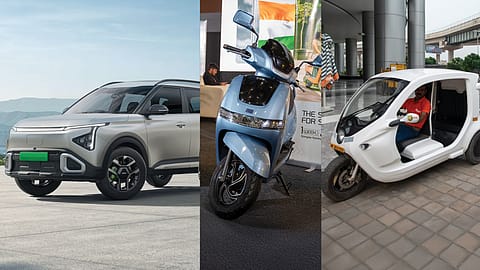
The record performance came despite a seasonally weak month for the broader automobile market, highlighting the growing acceptance of electric mobility across segments.
India's Electric Vehicle (EV) retail market touched a historic high in June 2026, with sales rising to 3,06,220 units, an increase of nearly 63% from 1,88,054 units in June 2025, according to the latest data released by the Federation of Automobile Dealers Associations (FADA). The record performance came despite a seasonally weak month for the broader automobile market, highlighting the growing acceptance of electric mobility across segments.
Passenger EVs power record-breaking growth
Electric passenger vehicles were among the standout performers during the month. Retail sales surged to 31,823 units from 15,318 units in June last year, registering 107.75% year-on-year growth, while market penetration rose to 7.7% from 4.8%. Tata Motors Passenger Vehicles continued to dominate the segment with 12,187 units, followed by Mahindra & Mahindra at 7,766 units and JSW MG Motor India at 5,861 units. Maruti Suzuki India and VinFast Auto India completed the top five.
Commenting on the performance, FADA President C S Vigneshwar said June 2026 marked a defining month in India's electric mobility journey, with EV retail sales reaching an all-time high despite a delayed monsoon and a seasonally lean period for the overall automobile industry.
He said the growth was broad-based rather than concentrated in one category. Electric passenger vehicles and commercial vehicles registered their highest-ever monthly retail sales, while electric two-wheelers maintained strong momentum and electric three-wheelers continued to record healthy volumes.
According to Vigneshwar, overall EV penetration crossed 12% for the first time. With more than 64% of three-wheelers and 10.6% of two-wheelers now being electric, the shift towards electrification has moved beyond an emerging trend and become an integral part of India's automotive retail landscape.
Electric two-wheelers remain the volume driver
Electric two-wheelers continued to account for the largest share of EV retail sales. The segment recorded 1,93,735 units in June, compared with 1,10,719 units a year earlier, reflecting 74.98% year-on-year growth. Its penetration in the overall two-wheeler market also improved to 10.6%, up from 7% in June 2025.
TVS Motor Company retained its leadership with 47,064 units, followed by Bajaj Auto at 43,306 units and Ather Energy at 31,230 units. Hero MotoCorp and Ola Electric Technologies rounded out the top five, indicating that both legacy manufacturers and new-age EV companies continue to compete aggressively in the segment.
Three-wheelers stay ahead; commercial EVs gather pace
The electric three-wheeler segment remained India's most electrified vehicle category, with retail sales rising to 77,448 units in June from 60,802 units a year earlier, marking 27.38% growth. EV penetration in the segment stood at 64.1%. Mahindra Group emerged as the leading player with 12,838 units, followed closely by Bajaj Auto at 11,279 units, while TVS Motor Company secured the third spot with 3,823 units.
{{#most-powerful-women-snapshot-individual.slug}} {{/most-powerful-women-snapshot-individual.slug}} {{^most-powerful-women-snapshot-individual.slug}} {{/most-powerful-women-snapshot-individual.slug}} {{#showRanking}} {{current-rank}} {{/showRanking}} {{#photo.0.url}}
{{name}}
Electric commercial vehicles also maintained their rapid expansion. Retail sales climbed to 3,214 units from 1,219 units in June 2025, translating into 163.7% year-on-year growth, while market penetration improved to 3.53% from 1.57%. Tata Motors led the segment, followed by Euler Motors and Mahindra Group.
The June retail data suggests that India's EV market is broadening beyond early adopters, with rising model availability, improving charging infrastructure and growing consumer confidence supporting demand across passenger vehicles, two-wheelers, three-wheelers and commercial vehicles alike.
Follow Fortune India
NEXT STORY